Al Hamra and Misfat Al Abriyeen: Oman's Best Preserved Mountain Villages
From Muscat: full-day to Nizwa-Misfat Al Abriyeen-Al Hamra
Duration: 10 hours
- Free cancellation
- Hotel pickup
- Small group
How far are Al Hamra and Misfat from Muscat?
Al Hamra is about 200km (2.5 hours) from Muscat via the Nizwa highway. Misfat Al Abriyeen is 10 minutes further by 4WD. Both are ideal day trips from Muscat or Nizwa.
Two Villages, One Perfect Day in the Omani Interior
There are villages in Oman that have been inhabited for five hundred years and show it in every crumbling wall and silted falaj channel — and there are villages that have been inhabited for five hundred years and are very much alive, their ancient architecture maintained, their water channels flowing, their date palms heavy with fruit in season. Al Hamra and Misfat Al Abriyeen, sitting within ten kilometres of each other in the foothills south of Jebel Shams, are emphatically the latter.
The contrast between these two villages and the modern world that presses in from the main highway below is stark enough to be briefly vertiginous. A twenty-minute drive from the perfectly standard dual carriageway connecting Nizwa to the coast delivers you to streets that have not fundamentally changed in centuries, above falaj irrigation systems that have kept the terraces green for as long as anyone has bothered to record.
For visitors spending time in the Nizwa region, or those making the day trip from Muscat, these two villages together with a morning at Nizwa Fort represent the ideal combination of architectural heritage, living culture, and landscape that makes the Omani interior so consistently rewarding.
At a Glance
| Where | Al Hamra and Misfat Al Abriyeen, foothills south of Jebel Shams, near Nizwa |
| Cost | Free to walk both villages; Bayt Al Safah museum charges a modest fee (around 2-3 OMR); occasional parking fee at Misfat’s upper car park |
| Time needed | Half a day for both villages; a full day if combined with Nizwa or Jebel Shams |
| Getting there | Around 2.5 hours from Muscat, 30-40 minutes from Nizwa; a regular car suffices if using Misfat’s upper car park |
| Best time | October to April, morning hours before 11:00; avoid Friday mornings at the villages |
Al Hamra: The Mud Brick City
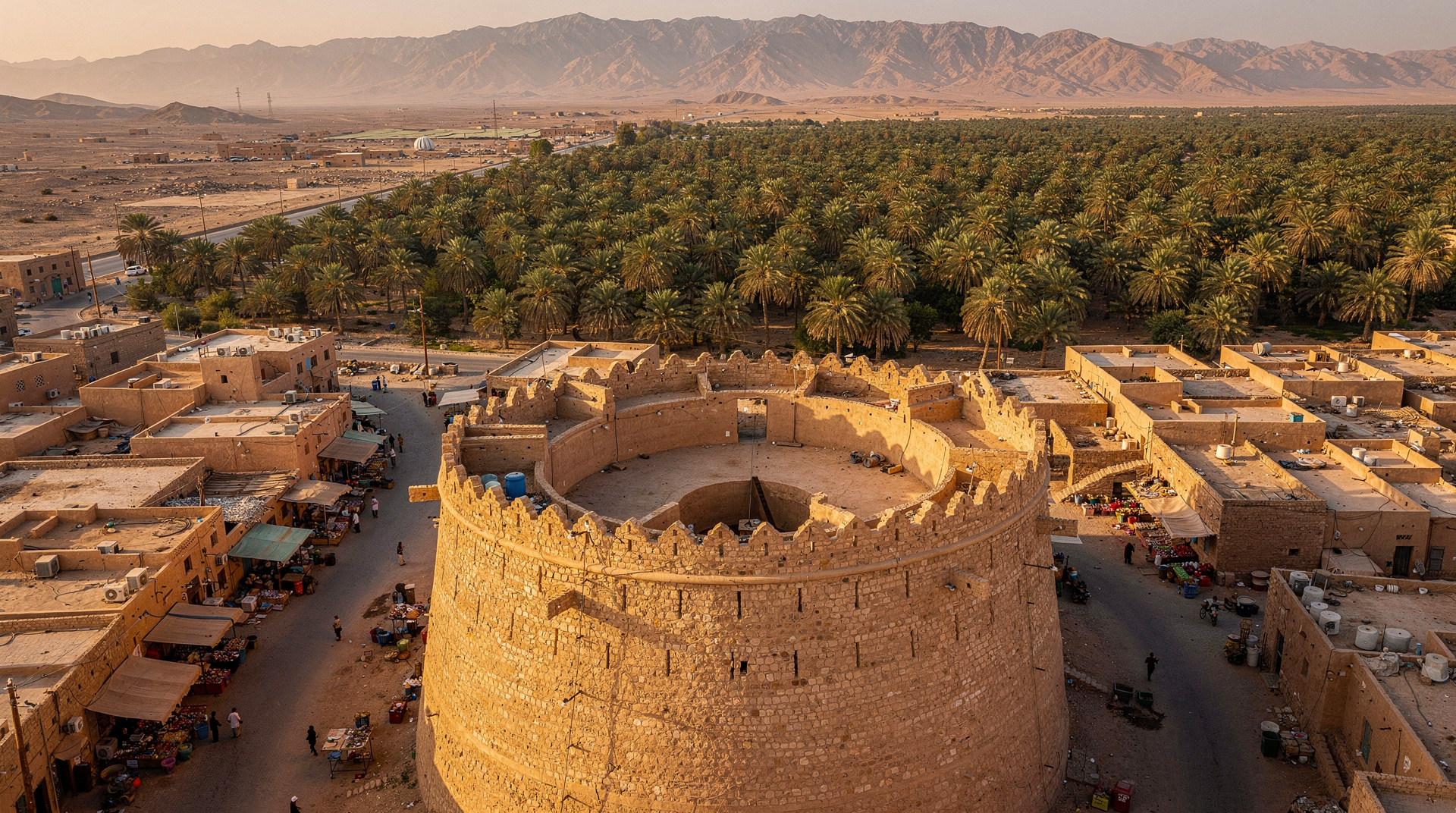
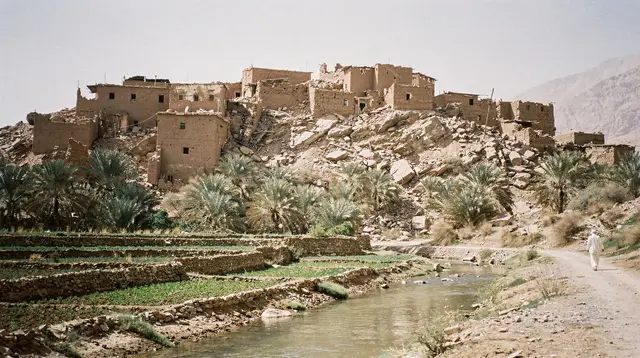
Al Hamra translates as “the red one” — a reference to the colour of the mud bricks that form the old town’s towering multi-storey houses. These buildings, some reaching four and five storeys, were the architecture of a prosperous agricultural community that needed defensive height and insulating mass in equal measure. The thick mud walls maintain interior temperatures fifteen degrees cooler than outside even in full summer heat.
The old town of Al Hamra is compact and walkable in an hour. The main market street is partially restored and serves as an orientation point. From here, a maze of narrow alleys winds between the tall houses, occasionally opening into small courtyards with wooden doors carved in traditional Omani geometric patterns. The houses that are occupied maintain their decoration; the abandoned sections show the beautiful deterioration of mud architecture over time — walls dissolving back into their constituent earth, the whole structure returning slowly to the landscape it emerged from.
Bayt Al Safah Living Museum
The most structured way to engage with Al Hamra’s domestic heritage is through Bayt Al Safah — a restored traditional house that operates as a living museum. Omani women demonstrate traditional food preparation, weaving, and household crafts in the rooms of a house preserved to show what daily life looked like two or three generations ago.
The house itself is instructive — the layout of rooms for different functions, the storage of grain and dates, the kitchen arrangements, and the sleeping areas combine to explain how the building’s architecture served the life lived within it. The women who demonstrate the crafts are from the community, and their knowledge of the traditional techniques is practical rather than academic.
The museum charges a modest entry fee and is most active in the morning hours. Photography is encouraged.
The Falaj System
The ancient falaj water channels that supply Al Hamra and its associated gardens are among the most impressive in the Nizwa region. The Omani aflaj (plural of falaj) system was inscribed as a UNESCO World Heritage feature in 2006 — a recognition of the extraordinary engineering achievement of underground and surface channels that capture groundwater and distribute it across terraced agricultural land with a precision that has sustained communities in an arid landscape for millennia.
At Al Hamra, the falaj channels are visible running along the base of the old town walls and through the palm and fruit groves that surround the village. Following a channel from its distribution point through the terraces and back into the old town gives a clear picture of how water management structured the entire settlement.
Full-day guided tours from Muscat covering Nizwa, Misfat Al Abriyeen, and Al Hamra include transport, a guide, and entry to the main sites, making the combination accessible without the navigation complexity of a self-guided approach in this area.
Misfat Al Abriyeen: The Village in the Cliff
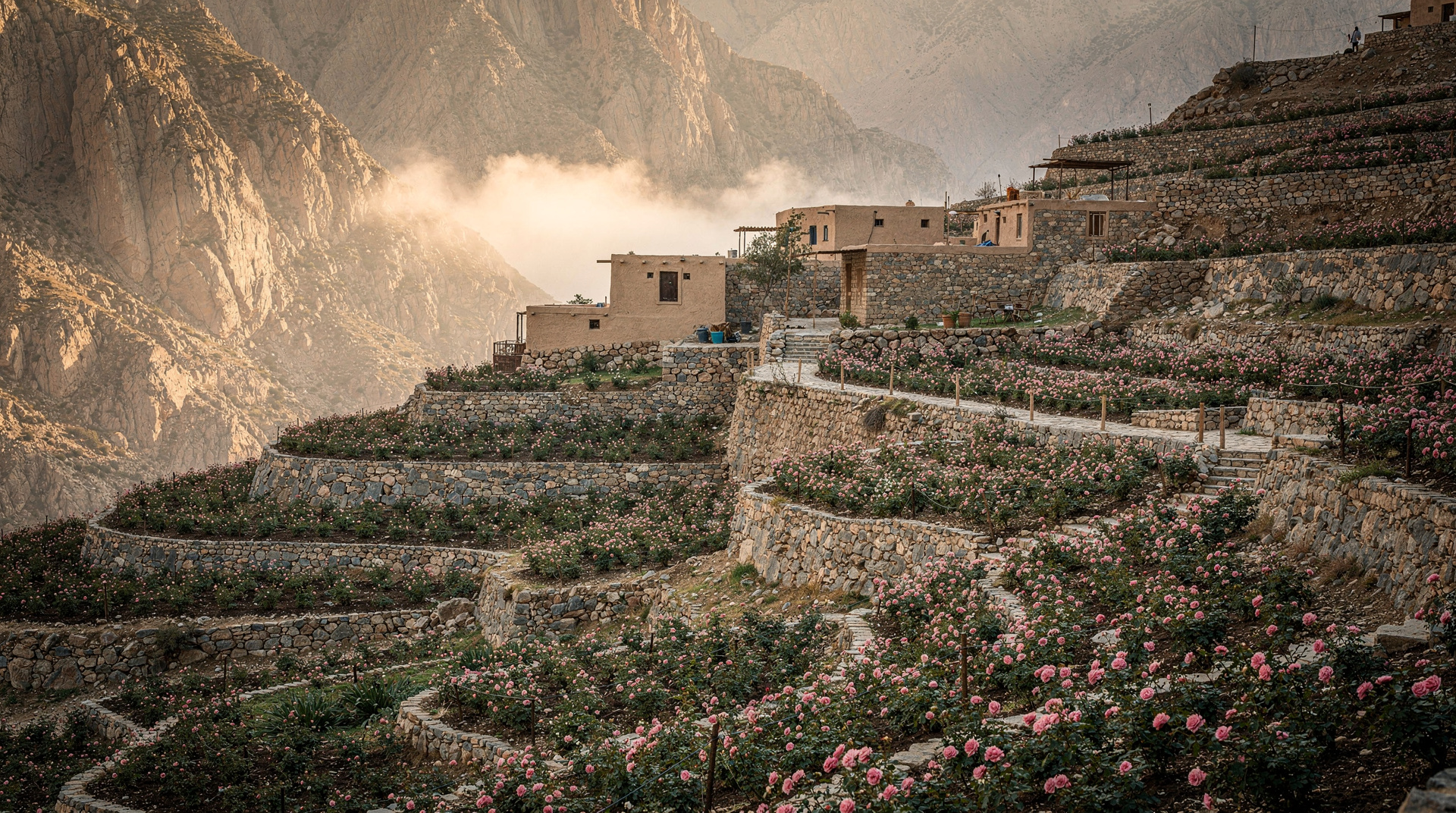
Ten kilometres south of Al Hamra, past the point where the tarmac road ends and a rough 4WD track begins, the village of Misfat Al Abriyeen appears to have been built into the cliff rather than onto it. The stone and mud houses cling to a steep rock face above a narrow wadi, connected by paths that require active attention on the more vertical sections. Below the village, a series of terraced palm and fruit groves step down the wadi walls in tight agricultural geometry, each terrace level fed by a falaj channel at its upper edge.
The approach walk from the car park area at the top of the village (the road is not passable to the bottom) takes about twenty minutes on a marked path. The first view of the village from above — the tight cluster of traditional houses, the green terraces below, and the dry desert mountains rising on all sides — is one of the most photogenic in Oman and thoroughly justifies the short approach walk.
Walking Through Misfat
The village has a single marked walking route that descends through the houses, along the main falaj channel, and down through the terraced gardens to the wadi floor below. The full circuit takes ninety minutes to two hours at a leisurely pace that allows proper attention to the details — the carved wooden doors, the incised plasterwork on the house facades, the elaborate distribution points where the falaj divides between different family plots according to water rights established centuries ago.
The terraces grow date palms, pomegranates, limes, bananas, and apricots depending on the season. In spring, the flowering apricots and pomegranates make the terraces particularly beautiful — this is when the fruit gardens of the Al Hajar foothill region are at their most vivid and when the combination of blossom, green water channels, and ancient stone architecture creates scenes that justify the journey from anywhere.
At the wadi floor, a natural pool fed by the overflow of the falaj system provides swimming in clear, cool water. The pool is deep enough for a proper swim and the water temperature is refreshing throughout the cooler months.
The People of Misfat
Misfat is a lived community, not an outdoor museum. Families inhabit the houses, work the terraces, and go about daily life in full view of any visitors who walk through. This is one of Misfat’s genuine distinctions from more heavily touristed heritage sites.
The appropriate response is courtesy — walking quietly, asking permission before photographing individuals, and accepting with grace any conversation that is offered. Many Misfat residents are accustomed to visitors and some welcome the opportunity to share knowledge of their village. The older residents in particular have memories of the pre-road era, when Misfat was accessible only on foot or by donkey and the community’s self-sufficiency was not a heritage concept but an economic necessity.
Combining Al Hamra and Misfat with Jebel Shams
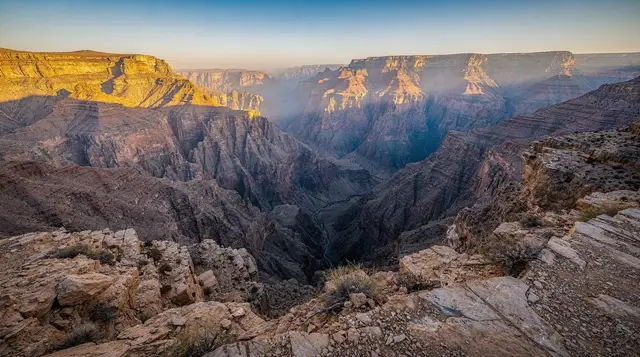
The natural extension of an Al Hamra and Misfat visit is the drive to Jebel Shams — Oman’s highest mountain at 3,009 metres — twenty kilometres further into the mountains. The road to the summit plateau passes the rim of Wadi Ghul, sometimes called the Grand Canyon of Oman, a gorge dropping 1,000 metres from the plateau edge that is the most dramatic landscape feature in northern Oman.
The Balcony Walk along the canyon rim takes about three hours and is one of the best marked hiking trails in the country. The views into the gorge from the path’s most exposed sections are genuinely vertigo-inducing. Combined with the village visits in Al Hamra and Misfat, the full day covers the full range of the interior Omani experience — living heritage and geological spectacle within a compact circuit.
For the complete Jebel Akhdar and mountain region context, see the guide to Jebel Akhdar, which covers the full western Hajar highlands including Jebel Shams.
The Nizwa Connection
Al Hamra and Misfat are most conveniently combined with a morning at Nizwa — the historic capital of the interior and one of Oman’s most rewarding towns. The Nizwa Fort is among the finest in the country, and the Friday morning goat and cattle market at the souq beside the fort is one of those genuinely local experiences that has not been staged for tourism.
From Nizwa, the drive to Al Hamra takes thirty minutes on the main Bahla road. The circuit of Nizwa, Al Hamra, Misfat, and optionally Jebel Shams constitutes a complete day in the western interior — one of the finest single days available anywhere in Oman.
The guide to Nizwa covers the town and its souq in full detail.
Practical Information
Getting There from Muscat
The drive from Muscat to Al Hamra takes approximately two and a half hours on the Nizwa highway (Route 15) and then the Bahla road. The highway is a fast, excellent dual carriageway for most of its length.
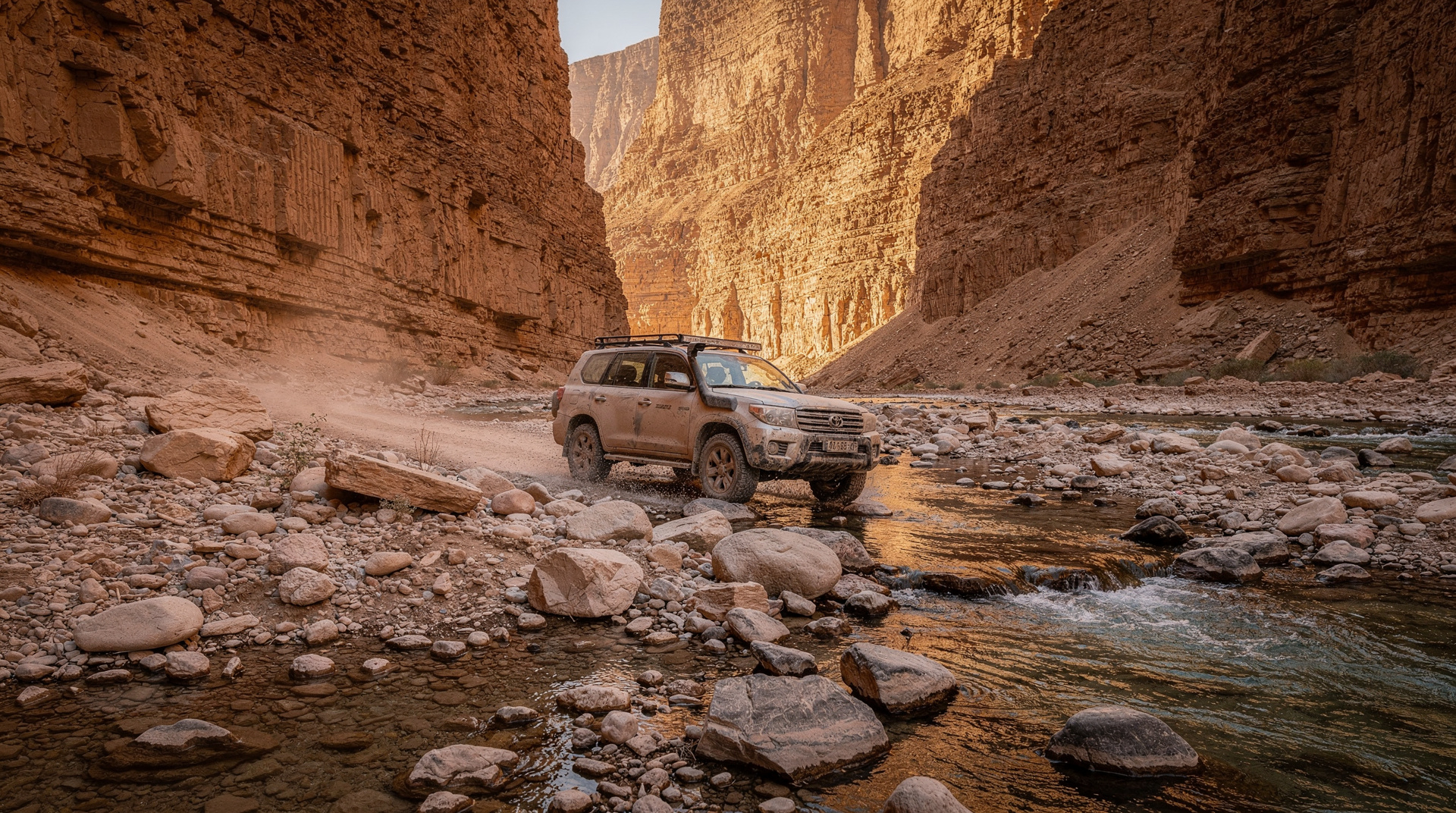
A regular car reaches Al Hamra and the car park above Misfat without difficulty. The final track into Misfat is rough and requires a 4WD if driving to the lower access — the 4WD is unnecessary if using the upper car park and walking down, which is the recommended approach regardless of vehicle type.
Getting There from Nizwa
From Nizwa, the drive to Al Hamra takes approximately 30 minutes west on Route 21. Misfat is signposted from Al Hamra and involves a further 10 minutes on increasingly rough road.
What to Wear
Conservative dress — long trousers or skirt, covered shoulders — is appropriate in both villages. Sturdy walking shoes are important for Misfat’s paths, which are uneven stone and can be wet near the falaj channels. Sun protection is essential; the villages themselves provide good shade, but the paths between them and the wadi walks are fully exposed.
Best Time to Visit
October through April provides the most comfortable temperatures. The morning hours (before 11:00) offer the best light for photography and the coolest conditions for walking. December through February often sees some moisture in the air from winter cloud, which can create atmospheric mist around the mountain villages — distinctive and beautiful in a way that the crystalline clarity of summer cannot replicate.
Avoid Friday mornings at these specific villages (though Friday is ideal for Nizwa’s market), as this is the traditional day of rest and community and the villages are at their quietest.
Frequently asked questions about Al Hamra and Misfat Al Abriyeen: Oman’s Best Preserved Mountain Villages
Can I visit Al Hamra and Misfat on a day trip from Muscat?
Yes, and this is one of the most rewarding day trips from the capital. Leave Muscat by 07:00, spend the morning at Nizwa Fort and souq, lunch in Nizwa, then afternoon at Al Hamra and Misfat, and return to Muscat by early evening. The full day covers approximately 400 kilometres of excellent highway driving.
Is there accommodation in or near Misfat?
Misfat Al Abriyeen has a small number of guesthouse rooms in converted traditional houses — one of the more atmospheric accommodation options in the Oman interior. These must be booked in advance as capacity is extremely limited. Al Hamra has a small guesthouse. Nizwa, 30 minutes away, has several well-established hotels including the Falaj Daris Hotel and smaller boutique options.
Is the swim at Misfat wadi floor available year-round?
Yes, the falaj overflow pool is present throughout the year. The water level and clarity is best in the cooler months when flow is higher. In summer, the pool may be smaller but still swimmable. The cool water temperature makes swimming most refreshing in the warm months when it matters most.
Are there any fees to enter Al Hamra or Misfat?
There is no general entry fee to either village. Bayt Al Safah living museum at Al Hamra charges a modest entry fee (typically 2 to 3 Omani Rials). Parking fees at Misfat’s upper car park are occasionally collected by a local manager.
What is the walking difficulty at Misfat?
The main marked route is moderate difficulty — the path is clear but involves uneven surfaces, some short steep sections, and slippery rocks near water channels. The walk is accessible for any reasonably fit adult and for children above about seven or eight years old with careful supervision. Proper footwear is important; sandals are not appropriate for the lower wadi section.
Can I combine Al Hamra and Misfat with Al Hoota Cave in one day?
Yes, and it is a natural pairing. Al Hoota Cave sits close to Al Hamra at the base of Jebel Shams, so a full day can cover Nizwa in the morning, Al Hamra and Misfat in the early afternoon, and the cave tour in the late afternoon before heading back to Muscat or up to Jebel Shams for sunset. See the Al Hoota Cave guide for tour times and how the sites fit together.
Do I need a guide to visit Al Hamra and Misfat?
No guide is required — both villages have marked paths and are straightforward to visit independently with a regular car (using Misfat’s upper car park). A guide adds context on the falaj system, traditional architecture, and etiquette, which some visitors find worthwhile, but it is not necessary to enjoy the villages.
The Architecture of Al Hamra and Misfat
The domestic architecture visible in both villages reflects a building tradition that solved specific problems — heat, security, water management, and the scarcity of timber in a mountain environment — with elegance that purely functional analysis understates.
The multi-storey mud brick towers of Al Hamra were not merely defensive. The height created vertical stratification of living space that managed the heat cycle: ground floors for animals and storage, intermediate floors for living and sleeping, upper floors for ventilation and light capture. The thick walls, typically 60 to 80 centimetres, create a thermal lag effect that delays the transmission of the day’s heat until after dark, and then releases it slowly through the cool night — a form of passive climate control that modern architects study with genuine interest.
The windows in the old Al Hamra houses are small and placed to maximise ventilation while minimising direct solar gain. The carved wooden screens visible in some of the better-preserved facades allow air movement while restricting direct sunlight — a passive cooling mechanism that predates the terminology of sustainable architecture by several centuries.
At Misfat, where the buildings are stone rather than mud brick, the same thermal principles apply but the construction technique is different. The dry-stone walling of the lower village sections uses a double-skin technique that creates an insulating air gap between the inner and outer walls. The mortar in the upper sections, where the walls needed to be tighter against occasional wind-driven rain in the monsoon-adjacent climate of the western Hajar foothills, is a lime render derived from burned local limestone.
Extending the Circuit: Al Hoota Cave and Beyond
Travellers with a full day can add a third stop between the villages and Jebel Shams: Al Hoota Cave, which sits close to Al Hamra at the foot of Jebel Shams and offers a striking contrast to the village walks — an underground lake with rare blind fish and a 45-60 minute guided tour through stalactite chambers. It fits naturally into an afternoon after Misfat, before the drive up to the Jebel Shams viewpoint for sunset.
For the broader UNESCO context behind the terraces you are walking through, the aflaj irrigation guide explains the 3,000-year-old channel system that feeds both villages’ gardens — understanding it transforms the terraces from pretty scenery into a genuine engineering marvel. Travellers assembling a longer interior loop should also see the top 10 forts guide, since Bahla Fort and its own UNESCO-listed falaj are within reach of the same day.
Buying Frankincense and Craft at Al Hamra
The small shops and the Bayt Al Safah museum both offer locally produced items for purchase. Frankincense from the interior Dhofar-connected trade network is available at the Al Hamra market in various grades, along with the traditional clay burners used throughout Oman. Honey from the mountain hives that populate the wadi walls is another locally significant product — Omani honey, particularly from the highland hives of the interior, has a reputation across the Gulf for quality and medicinal properties.
Woven baskets and palm-leaf products reflect a craft tradition that is maintained actively in Al Hamra rather than purely for tourist consumption. The women who weave these at Bayt Al Safah are demonstrating skills they use in daily life and sell through the community. Purchasing directly from the museum supports the community directly.
Embroidered textiles in the distinctive Omani interior style — geometric patterns in saturated colours on dark backgrounds — are available in better quality at the Nizwa souq but occasionally surface at Al Hamra in the form of cushion covers and small household items that make significant and packable souvenirs. See the complete guide to Nizwa for the full context of interior Omani craft shopping.
Planning the Rest of Your Interior Loop
Al Hamra and Misfat rarely stand alone in a good itinerary. If you plan to drive yourself, the guides to renting a car in Oman and getting around Oman explain what to expect from the roads and from the logistics of a self-guided day, and the Oman road trip planning guide helps you decide where the villages fit in a longer route.
For the mountain side of the day, the Jebel Shams destination page and the Balcony Walk guide cover what lies above the villages. For the market side, the Nizwa goat market guide explains how a Friday in Nizwa works, and Bahla Fort is the natural next heritage stop for anyone who enjoys the mud-brick architecture of Al Hamra.
Respect matters in villages where people live. The Oman etiquette and culture guide and the dress code guide are worth a few minutes before you go, and the photography guide offers advice on how to photograph architecture and landscapes without intruding on daily life. If you are still choosing your travel dates, the best time to visit Oman puts the villages in a seasonal context, and the 7-day classic Oman itinerary shows how an interior day can sit within a wider trip.
Top experiences
Bookable activities with verified prices and instant confirmation on GetYourGuide.
 📍 Nizwa
 From Muscat: full-day to Nizwa-Misfat Al Abriyeen-Al Hamra
- Free cancellation
- Hotel pickup
- Small group
 📍 Nizwa
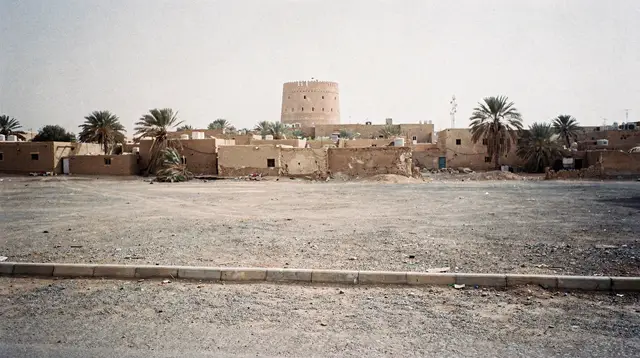
 Full-day tour: enchanting forts of Nizwa and Jabreen
- Free cancellation
- Hotel pickup
- Best seller
 📍 Nizwa
 Muscat: explore Nizwa Fort and Souq + Jebel Akhdar
- Free cancellation
- Hotel pickup
- English guide
 📍 Jebel Shams
 Jebel Shams (day trip): the Grand Canyon of Oman
- Free cancellation
- Hotel pickup
- Small group