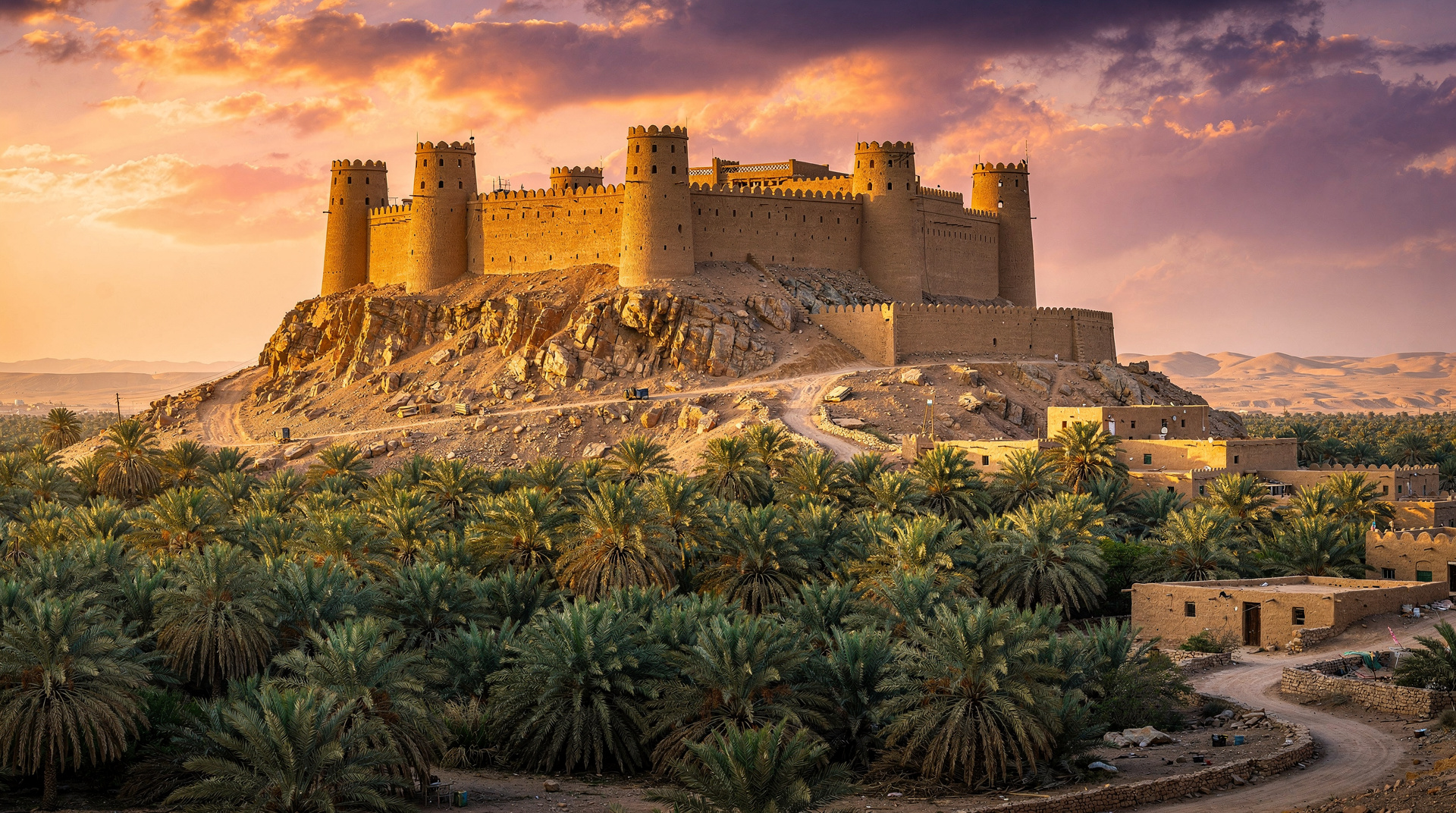
Nizwa Friday Goat Market: The Complete Experience Guide
Old capital of Oman: highlights tours of Nizwa
Duration: 5 hours
- Free cancellation
- Instant confirmation
- English guide
When does the Nizwa goat market take place and how long does it last?
Every Friday morning, starting around 6 AM and largely finished by 9 AM. Arrive by 7 AM for the best atmosphere. The market is free to enter and observe.
The Friday Ritual That Has Never Changed
| At a glance | |
|---|---|
| Where | Open ground beside Nizwa Fort, northern side of the fort/souq complex |
| Cost | Free to enter and observe (no ticket, no gate) |
| Time needed | 1.5-2 hours for the market itself; add a fort/souq visit to fill the morning |
| Best arrival time | By 6:30-7 AM; largely over by 9 AM |
| Getting there | Around 1.5 hours’ drive from Muscat via Route 15, or stay overnight in Nizwa |
Every Friday morning, before the heat of the day has fully arrived and before the muezzin calls the faithful to prayer, something extraordinary happens in the open area beside Nizwa Fort. Farmers from across the Omani interior — from mountain villages, from the date-garden towns of the wadis, from the edge of the Empty Quarter — arrive with goats, sheep, and occasionally cattle and camels. And then, in a rapid, call-and-response process that has changed little in centuries, the animals change hands.
The Nizwa Friday livestock market is not a tourist attraction. It has not been preserved or revived for visitors. It happens because Omani farmers need to sell and buy animals, and because Nizwa has been the commercial centre of the interior for at least a thousand years. Visitors are welcome — Omanis are unfailingly courteous and most participants simply ignore the cameras and continue their business — but the market operates entirely according to its own logic, its own pace, and its own rules.
This is among the most authentic cultural experiences available to a visitor in the Gulf region, and it requires only one thing of you: arrive early.
The Animals: Goats, Sheep, Cattle, and Camels
Goats
Goats are the primary livestock at the Nizwa Friday market, and the variety on display is considerable. Several breeds are raised in the Omani interior, varying in size, coat colour, horn configuration, and the specific environmental niche they occupy. The most common is the Omani goat, a medium-sized animal adapted to the arid conditions of the interior. Larger animals — clearly well fed and healthy — command premium prices. The breeders who bring animals for sale know their livestock individually and handle the price negotiations with absolute confidence in their assessment of what each animal is worth.
The goats are typically brought to the market in the backs of pickup trucks, unloaded into a designated area, and held by their owners or by hired assistants. The animals are remarkably calm — or at least resigned — during this process, and the experienced handlers manage them with minimal fuss.
Sheep
Sheep are present in smaller numbers than goats. The Omani fat-tailed sheep, bred for both meat and the fat stored in its broad tail (used in traditional cooking), is the predominant variety. Fat-tailed sheep command high prices for the table, particularly before Eid festivals when demand for livestock for slaughter is at its annual peak.
Cattle and Camels
A separate area near the main goat market handles cattle and, occasionally, camels. The cattle market moves more slowly than the goat market — each individual animal represents a more substantial transaction and the evaluation takes more time. Camels, when present, attract considerable attention both from serious buyers (working camels for agricultural and transport purposes, racing camels, breeding animals) and from photographers. A fine racing camel can command extraordinary prices; a working farm camel is a more modest transaction but still a significant one.
How the Auction Works
The auction process at Nizwa is not a formal Western-style auction with a single auctioneer and clear paddle signals. It is a series of simultaneous, fast-moving individual negotiations conducted in a shared space, with multiple deals happening at once across the market area.
A seller arrives with his animals, positions himself with them, and begins receiving offers from buyers who move through the market assessing the livestock. The offers and counter-offers come rapidly — experienced participants can complete a transaction in under two minutes. Hands are shaken to confirm a deal. Cash changes hands (always in Omani rials; no cards, no receipts).
For a visitor, the speed and density of simultaneous transactions makes it difficult to follow any individual deal from beginning to end. The better approach is to position yourself in one area and simply observe the overall pattern — the movement of buyers between animals, the physical assessment of an animal (checking teeth, feeling legs, assessing body condition), the hand gestures of negotiation, the final handshake.
The Arabic negotiation is fast, idiomatic, and beyond the comprehension of most visitors, but this does not significantly reduce the experience. The body language, the quality of attention directed at the animals, and the evident expertise of the participants communicates across the language barrier very effectively.
Practical Guide: Everything You Need to Arrive Ready
When to Arrive
The critical advice, repeated by everyone who has been and come back to report, is arrive by 7 AM at the latest. Ideally, arrive by 6:30 AM or even 6 AM. The market starts filling up from dawn, peaks in intensity around 7 to 7:30 AM, and begins to thin out from 8 AM. By 9 AM most transactions are complete and the animals are being reloaded for transport. By 9:30 AM the area is largely empty.
Missing this timing window means seeing a fraction of the experience. There is no equivalent in the afternoon.
If you are staying in Muscat and travelling to Nizwa for the Friday market, this means leaving Muscat by 4:30 to 5 AM. It is worth it. The drive through the pre-dawn desert as the sky lightens behind the Hajar Mountains is beautiful in its own right.
If you are staying overnight in Nizwa — which this guide strongly recommends for Friday market visitors — the logistics are dramatically simpler.
Where Exactly to Go
The livestock market is held in the open area immediately adjacent to Nizwa Fort and the souq, on the northern side of the fort complex. It is clearly visible from the main road. There is no entrance gate or fee. Simply walk in.
The goat market occupies the central area. Cattle and camels are typically in a separate designated zone nearby. Follow the sound and, frankly, the smell.
What to Wear
Conservative dress is appropriate and respectful. Long trousers for men; long skirt or trousers and a covered top for women. This is not a tourist attraction but a working market where local farmers are conducting serious business. Shorts and revealing clothing would be inappropriate and would mark you as either ignorant or disrespectful.
Closed shoes are essential. The ground underfoot is unpaved and the presence of many animals means the surface is exactly what you would expect.
Camera Advice
The Nizwa goat market is photographically extraordinary. The early morning light, the movement of the animals, the faces of the farmers and buyers — it is the kind of subject that rewards both the casual smartphone photographer and the serious camera user.
A few practical notes: a telephoto lens or a long zoom allows you to capture the expressions and interactions without physically crowding participants. Most people at the market do not object to being photographed but some do — read the body language, avoid pointing a camera directly at someone’s face without any acknowledgement, and if someone indicates they prefer not to be photographed, respect this immediately.
The light at 7 AM in the autumn and winter months (October through March) is warm and directional — very flattering for the reddish-brown goats against the cream-coloured fort walls. In summer the quality of light later in the morning is harsher, but in summer you are also at the market much earlier so the pre-dawn light and the first light of sunrise provide their own opportunities.
Conduct
The single most important thing about visiting the Nizwa goat market is to remember that you are a guest at a working market, not an observer at a performance. Move carefully to avoid startling animals. Do not touch animals without explicit invitation from their owner. Stay out of the direct path of livestock being moved between areas. Do not obstruct access for buyers and sellers moving through the market.
Omanis are exceptionally hospitable and patient with foreign visitors. In most cases you will be warmly received, may be offered tea or coffee by a seller who wants to tell you about his animals, and will encounter almost nothing but friendliness. This generosity is not unconditional — it comes with the implicit understanding that visitors behave respectfully.
Best Months to Visit the Nizwa Market
The market runs every Friday year-round, but the experience of standing in the open for two hours changes dramatically with the season. If your Nizwa visit is flexible, the table below helps you choose.
| Months | Morning weather at 7 AM | Market atmosphere |
|---|---|---|
| October-March | Around 20-25°C, cool and pleasant | Relaxed pace, best light for photography, most visitors |
| April-May | Warming toward 30°C | Still comfortable early, market starts to move faster |
| June-September | Often 35°C or higher even at dawn | Functional, shorter, animals and people uncomfortable; market wraps up sooner |
If you are building a wider Interior itinerary around the market, the cooler months also suit day hikes like the Jebel Shams Balcony Walk or an off-road run up to Jebel Akhdar, both far more pleasant outside the summer heat. Check our guide to Oman’s best time to visit for how the goat market fits into a broader seasonal plan.
Pairing Nizwa With the Rest of the Interior
Nizwa rarely stands alone on an itinerary. Most visitors treat the Friday market as the anchor of a longer loop through the Omani interior, and the town’s location makes this easy. From Nizwa, Bahla Fort, Oman’s only UNESCO-listed fort, is a short drive away, and the beautifully preserved mud-brick village at Al Hamra and Misfat Al Abriyeen makes a natural half-day add-on. History-focused travellers often continue to Jabreen Castle, generally considered the most elaborately decorated of Oman’s interior fortifications.
For travellers coming from the coast, Wadi Bani Khalid and the turquoise pools of Wadi Shab lie in the opposite direction and are usually paired with Sur rather than Nizwa, but a longer road-trip itinerary can string all of these together — see our full guide to Oman’s forts for how the interior’s fortresses connect geographically. If you are staying in Muscat and treating Nizwa as a day trip, budget the whole day: the early departure, the market itself, and at least one more Interior stop make far better use of the drive than the market alone.
Combining the Goat Market With a Full Friday in Nizwa
Arriving at the goat market by 6:30 AM and spending two hours there brings you to 8:30 to 9 AM. Nizwa Fort opens to non-Muslim visitors from 8 AM on Fridays (and closes at 11 AM, earlier than on other days). So after the market you have time for a 2-hour visit to the fort before the Friday morning closure. The adjacent souq on Friday mornings is quieter than on other days as many shopkeepers attend Friday prayers, but the produce and livestock sections remain active.
If you stay in Nizwa for the afternoon, Friday prayer ends around 1 to 1:30 PM (depending on the season), after which the souq gradually reopens and the city resumes its normal pace. Friday afternoon in Nizwa is a good time to walk the date gardens, follow a falaj channel (see our aflaj guide), and absorb the quieter rhythms of the old town.
For a day tour from Muscat that combines Nizwa’s highlights — including the morning market experience — with a guide who can provide context for everything you see, this Nizwa highlights tour is the most practical option for visitors who are not driving independently.
Staying Overnight in Nizwa for the Friday Market
Spending a night in Nizwa in order to reach the market without a brutal 4 AM departure from Muscat is the approach most rewarding in terms of energy and flexibility. Thursday evening in Nizwa gives you time to explore the souq during its busy evening hours, have dinner in the old town, and arrive at the market well rested.
Several hotels in Nizwa offer comfortable accommodation at various price points. The Falaj Daris Hotel is the most established option and its position near the falaj channels of the date gardens makes it one of the more atmospheric places to stay in the Omani interior. More affordable guesthouses in the old town area exist for visitors on a tighter budget.
The Market in Context: Livestock and Omani Life
The Nizwa livestock market is not merely picturesque. It is a window into a way of life that remains genuinely central to the Omani interior. Goat and sheep farming is not marginal subsistence activity in the Omani interior — it is an important component of the agricultural economy of the region, providing meat, dairy products, and secondary income for many families who combine herding with date farming and other activities.
The social function of the market is equally important. For farmers from isolated mountain villages and remote desert communities, the Friday market at Nizwa is a weekly point of contact with the broader economy and with other farming communities. The time before and after the formal livestock trading is spent exchanging information about prices, pasture conditions, water sources, and the general news of the region.
Understanding the market in this context — as a genuine node in a living rural economy rather than as a historical survival — changes how you experience it. The farmers loading their goats back into pickups at 9 AM are not participants in a heritage performance. They are working people going about necessary business, and the ancient setting of Nizwa Fort behind them is simply the backdrop of their working lives.
The Fort and Souq: Completing the Nizwa Experience
The goat market without the fort and souq is an incomplete experience of Nizwa. The fort provides the historical depth that contextualises why this particular town became the commercial centre of the interior. The silver souq shows the craft tradition that was sustained by the agricultural wealth the falaj and date gardens generated. And the goat market shows the living agricultural system that has always underlain everything else.
Together, the three elements of Nizwa — fort, souq, and Friday market — make a complete cultural portrait of one of the most significant towns in Arabian history. No other destination in Oman offers a comparably coherent and vivid picture of a traditional society that has adapted to modernity while retaining its essential character.
For more context on the broader fortification heritage of the country, including how Nizwa Fort relates to the other great forts, see our complete guide to Oman’s forts.
Frequently asked questions about Nizwa Friday Goat Market: The Complete Experience Guide
Do I need a guide to visit the Nizwa goat market?
No guide is required — the market is open, free, and easy to find beside Nizwa Fort. A guide adds context on livestock breeds and negotiation customs but isn’t necessary to have a rewarding visit; independent travellers with a car and an early alarm do perfectly well on their own.
Is it disrespectful for tourists to attend the goat market?
No, visitors are generally welcome as long as they behave as guests at a working market rather than spectators at a show: dress modestly, stay out of the way of buyers and sellers, and ask before photographing individuals up close. Most Omani farmers are used to visitors and remain focused on their own business.
Is the Nizwa goat market suitable for children?
Yes, with supervision. Children generally love the animals, and the energy of the market is exciting rather than intimidating for most kids. The surface underfoot is uneven and the density of people and animals requires keeping a close eye on small children. Older children (8 and above) who are comfortable in busy outdoor environments will find the market genuinely fascinating.
Are there other livestock markets in Oman similar to Nizwa?
Similar markets exist at other inland towns, including Sinaw and Ibra in the Al Sharqiyah region. The Sinaw market on Thursday mornings has a particularly strong reputation among experienced Oman travellers as an alternative to Nizwa that sees fewer foreign visitors. However, Nizwa’s market is larger, more accessible, and combined with the fort and souq offers a more complete single-destination experience.
Can I buy anything at the goat market as a visitor?
Theoretically yes, but practically the answer is no for most visitors. Purchasing livestock requires the ability to transport the animal, knowledge of what constitutes a fair price (the process is not tourist-friendly), and a reason to need a goat. The buying and selling process is conducted in rapid Arabic and is firmly oriented toward people who are there to do business. Visiting as an observer is the appropriate role for foreign visitors.
What happens to the animals after the market?
Animals purchased for immediate slaughter go directly to the buyer’s farm or household. Animals purchased for breeding or ongoing herding return to the buyer’s farming operation. The market is a practical agricultural transaction, not a prelude to anything ceremonial from the buyer’s perspective (unless it happens to fall near an Eid festival, when many purchases are specifically for celebration).
Is the market open in summer?
The market operates year-round, every Friday. In summer the temperature even at 7 AM can be 35 degrees Celsius or above, and the market concludes earlier as both people and animals become uncomfortable with the heat. The experience in summer is functional rather than leisurely; in the cooler months (October to March) the temperature at 7 AM is 20 to 25 degrees Celsius and the market has a more relaxed character.
How do I get to Nizwa from Muscat for the Friday market?
If driving, leave Muscat by 5 AM at the latest to arrive in Nizwa by 7 AM. The route is straightforward along Route 15. Taxis can be hired from Muscat for the day at a negotiated rate, though the driver will need to be willing to leave very early. Staying overnight in Nizwa on Thursday removes the logistics problem entirely. Organised tours specifically for the Friday market from Muscat are available but require checking current providers for availability.
Top experiences
Bookable activities with verified prices and instant confirmation on GetYourGuide.
 📍 Nizwa
 Old capital of Oman: highlights tours of Nizwa
- Free cancellation
- Instant confirmation
- English guide
 📍 Nizwa
 Full-day tour: enchanting forts of Nizwa and Jabreen
- Free cancellation
- Hotel pickup
- Best seller
 📍 Nizwa
 Muscat: explore Nizwa Fort and Souq + Jebel Akhdar
- Free cancellation
- Hotel pickup
- English guide
 📍 Muscat
 Muscat: half-day city tour
- Free cancellation
- Instant confirmation
- Hotel pickup