Top 10 Forts in Oman: UNESCO Sites and Hidden Gems
Muscat to Nizwa: private fort, souq, falaj and museum tour
Duration: 8 hours
- Private tour
- Hotel pickup
- Free cancellation
Which fort in Oman is the most impressive?
Nizwa Fort is the most visited and most photogenic, with its massive circular tower and adjacent souq. Bahla Fort is the most historically significant as Oman's only UNESCO-listed fort, while Jabrin Castle offers the finest interior with painted ceilings and library chambers.
Oman’s fort legacy: why it matters
No country in the Arabian Peninsula matches Oman for the sheer number, variety, and condition of its historic fortifications. From the date-palm lowlands of the Batinah coast to the jagged peaks of the Hajar Mountains and the desert oases of the interior, stone towers and fortified palaces punctuate the landscape at regular intervals.
Most of these forts were built or extensively rebuilt during the Al Ya’ruba dynasty of the 17th and 18th centuries, when Oman expelled the Portuguese from the coast and established itself as a maritime empire stretching to East Africa and the Indian subcontinent. The forts served as military strongholds, royal residences, grain stores, and centres of commerce. Many remain in remarkable condition, restored by the Ministry of Heritage and Tourism since the 1970s.
This ranked list cuts through the 500-plus fortifications to identify the ten that most reward a visit — for their architecture, history, setting, or sheer dramatic impact.
| At a glance | |
|---|---|
| Where | Mostly the interior (Nizwa, Bahla, Jabrin) and the Batinah coast (Nakhal, Rustaq, Sohar), reachable on self-drive loops from Muscat |
| Cost | Most forts charge around 0.5–3 OMR entry; Mirani and Jalali in Muscat are viewed from outside only, free |
| Time needed | Around 1 hour for a single fort, a full day for the Nizwa-Jabrin-Bahla circuit |
| Getting there | Rental car or organised day tour; tarmac roads throughout, no 4x4 required for any fort on this list |
| Best time | October–April for comfortable daytime walking; forts are covered attractions so a summer visit is workable if timed for morning |
1. Nizwa Fort
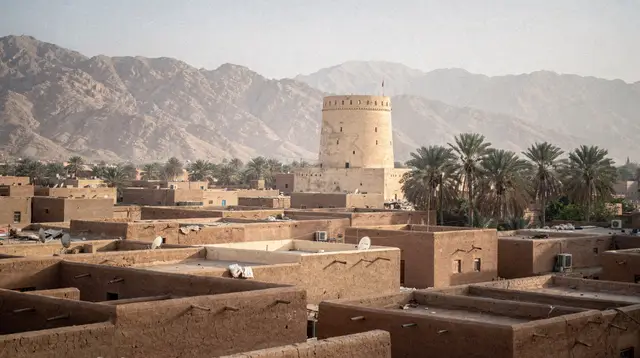
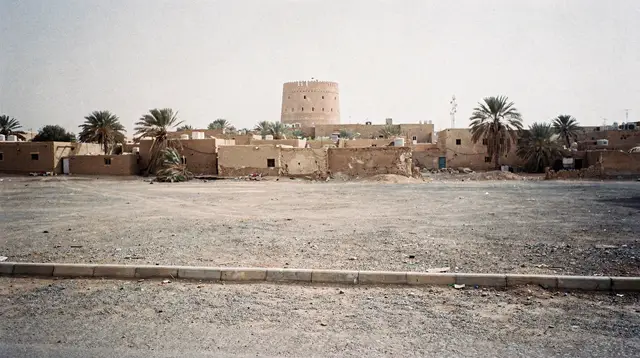
Nizwa’s massive cylindrical tower — 36 metres in diameter — is the most photographed structure in Oman’s interior, and rightly so. Built in the 17th century by Imam Sultan bin Saif Al Ya’ruba, it took 12 years to complete. The roof bristles with artillery ports, and the interior is a labyrinth of corridors, storage rooms, and trap doors designed to frustrate attackers.
The fort sits at the edge of Nizwa’s famous souq, still one of the most authentic markets in Oman. Friday mornings bring a livestock auction for goats and cattle that has continued for centuries. The combination of fort, souq, and the adjacent falaj makes Nizwa a full day.
Book a private Nizwa fort, souq, falaj and museum tour for the deepest experience, including stops the standard tours skip.
Climb to the top of the tower before wandering the souq: the view over the palm grove, the town and the mountains behind it explains why this spot mattered so much, and it gives you a mental map of the old quarter before you walk it. If you want the practical details, our Nizwa Fort and Souq guide covers the visit in depth, and the Nizwa goat market guide explains how the Friday auction works. Nizwa is also the natural gateway to the Nizwa destination page and the cooler heights of Jebel Akhdar.
2. Bahla Fort
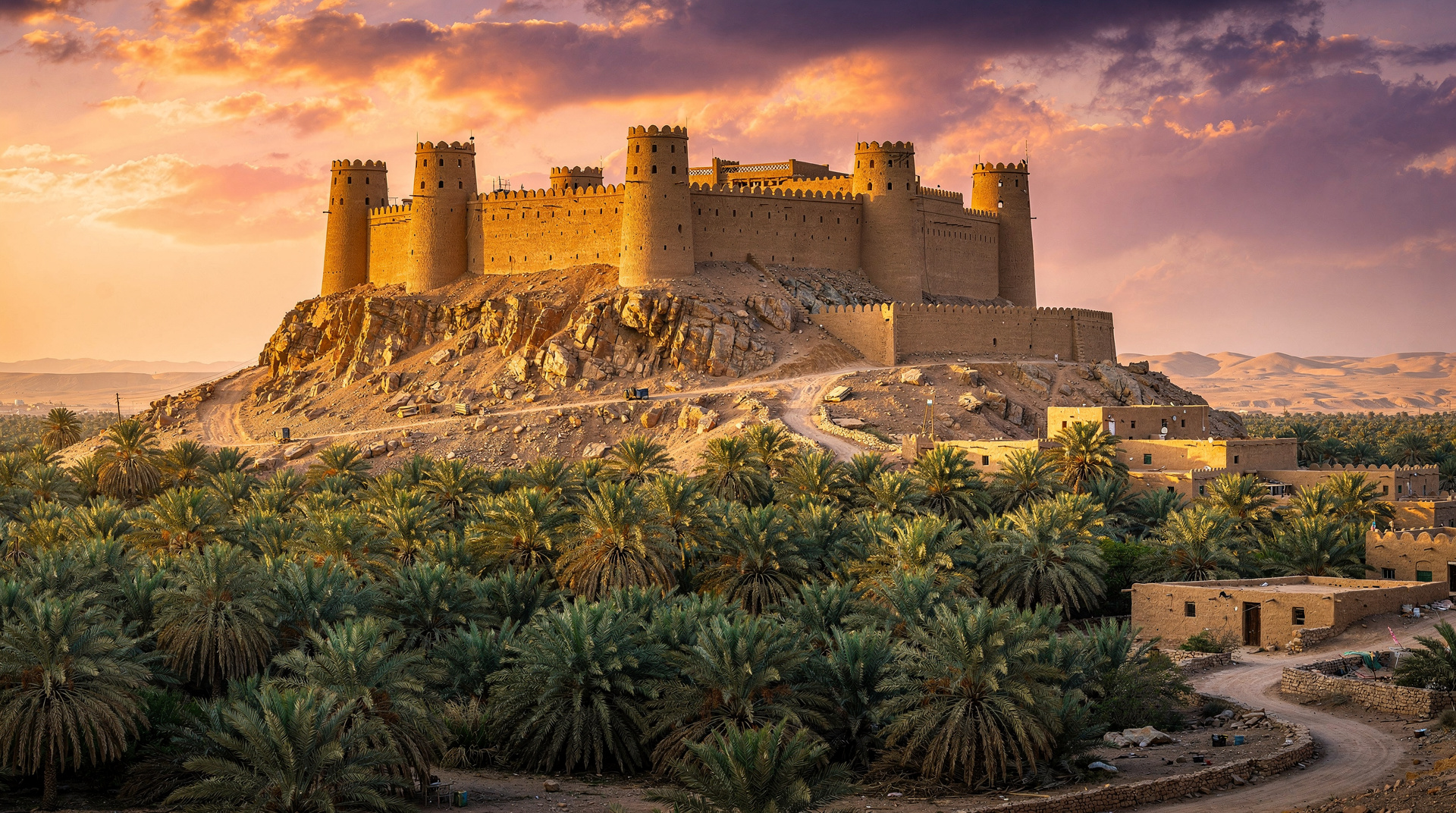
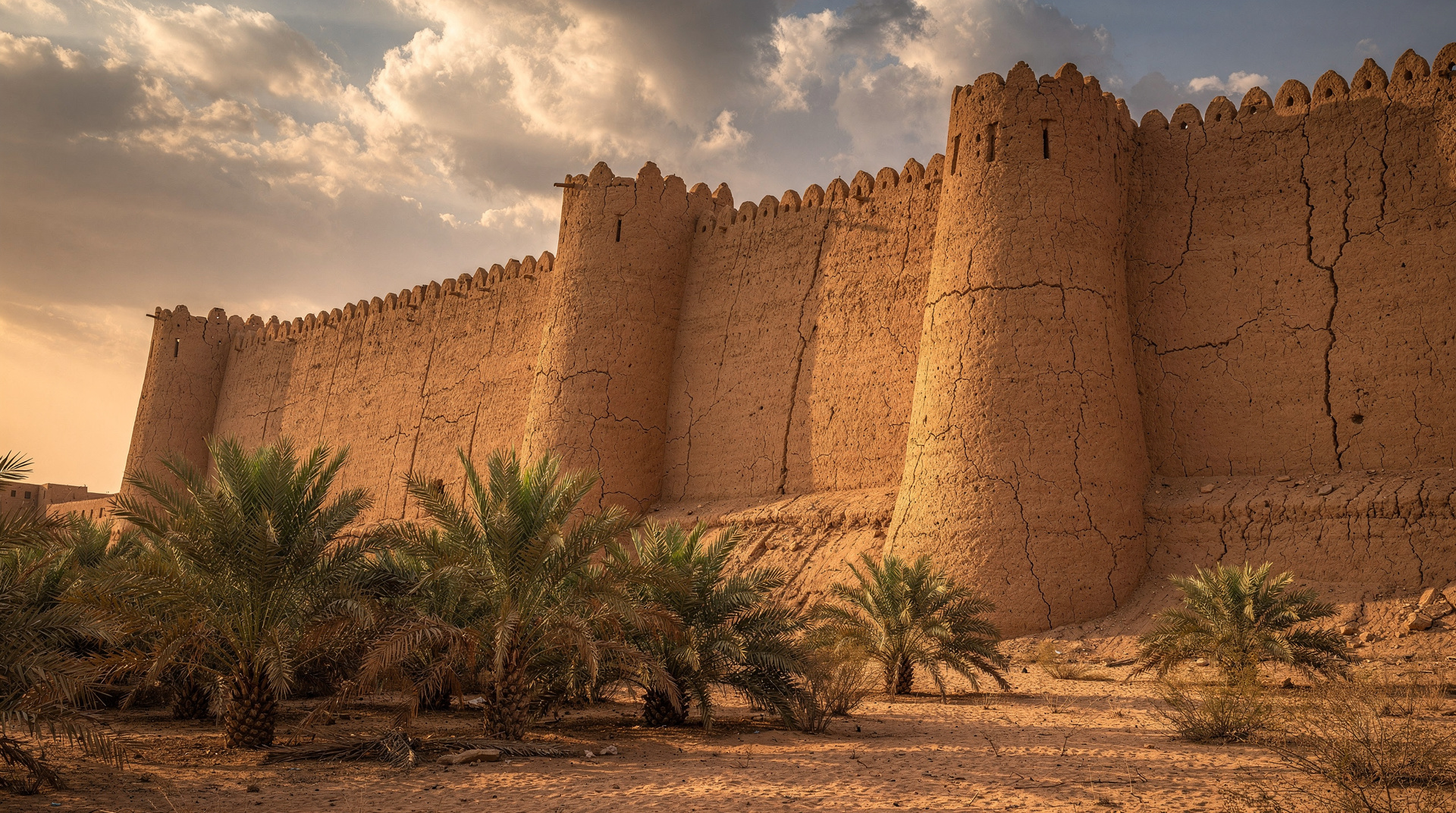
The largest fort in Oman and its only UNESCO World Heritage Site (listed 1987), Bahla is an extraordinary complex of towers, ramparts, and inner citadels rising from a palm oasis at the foot of the Hajar Mountains. The surrounding mud-brick town walls extend for 12 kilometres.
Bahla has been a centre of power since the pre-Islamic period, and the fort encapsulates centuries of Omani architectural evolution. The site requires 2–3 hours to explore properly and is best combined with Jabrin Castle 8 km away.
See our detailed Bahla Fort UNESCO guide for a full itinerary.
Take your time here rather than ticking it off. The fort is a layered place, and the pleasure lies in the shifts between dark stairways, open ramparts and sudden views over the oasis. Bring water, wear a hat, and give yourself room to wander the lanes of the old town outside the walls. The irrigation channels that feed the oasis are part of the same story, and the aflaj irrigation UNESCO guide shows how water shaped settlement across the interior.
3. Jabrin Castle
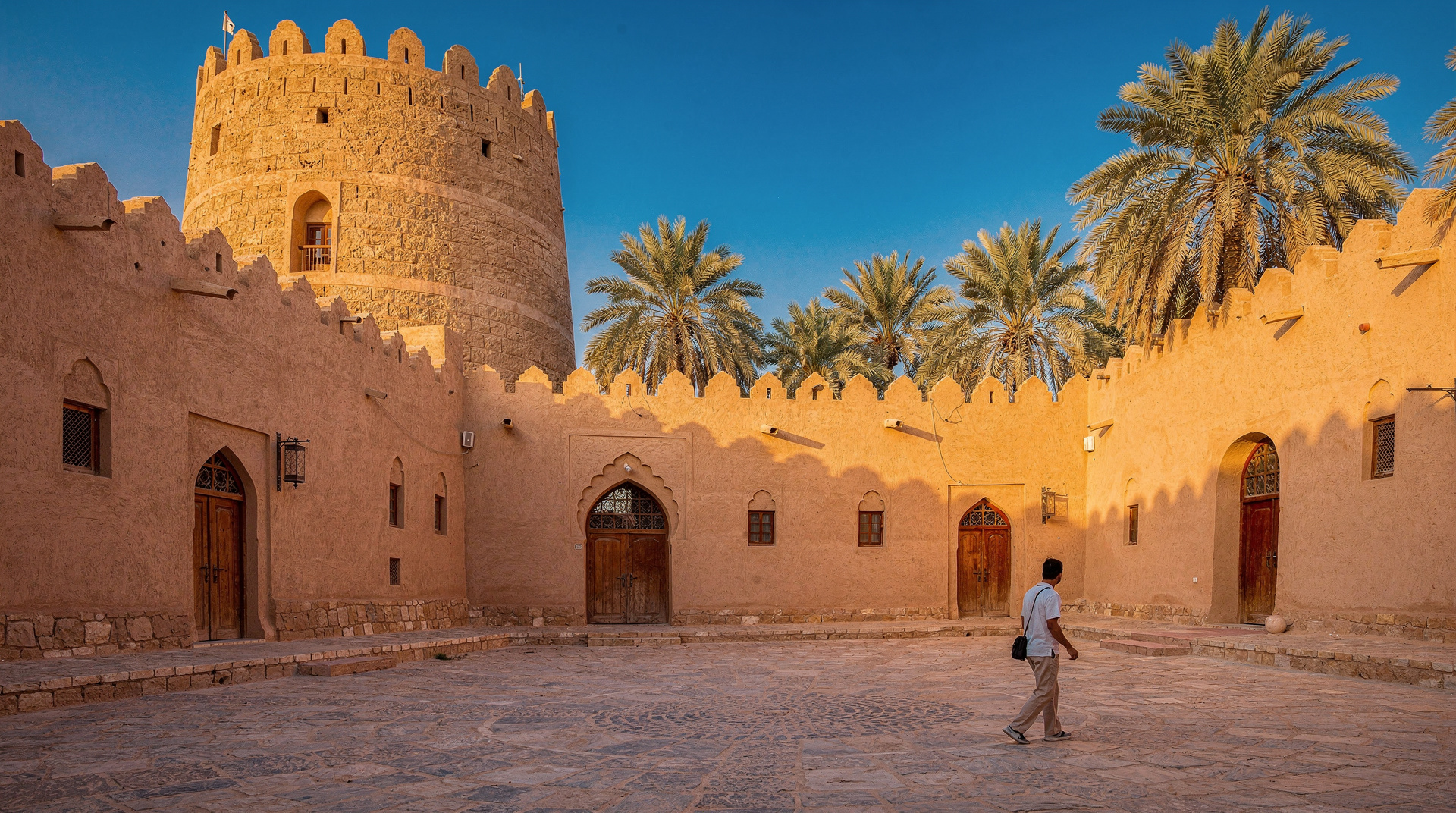
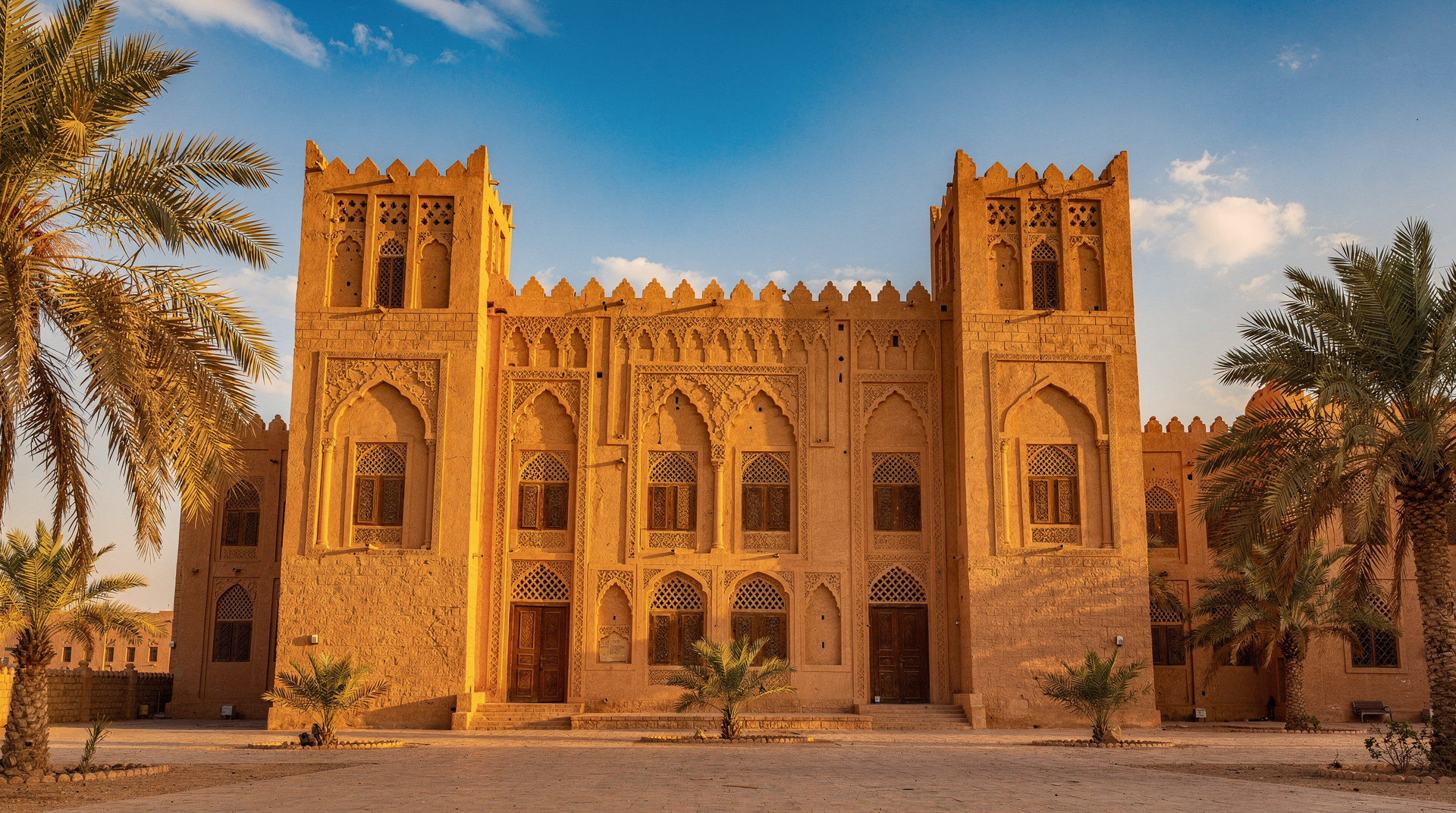
Jabrin is the most refined of Oman’s historic buildings — less a military fort than a fortified palace of extraordinary elegance. Built in 1670 by Imam Bil’arab bin Sultan Al Ya’ruba, it features painted ceilings of intricate geometrical design, a library, a Quran school, royal apartments, and a horse stable integrated into the ground floor.
The defensive elements are present — arrow slits, a fortified gate, a well — but the overall impression is of a place built for scholarship and statecraft as much as war. Entry is cheap and crowds are thin by international standards.
Visit with patience: the rooms are small, the ceilings are the main event, and the best moments come when you stop and look up. Our Jabrin Castle guide walks through the rooms in order, which helps if you want to understand what each chamber was used for.
4. Nakhal Fort
Nakhal Fort stands on a volcanic outcrop above the Al Batinah plain and hot springs, creating one of the most dramatic fort silhouettes in Oman. The site has been fortified since pre-Islamic times; the current structure is largely 17th century with later additions.
The nearby Ain Ath Thowwara hot springs make this an easy half-day from Muscat. In spring, the surrounding date palms and mountain backdrop are outstanding.
Nakhal suits travellers who want a fort without a long drive, and it pairs naturally with a swim or a paddle nearby. If you like that mix of heritage and water, read about the best wadis in Oman, several of which are an easy addition to a Batinah day.
5. Khasab Fort
In Musandam, Khasab Fort sits at the edge of a town carved into fjord country. Built by the Portuguese in the early 17th century on earlier Islamic foundations, it was used as a military barracks until 1990 and now houses a museum of traditional Musandam life — dhow models, fishing equipment, and photographs of the region’s remarkable landscapes.
Pair it with a Khasab city tour including the fort to cover the old quarter in one organised morning.
Khasab is the most remote fort on this list, and the setting is half the reason to go. Once you have seen the museum, the town gives you a base for the fjords: see the Khasab dhow cruise guide and the wider Musandam destination page to plan the rest of your stay.
6. Rustaq Fort
The largest fort in the Al Batinah region and historically one of Oman’s most important, Rustaq was Oman’s capital for extended periods. It contains four towers of different periods and styles, a mosque inside the fort walls, and a falaj system that still delivers water today. The oldest sections may date to the pre-Islamic period.
Rustaq makes an excellent combination with Nakhal on a Batinah day loop from Muscat — roughly 180 km in total.
Rustaq rewards a slower look at the details: the way the towers differ from one another tells you that the fort grew over generations rather than being built to a single plan. Because the route is a loop with long stretches of driving, the renting a car in Oman guide is worth a read before you set out.
7. Al Hazm Castle
Built in 1711 by Imam Sultan bin Saif II, Al Hazm is known for two unusual features: a cannon tunnel through which guns could be fired from inside the fort walls, and inscriptions from the Quran carved into the stonework above its gates. The interior staircases are designed to make ascending horsemen expose their right (sword) side to defenders — a military innovation centuries ahead of its time.
Al Hazm is a good stop for readers who enjoy the engineering side of fortification. Look for how the entrance, the stairs and the gun positions work together as one defensive system, rather than as separate features. It is a quieter visit than Nizwa, which many travellers find a welcome change after the busier sites.
8. Mutrah Fort
Perched on the headland above Mutrah Corniche, this small fort offers panoramic views over Muscat’s historic port, the Gulf of Oman, and the old merchant quarter below. It is not the most elaborate fort in Oman, but its position is unbeatable and the views at sunset rival anything in the country.
Combine it with a walk along the Mutrah Corniche and the atmospheric Mutrah Souq, covered in the Muscat half-day city tour.
For the market itself, our Muttrah Souq guide explains what to look for, and the Muscat destination page shows how the fort fits into a wider stay in the capital. A late-afternoon visit works best, when the light softens and the heat eases.
9. Mirani and Jalali Forts, Muscat
These twin 16th-century Portuguese-built forts flank the entrance to Muscat’s old harbour and have guarded the city for 500 years. They are closed to the public, but form one of Oman’s most iconic images — best photographed from the Sultan Qaboos seafront road or from a dhow cruise.
If the water view appeals, the Muscat sunset dhow cruise guide is a relaxed way to see both forts from the sea, which is the angle their builders designed them to be seen from.
10. Sohar Fort
Sohar on the Batinah coast was once the most important trading city in the Arabian Peninsula and the legendary birthplace of Sinbad the Sailor. The white-plastered fort that stands today houses a museum covering Sohar’s maritime history. It lacks the grandeur of the interior forts but rewards visitors with its cultural context and the pleasant surrounding gardens.
Sohar works best as a cultural pause rather than a headline sight. Treat it as a way to understand the maritime side of Omani history, which is easy to miss if you only visit the mountain forts of the interior.
Reading a fort: what to look for
Once you have visited two or three, the forts start to feel alike unless you know what to notice. Look first at the entrance: gates were deliberately narrow, turned at an angle, and often fitted with openings above for defence. Then look at the towers, whose shape (round or square) often hints at the period and purpose. Finally, look at the water. Almost every inland fort sits beside a falaj or a well, because a fort without water could not survive a siege. For the wider picture of how these pieces fit together, the complete Oman forts guide is the best companion to this ranking.
Photographers will find that the forts reward different times of day. Interior forts are at their best in early light, when the walls glow and the courtyards are empty, while coastal forts such as Mutrah are better towards sunset. Our photography guide for Oman has more on working with the light.
How we chose this list
Selection prioritised: architectural significance, state of preservation, interior access, historical importance, and the quality of the visitor experience including context, labelling, and accessibility. Several other forts merit mention — Barka Fort, Bidiya Fort, and the towers of Ibra — but were omitted because they offer a less complete visitor experience than those listed above.
Fort vs fort: which suits your itinerary
| Fort | Best for | Time needed | Access |
|---|---|---|---|
| Nizwa Fort | First-timers, souq combo | ~1.5 hours | Self-drive, flat streets |
| Bahla Fort | History and UNESCO status | ~2–3 hours | Self-drive, combine with Jabrin |
| Jabrin Castle | Architecture and interiors | ~1 hour | Self-drive, 8 km from Bahla |
| Nakhal Fort | Half-day from Muscat, hot springs | ~1 hour | Self-drive, tarmac all the way |
| Mirani and Jalali | A quick photo stop, no ticket needed | 15–20 minutes | View from the Muscat corniche only |
What to expect on arrival
Ticket booths at the larger forts (Nizwa, Bahla, Jabrin) accept cash in Omani rial; card payment is inconsistent, so carry small notes. Signage is generally in Arabic and English, though the depth of interpretation varies — Jabrin has the best in-fort context, while smaller forts rely more on a printed leaflet or nothing at all. Stone stairways inside the towers are steep, uneven, and often unlit, so flat closed shoes are worth the extra weight in your bag over sandals. Most forts close for a midday prayer break on Fridays and shut earlier than other days of the week, so plan a Friday visit for the morning or push it to Saturday if your itinerary allows.
For a wider view of Oman’s heritage circuit beyond forts alone, our complete Oman forts guide maps out the full network, and the Muscat city guide covers where Mirani and Jalali fit into a day in the capital. Timing your fort circuit around the best time to visit Oman makes a real difference to comfort, since these are outdoor, largely unshaded sites.
Etiquette and comfort at the forts
Many forts are protected heritage sites and, in some cases, places with religious significance, so modest clothing is appreciated; our Oman dress code guide explains what is comfortable and respectful. Ask before photographing local people, keep to marked routes inside the towers, and do not climb on walls or cannon. More general advice is in the Oman etiquette and culture guide.
If you are building a fort circuit into a longer trip, the 7-day classic Oman itinerary and the Oman road trip planning guide show how to fit the interior forts around the coast and desert without rushing.
Which fort should you prioritise?
One day: Nizwa Fort plus the souq — non-negotiable. Two days: add Jabrin Castle and Bahla Fort in a loop. Three days: extend to Rustaq and Nakhal via the Batinah. For the dedicated fort hunter with a week: the full-day Nizwa and Jabreen fort tour from Muscat is an excellent base from which to plan further exploration.
Full fort guides: Nizwa Fort and Souq, Bahla Fort UNESCO, Jabrin Castle.
Frequently asked questions about Top 10 Forts in Oman: UNESCO Sites and Hidden Gems
Are Oman's forts free to visit?
Most government-managed forts charge a small entry fee of 0.5–1 OMR (around $1.30–2.60). Muscat's Al Jalali and Al Mirani forts are closed to the public. Bahla Fort charges 3 OMR for the full site.Which forts are UNESCO World Heritage Sites in Oman?
Bahla Fort (with its Falaj Daris irrigation system) is Oman's sole UNESCO-inscribed fort, listed since 1987. Nizwa, Jabrin, Rustaq, and Nakhal are all historically significant but not individually UNESCO-listed.How many forts does Oman have?
Oman has over 500 castles and forts — more per capita than almost any country on earth. This reflects the country's historic role as a maritime trading power and the need to defend mountain passes, coastal ports, and inland oases.Can I visit multiple forts in one day?
Yes — the classic Nizwa-Jabrin-Bahla circuit fits comfortably in a full day from Muscat. Many organised tours cover this route with a guide, making it easier than self-driving.Do I need a guide to visit Oman's forts?
No — Nizwa, Bahla, and Jabrin Castle are all self-guided with signage and ticket booths at the entrance, and are easy to combine on a self-drive loop. A guide adds context and saves time on the drive, which is why many first-time visitors book a private day tour instead.Which fort is best for families with children?
Nizwa Fort is the easiest for families — flat courtyards, a manageable tower climb, and the adjoining souq to explore afterwards. Jabrin Castle's painted ceilings also tend to hold children's attention longer than a purely military fort.
Top experiences
Bookable activities with verified prices and instant confirmation on GetYourGuide.
 📍 Nizwa
 Muscat to Nizwa: private fort, souq, falaj and museum tour
- Private tour
- Hotel pickup
- Free cancellation
 📍 Nizwa
 Muscat: explore Nizwa Fort and Souq + Jebel Akhdar
- Free cancellation
- Hotel pickup
- English guide
 📍 Nizwa
 Full-day tour: enchanting forts of Nizwa and Jabreen
- Free cancellation
- Hotel pickup
- Best seller
 📍 Jebel Shams
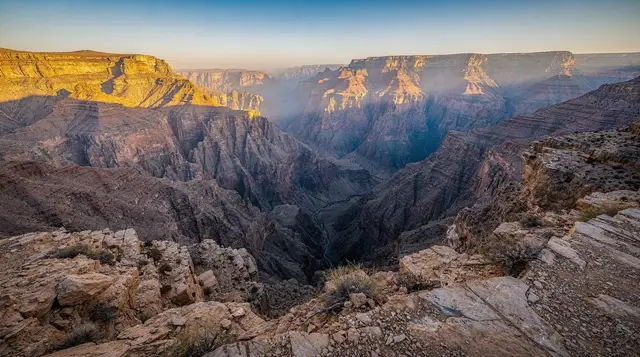
 Jebel Shams (day trip): the Grand Canyon of Oman
- Free cancellation
- Hotel pickup
- Small group
 📍 Muscat
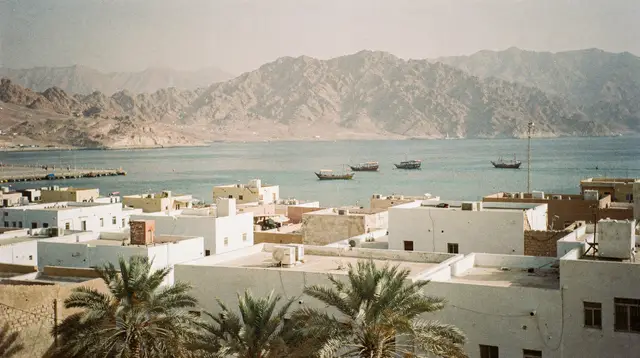
 Muscat: half-day city tour
- Free cancellation
- Instant confirmation
- Hotel pickup