Wadi Shab Complete Guide: Oman's Most Beautiful Hike
How do you get to Wadi Shab from Muscat?
Wadi Shab is 140 km south of Muscat on the coastal highway toward Sur. The drive takes about 2 hours. You park at the main car park, take a short boat crossing (500 baisa each way), then hike 2-3 km to the swimming pools. A day trip with guided transport takes the stress out of logistics entirely.
The Turquoise Jewel of Eastern Oman
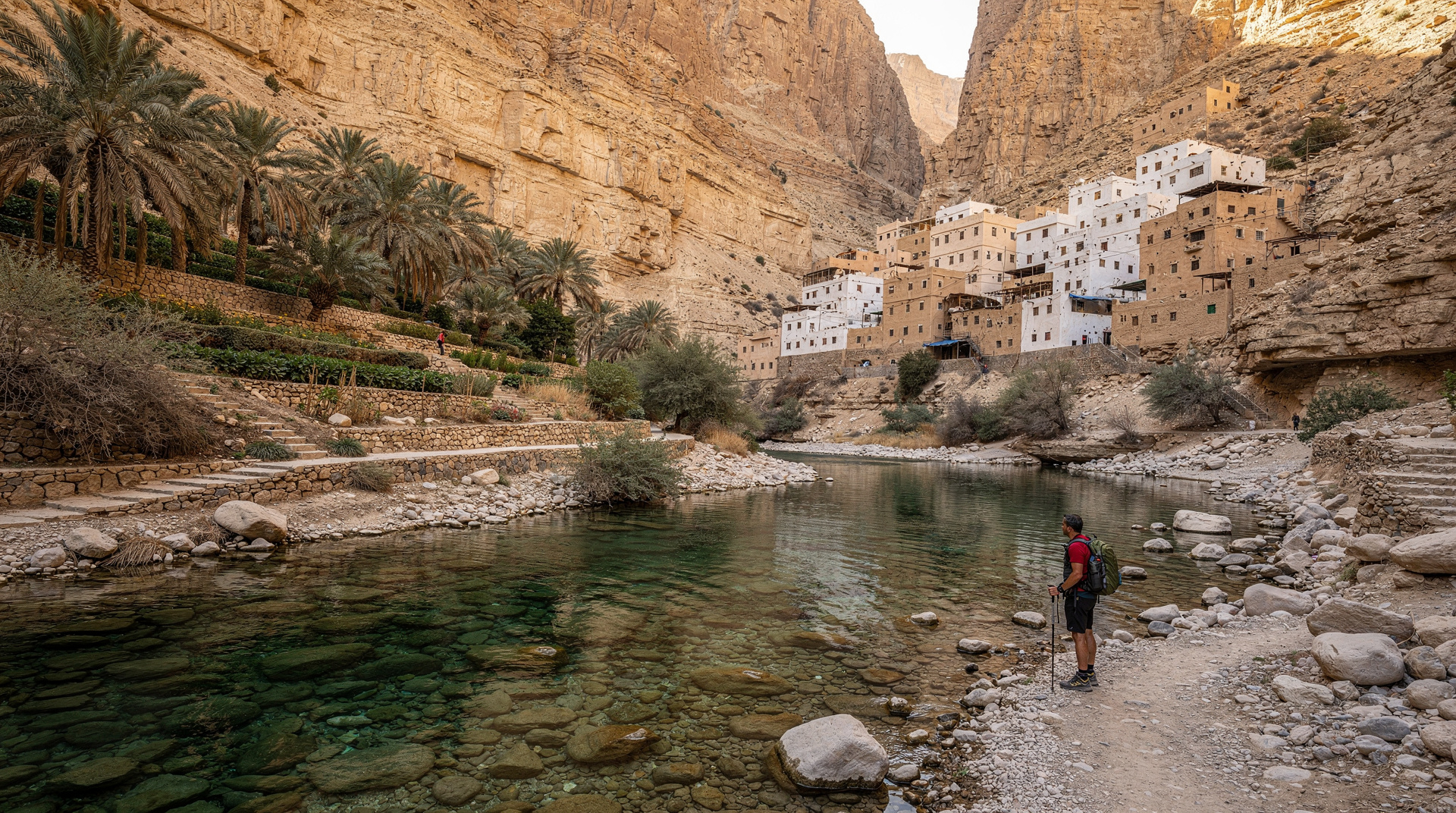
Some places earn their reputation slowly. Wadi Shab is not one of them. The moment you round the first canyon bend and see the colour of the water — an almost unreal turquoise-blue set against walls of pale limestone — you understand immediately why this place appears on every list of Oman’s must-see destinations.
Wadi Shab (pronounced “sha-b”) runs between steep, sculpted canyon walls south of Muscat on the road toward Sur. The hike into the wadi passes date palm plantations, traditional watchtowers, natural swimming pools and culminates — for those willing to swim the final stretch — in a cave with a hidden waterfall inside. It is genuinely one of the most extraordinary natural experiences in the Arabian Peninsula.
This guide covers every detail: the exact logistics of the car park and boat crossing, the full trail breakdown, swimming tips, the cave approach, Bimmah Sinkhole combinations, and the best guided day trips from Muscat.
At a glance
| Where | Coastal Route 17, around 140 km south of Muscat toward Sur |
| Cost | Around 1 OMR car park fee plus 500 baisa each way for the boat crossing (self-drive); guided day tours run roughly 30-45 OMR per person |
| Time needed | Half a day minimum (4-6 hours in the wadi); a full day if combined with Bimmah Sinkhole |
| Getting there | Self-drive (2WD is fine to the car park) or a guided day tour from Muscat |
| Best time | October to April for comfortable hiking; arrive before 8am year-round to beat the crowds |
The Boat Crossing and Car Park
Wadi Shab begins at a simple car park on the coastal highway. From Muscat, it is about 140 km south on Route 17 — the dramatic coastal road through the mountains. The car park sits beside a narrow channel of water separating the road from the wadi entrance.
A small motorised wooden boat crosses this channel continuously. The crossing takes about 2 minutes and costs 500 baisa (half an Omani rial) each way — you pay 500 baisa going in and another 500 on return. The boats run from early morning until around 5pm. Do not mistake this timing — if you are slow returning, you may miss the last boat and face a very long walk around. The channel is technically swimmable but it is brackish and not recommended.
Car park fee: 1 OMR per car. An attendant collects fees from around 8am onward. Early arrivals before 7am often park without paying, but this changes seasonally.
The Trail: Full Route Breakdown
Section 1: Car park to first pools (1.5 km, 30-40 minutes)
After crossing the channel, the path immediately enters the wadi. The first section passes through a lush date palm plantation irrigated by natural wadi water — a remarkable sight given the bare rock canyon walls rising on both sides. The path is clear and follows the wadi floor, occasionally crossing shallow water sections that may require removing shoes.
The canyon walls gradually narrow and the light changes dramatically as you progress deeper into the wadi. The pale limestone has been sculpted by millennia of seasonal flooding into extraordinary shapes — undercut walls, polished channels and cavern-like overhangs.
Section 2: First swimming pools (the turquoise pools)
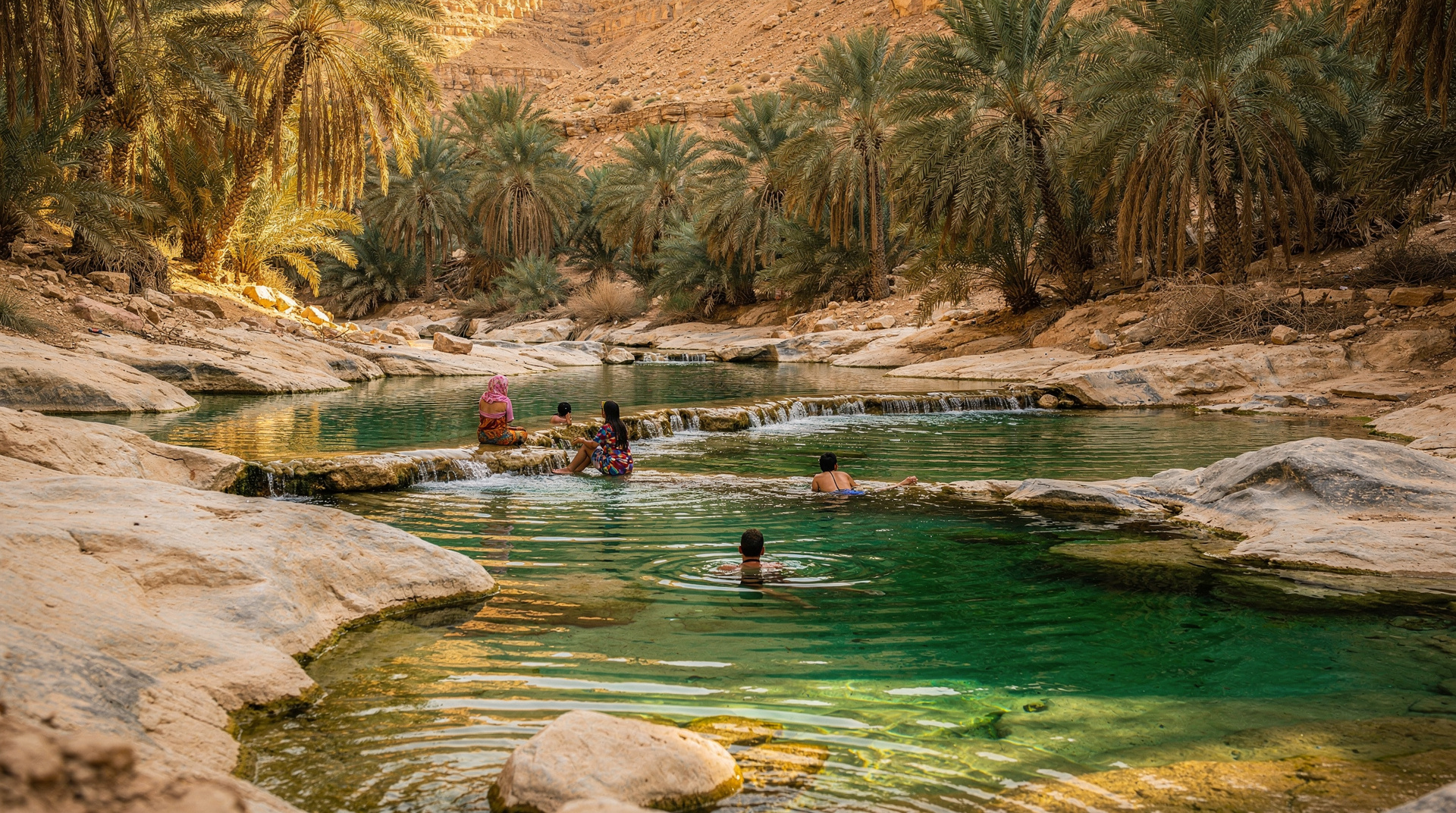
The wadi opens into a series of natural swimming pools around 1.5 km from the boat crossing. These are the pools that appear in every photograph of Wadi Shab — clear, turquoise water sitting in bowls of smooth white rock, surrounded by towering canyon walls. The water is cool even in summer (around 22-24°C) and crystal clear.
Most day visitors stop here. The pools have flat rocks for sunbathing, areas of shallow water safe for non-swimmers, and deeper sections for swimming. Crowds peak between 9am and 2pm. Morning visits before 9am offer the most peaceful experience.
Water shoes are strongly recommended — the rocks around the pools are slippery and the wadi floor leading to the cave section requires wading.
Section 3: The cave approach (additional 30-45 minutes from pools)
Beyond the main pools, the trail continues upstream. This section requires wading through water (knee to waist depth depending on season) and some scrambling on wet rocks. The canyon narrows again and the walls press close on either side.
After a series of shallow pools and rock scrambles, you reach the final pool before the cave. This pool cannot be walked around — you must swim across it, a distance of around 20-30 metres. Life jackets are sometimes available from local guides at the cave entrance, though you should not rely on this. Strong swimmers have no difficulty with the crossing.
Section 4: The cave and waterfall
Inside the cave, the air cools instantly and the light changes to a blue-green glow from the water below and the cave opening above. Swimming forward in the darkness, you hear the waterfall before you see it — a curtain of falling water from a natural opening in the cave roof. Behind the waterfall is a small dry platform where visitors can rest and take photographs.
This is the defining experience of Wadi Shab and unlike almost anything else in Oman. The combination of swimming in near-darkness, the echo of falling water, and the ethereal light filtering through the cave entrance is profoundly memorable.
Important: Do not enter the cave alone. At minimum go with one other person. The swim is straightforward for confident swimmers but the darkness is disorienting and the rocks inside are uneven and slippery.
Bimmah Sinkhole: The Perfect Combination
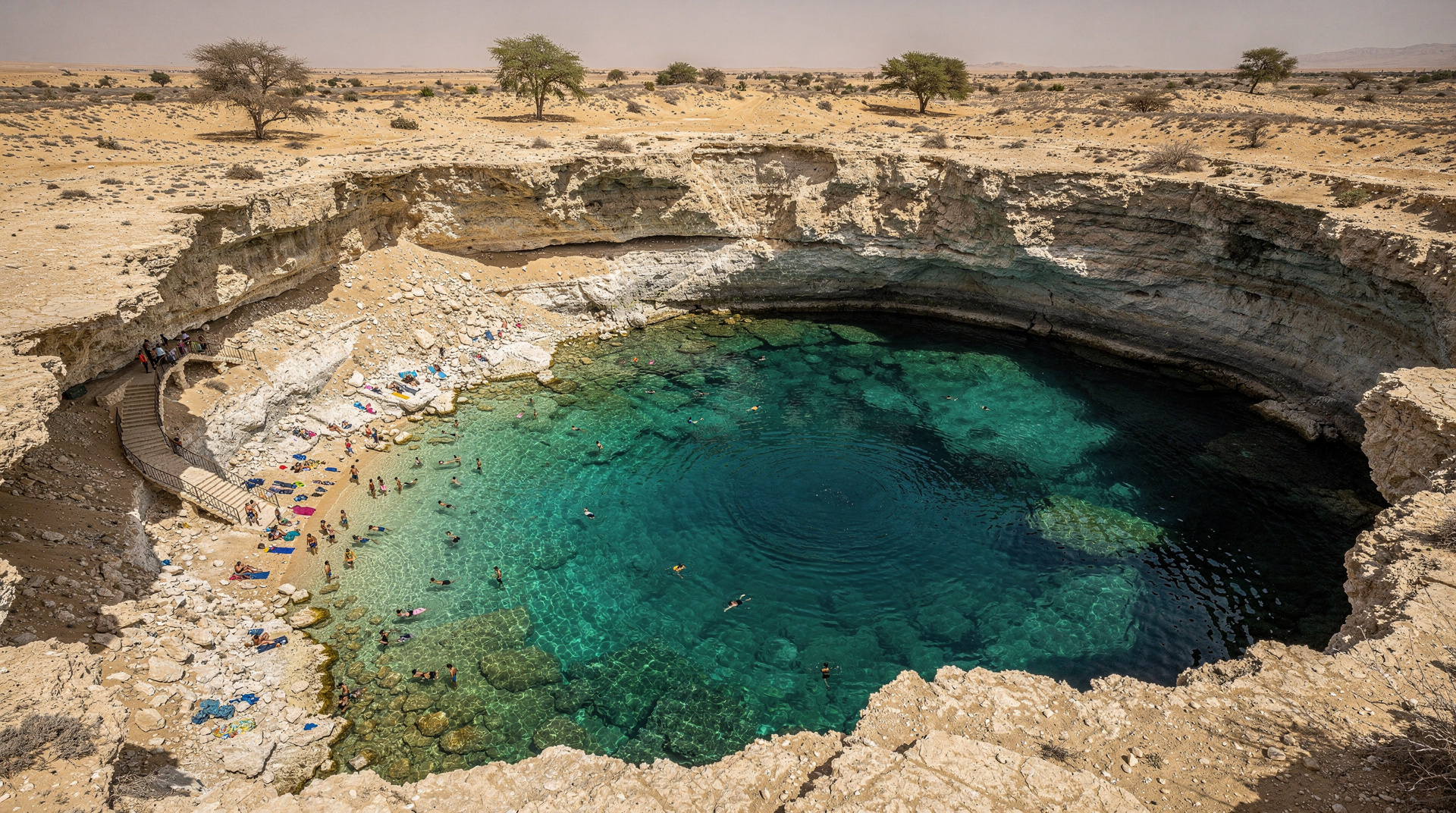
Located just 9 km north of the Wadi Shab car park, the Bimmah Sinkhole is a natural karst feature — a collapsed limestone cavern now filled with turquoise water. It takes only 15-20 minutes to visit and combines naturally with Wadi Shab as part of a single day.
Most organised tours from Muscat cover both sites together. The most popular option is the Wadi Shab and Bimmah Sinkhole full day tour from Muscat. This covers hotel pickup, the coastal drive, guided entry to both sites, and return to Muscat — from around 35-45 OMR per person.
For a more intimate experience focused purely on the hike and swim, the Wadi Shab hike and swim in paradise tour offers a smaller group experience with an experienced local guide who knows the cave section well.
Families and those who prefer maximum flexibility can book the private full-day Wadi Shab and Bimmah Sinkhole tour from Muscat, which provides a dedicated vehicle and guide for your group alone — allowing you to set your own pace at the pools and cave section.
For a very small group experience, the Wadi Shab and Bimmah Sinkhole small group tour (maximum 8 people) is one of the most personal shared-tour options available, keeping groups small enough that the guide can give attention to every participant.
Those who prefer to learn at their own pace will appreciate the Wadi Shab and Bimmah Sinkhole tour with audio guide, which provides narrated commentary at each key point along the route.
For more on the sinkhole, read the complete Bimmah Sinkhole guide.
Beyond the immediate eastern coast, the Wadi Bani Khalid guide covers the year-round oasis near Wahiba Sands — reachable as a second day from Sur. For mountain contrast, the Jebel Shams Balcony Walk is the premier highland experience accessible from Muscat, while the Jebel Akhdar Green Mountain offers rose gardens and cooler temperatures.
Travellers curious about underground Oman will find the Al Hoota Cave guide useful — a remarkable subterranean lake with blind fish near Nizwa. In the far north, the Jebel Harim mountain safari provides a completely different landscape: fjord-like inlets and the Strait of Hormuz visible from 2,000 metres.
Getting There Independently
By car
From Muscat, take Route 17 south along the coast toward Sur. After passing the town of Quriyat and continuing through the mountain tunnels, look for the Wadi Shab signpost approximately 40 km past Quriyat. The car park is clearly marked on Google Maps as “Wadi Shab”.
Driving independently offers total flexibility on timing — crucial for beating the crowds by arriving before 8am. A standard 2WD car is sufficient for the drive to the car park. No 4WD is needed.
Fuel: Fill up in Muscat or Quriyat. There are no petrol stations at the wadi.
By public transport
Buses run from Muscat to Sur via the coastal route. Ask the driver to drop you at the Wadi Shab junction — they know it. The walk from the junction to the car park is about 10 minutes. For the return, flag down a passing bus on the highway or arrange for a taxi from Quriyat.
This option works but has limited timing flexibility. Missing the last bus back means a 140 km taxi ride.
Best Time to Visit
October to April is optimal. Temperatures are comfortable for hiking (25-32°C at the wadi floor) and the canyon is at its most photogenic with clear skies.
December to February brings the most pleasant conditions. Occasional light rain in the mountains can cause the wadi to run higher — check conditions locally before heading deep into the canyon.
May to September is hot, with wadi floor temperatures reaching 38-42°C. The cave and pools become extremely popular among Omani families seeking relief from the heat. The water temperature stays refreshingly cool. Visit before 8am or after 3pm to avoid the worst heat.
Avoid after heavy rain: Flash flooding is a real danger in wadis. After significant rainfall anywhere in the Eastern Hajar mountains, Wadi Shab can flood rapidly and without warning. Check with locals or tour operators if there has been recent rain in the region.
What to Wear and Bring
Clothing: Swimwear is worn under clothing for the hike to the pools. At the pools and cave, swimwear is acceptable. On the path from the boat crossing to the pools, modest dress (covered shoulders and knees) is polite given the presence of local farming communities.
Footwear: Water shoes or old trainers that you do not mind getting wet. The path near the cave involves wading and the rocks are genuinely slippery. Flip flops are dangerously inadequate for this terrain.
Essential items:
- Waterproof bag or dry bag for phone and valuables during the cave swim
- At least 2 litres of water per person (no drinking water in the wadi)
- Snacks and lunch — no food available inside the wadi
- Sunscreen (apply before entry — reapplication after swimming is limited)
- Small towel
- Change of clothes for the drive back
Planning Your Eastern Oman Circuit
Wadi Shab is almost always paired with other sites on the eastern coastal road or the inland desert. The most logical multi-day circuit from Muscat runs:
Day 1: Drive south on Route 17. Stop at the Bimmah Sinkhole (30 min), then Wadi Tiwi for a quiet morning swim (2-3 hours), then Wadi Shab for the afternoon cave swim. Stay overnight in Sur.
Day 2: Sur dhow-building yard in the morning, then drive inland to Wadi Bani Khalid for swimming and cave exploration. Stay at a Wahiba Sands desert camp overnight for a complete contrast.
Day 3: Return toward Muscat via the inland route through Nizwa. Visit Nizwa Fort and Souq in the afternoon, with an optional stop at Al Hoota Cave on the way. Return to Muscat by evening.
This three-day circuit gives you the coast, the desert, the inland oasis, and the mountain towns in a logical loop that avoids backtracking.
Compared to Wadi Tiwi
Wadi Tiwi, located just 2 km north of Wadi Shab, is a compelling alternative for those seeking similar scenery with far fewer crowds. Where Wadi Shab sees hundreds of visitors on a busy day, Wadi Tiwi might see a few dozen. The pools are similarly beautiful and the canyon drive offers some of the most dramatic mountain scenery in eastern Oman.
The trade-off is that Wadi Tiwi lacks the famous cave waterfall and requires a 4WD to explore the upper canyon sections. Read more in the Wadi Tiwi hiking guide.
The Ecology of Wadi Shab
The permanent presence of water in Wadi Shab creates a microecology entirely different from the surrounding limestone mountains. Where the canyon walls above the waterline are bare rock and sparse desert scrub, the wadi floor is a ribbon of intense biological activity.
Date palms (Phoenix dactylifera) dominate the lower wadi, their root systems anchoring into the wadi gravel and drawing water from the shallow water table. These palms were planted and tended by farming communities over generations, and some trees are estimated to be well over a century old. The fronds provide shade that makes the early part of the walk genuinely pleasant even in summer.
Climbing vines trail from rock faces near the water. Wild fig trees (Ficus salicifolia) root in seemingly impossible crevices in the canyon walls, their roots penetrating deep into the rock to find moisture. In spring, small flowering plants appear in the spray zone near the pools — adapted to an existence that alternates between flooding and drought with the seasons.
The pools themselves support a population of small freshwater fish — grey mullet-like species that have moved upstream from the coastal estuary. Crabs pick their way across the rocks at the waterline. The most remarkable aquatic residents are the freshwater shrimp visible in the clearer pools, their transparent bodies making them nearly invisible against the pale rock bottom.
Birdlife concentrates around the wadi water. Kingfishers nest in holes in the canyon walls. Herons stalk the pool edges at dawn and dusk. White-throated robins and other small migrants use the wadi as a refuelling stop during spring and autumn migration. The wadi acts as a green corridor through otherwise harsh terrain, channelling wildlife movement through the mountains to the coast.
The Local Farming Community
Wadi Shab is not a wilderness — it is the water source for a small farming community whose history in this canyon predates the current tourism interest by many centuries. The date palms you walk through in the first section of the hike were planted by the ancestors of families who still farm here today. The watchtowers visible on the canyon rim served a defensive function during tribal conflicts of earlier centuries.
Several farming families still cultivate plots in the lower wadi, using traditional methods of water management. The narrow channels you see carved into the wadi floor are gravity-fed irrigation cuts directing water from the main flow to specific plots. The right to use wadi water is a carefully managed resource, with traditional allocation systems (similar to the aflaj system used in mountain villages) governing which plot gets water and when.
The relationship between the farming community and the increasing tourist traffic is complicated. Tourism brings economic benefit — boat operators, local guides, and food sellers around the car park are almost all from the local community. At the same time, the sheer volume of visitors creates pressure on the water quality, the path through the farmland, and the privacy of the community. Treating the farming areas with respect — staying on established paths, not picking dates or other produce, keeping noise down — is not merely polite but practically important for the long-term sustainability of this extraordinary site.
Who Wadi Shab Suits Best
Confident swimmers with a full day to spare get the most out of Wadi Shab — the cave swim is genuinely the highlight, and skipping it means missing the reason the site is famous. Families with young children or anyone uneasy in open water can still have a rewarding half-day at the first pools, which are reachable on foot with no swimming required; pair this with the gentler, less crowded Wadi Bani Khalid if a full swim-through cave feels too ambitious. Photographers should prioritise an early arrival — the canyon light before 9am, before the boats are busy and the pools are full of swimmers, is dramatically better than midday.
Travellers assembling a wider eastern Oman trip often ask how Wadi Shab compares with the region’s other wadis. For a broader view beyond the Wadi Tiwi comparison above, the guide comparing Oman’s wadis lays out the full picture, and the wadi swimming guide covers technique and safety across all of them, not just Wadi Shab.
Nearby Accommodations
Sur: The city of Sur, 80 km south of Wadi Shab, is the main accommodation hub for the region. A practical base if you want to combine Wadi Shab with Sur’s dhow-building yard, turtle beaches at Ras al Jinz, and the Eastern Hajar mountains. Mid-range hotels in Sur cost 25-50 OMR per night.
Quriyat: A smaller coastal town about 40 km north of the wadi. Limited accommodation options but useful for an early-morning start.
Wadi Shab itself: There is no accommodation at or near the wadi. Wild camping is possible along the coastal road near the car park, though facilities are minimal.
Responsible Visiting
Wadi Shab has grown enormously popular in the last decade and this popularity has brought challenges. The wadi is a sensitive natural ecosystem and a working agricultural area for local farming communities.
Key practices to observe:
- Do not leave any rubbish in the wadi. Pack out everything you bring in.
- Do not use sunscreen or body products in the swimming pools — chemical contamination affects the ecosystem.
- Respect the date palm plantations — do not climb trees or pick fruit.
- Noise levels near the cave affect the experience for others. The acoustic environment inside the cave deserves quiet.
- Do not attempt the cave section if you are not a confident swimmer. Rescue operations in this confined space are exceptionally difficult.
Day Trip Logistics Summary
| Option | Duration | Cost approx | Boat crossing included |
|---|---|---|---|
| Self-drive from Muscat | 8-10 hours total | Fuel + 1 OMR parking + 1 OMR boat | Pay separately |
| GYG full day tour (Wadi Shab + Bimmah) | 10-11 hours | 35-45 OMR per person | Yes |
| GYG hike and swim tour | 8-9 hours | 30-40 OMR per person | Yes |
Frequently asked questions about Wadi Shab Complete Guide: Oman’s Most Beautiful Hike
Can non-swimmers enjoy Wadi Shab?
Yes. The main turquoise pools 1.5 km from the boat crossing are fully accessible without swimming. You can reach these on foot, wade in the shallows, and have an exceptional experience. The cave section requires swimming and is not accessible without this ability, but it represents only the final portion of the wadi experience.
Is Wadi Shab safe?
For confident swimmers following the trail, yes. The main risks are flash flooding (rare but serious), slippery rocks near the cave section, and sun exposure on the open sections of path. The cave swim itself carries no particular hazard for competent adult swimmers in normal water levels.
How long does the full hike take?
Allow 4-5 hours for the complete route including the cave: approximately 40 minutes to the pools, time swimming and resting, plus 45 minutes for the cave section and return. The walk back to the car park takes about the same time as the walk in. A comfortable full visit is 5-6 hours in the wadi.
Are there toilets at Wadi Shab?
There are basic facilities near the car park. There are no toilets inside the wadi once you pass the boat crossing. Plan accordingly.
What is the water temperature in the pools?
Year-round the pool water stays between 20-24°C — refreshingly cool even in summer. The cave interior is noticeably cooler than the open pools.
Is there a guide inside the wadi?
Local guides are sometimes present near the cave entrance and can provide life jackets and assist with the cave section. Their services cost 5-10 OMR and are worth considering if you are uncertain about the swimming. They are not always present — do not rely on finding one.
Can I drive into the wadi?
No. The wadi is pedestrian access only from the boat crossing. A 4WD track does run into the wadi from a different direction through the mountains, but this is not the standard tourist route and requires local knowledge to navigate.
What happens if there has been recent rain?
After significant rainfall, wadi flood water can arrive suddenly and with enormous force. Even if the sky is clear at the wadi, rain falling 50 km away in the mountains can cause dangerous flooding within minutes. If there has been recent rain anywhere in the region, do not enter the wadi. Check with local tour operators or at your hotel before going.
Is Wadi Shab better than Wadi Bani Khalid?
They suit different priorities. Wadi Shab offers the more dramatic hike and the unique cave-swim experience, while Wadi Bani Khalid is easier to reach on foot, has year-round accessible pools without a swim requirement, and suits families better. Many visitors combine both across a two-day eastern Oman circuit.
Can I visit Wadi Shab and Wadi Tiwi on the same trip?
Yes, very easily — they are only 2 km apart on the same coastal highway. A common pattern is Wadi Tiwi in the morning for a quieter swim, then Wadi Shab in the afternoon once the busiest tour groups have started to leave. See the Wadi Tiwi hiking guide for the full logistics.