Wadi Tiwi: Oman's Hidden Canyon Alternative to Wadi Shab
Is Wadi Tiwi better than Wadi Shab?
Wadi Tiwi offers similar turquoise pools and dramatic canyon scenery with a fraction of the crowds. It requires a 4WD to explore the upper canyon and lacks a famous cave waterfall, but its terraced villages and remoteness make it exceptional for travellers seeking authenticity.
The Wadi That Tourism Forgot (Mostly)
Two kilometres north of the famous Wadi Shab car park, a second canyon cuts into the Eastern Hajar mountains. Wadi Tiwi does not have a celebrity cave waterfall. It does not appear on as many Instagram accounts. It does not get mentioned in most guided tours unless you specifically ask. And that is almost entirely the point.
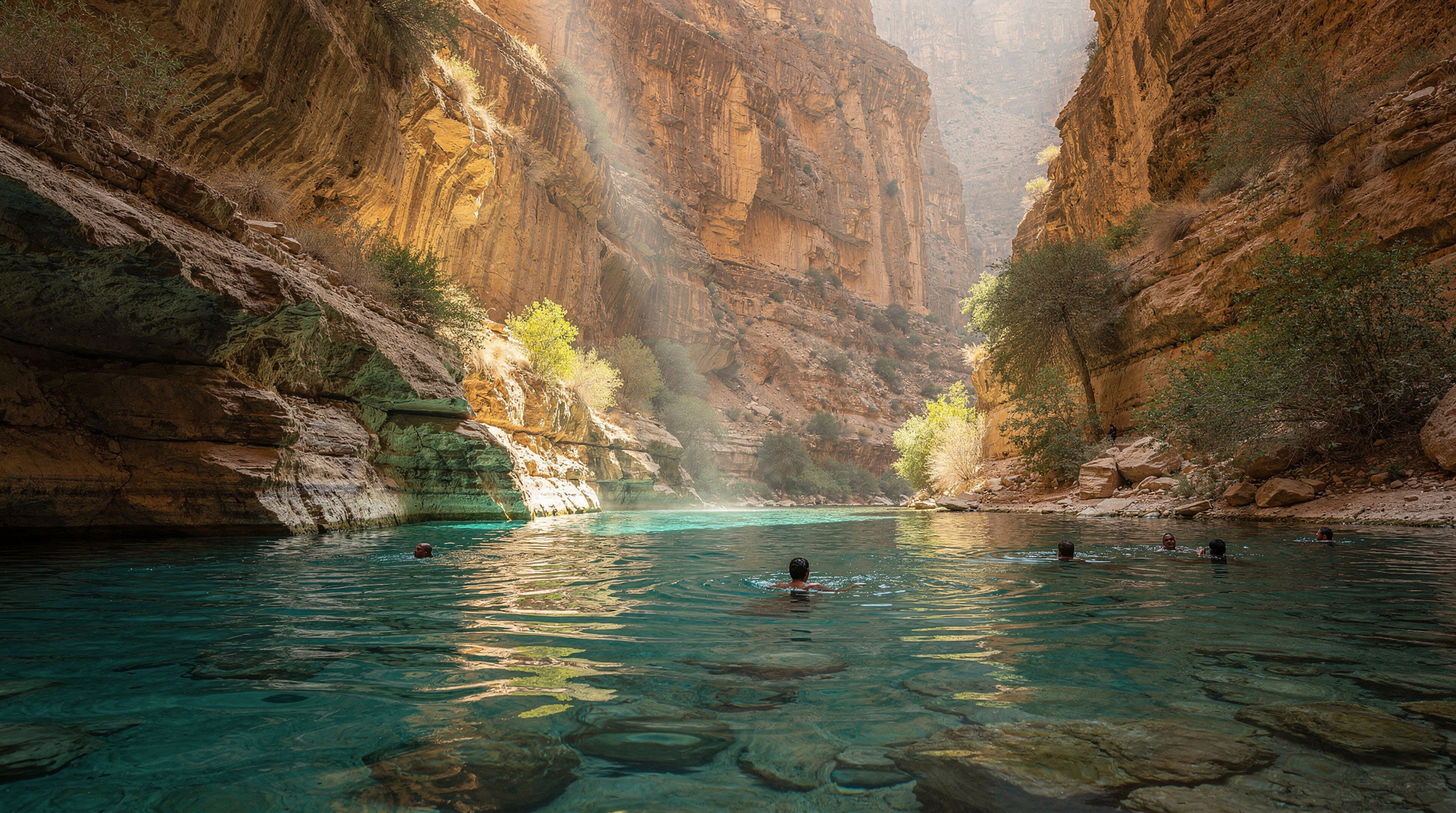
Wadi Tiwi is longer, wilder, and in many ways more visually extraordinary than its famous neighbour. The canyon road climbs for 17 km through a series of inhabited villages clinging to terraced mountainsides, past falaj channels, date palm plantations, and viewpoints that look down into pools of water the colour of glacial lakes. On a typical weekday, you might share the wadi with fewer than twenty other visitors.
This guide covers how to explore Wadi Tiwi: the road route through the canyon, the hiking options, the swimming pools, and how to combine it with neighbouring Wadi Shab and Bimmah Sinkhole for a full eastern Oman day.
At a glance
| Where | Eastern Hajar mountains, 2 km north of Wadi Shab, around 142 km south of Muscat on Route 17 |
| Cost | Free to enter on foot; no car park or entry fee at the lower canyon |
| Time needed | 2-3 hours for the lower canyon walk; a full day if driving the upper 17 km road by 4WD |
| Getting there | Self-drive (2WD reaches the lower canyon, 4WD required beyond 6 km) or a specialist guided tour from Muscat |
| Best time | October to April, with November-March offering the clearest water and light |
Why Wadi Tiwi Is Special
The defining characteristic of Wadi Tiwi is that it is a living landscape. Unlike some wadis that function primarily as tourist destinations, Wadi Tiwi is a inhabited valley with working farms, mosque minarets visible above the date palms, children walking home from school, and the sound of water running through ancient falaj channels alongside the road.
The terraces carved into the canyon walls over generations are still actively cultivated. Farmers grow limes, tomatoes, and bananas in micro-plots irrigated by gravity-fed water channels. The contrast between the lush green terraces and the sheer white limestone cliffs behind them is one of the most photogenic scenes in eastern Oman.
The wadi floor pools, fed by natural springs, stay remarkably clear and cool. Unlike Wadi Shab where the swimming pools see hundreds of visitors daily, Wadi Tiwi’s equivalent pools are sometimes completely empty on weekday mornings.
The Canyon Road: Driving Into Wadi Tiwi
A paved road enters the wadi from the coastal highway and follows the canyon floor upstream. The first 5-6 km are accessible in a standard 2WD vehicle. Beyond the village of Tiwi, the road becomes rougher and steeper, requiring a 4WD for safe passage through to the upper canyon.
What you can see in a 2WD:
- The lower canyon walls and initial pools
- The villages of Tiwi and Mibam at the lower canyon entrance
- Stunning views from pulloffs along the first stretch of road
What requires 4WD:
- The upper canyon villages of Wiriyah and Al Suwayh
- The most dramatic viewpoints above the valley floor
- The deep upper pools accessible only by 4WD track plus short hike
The road surface in the upper canyon involves loose gravel, steep inclines and narrow sections with significant drop-offs. Do not attempt this in a standard car — it is dangerous and vehicles regularly get into trouble on the descent.
Hiking Options in Wadi Tiwi
Lower Wadi Walk (no 4WD needed)
Park at the small layby near the canyon entrance (coordinates approximately 22.756°N, 59.219°E) and walk the wadi floor upstream from here. The path follows the water course and passes through palm plantations, over smooth flood-polished rock, and along the base of increasingly tall canyon walls.
The first swimming pool is roughly 20 minutes on foot from this parking area — a natural basin of turquoise water in a sandstone bowl. The path continues beyond to a second and third pool, each progressively more secluded.
Distance: 2-4 km depending on how far you push upstream
Duration: 1.5 to 3 hours
Difficulty: Easy to moderate, with some scrambling on wet rocks near the pools
Upper Canyon Exploration (4WD drive plus short hikes)
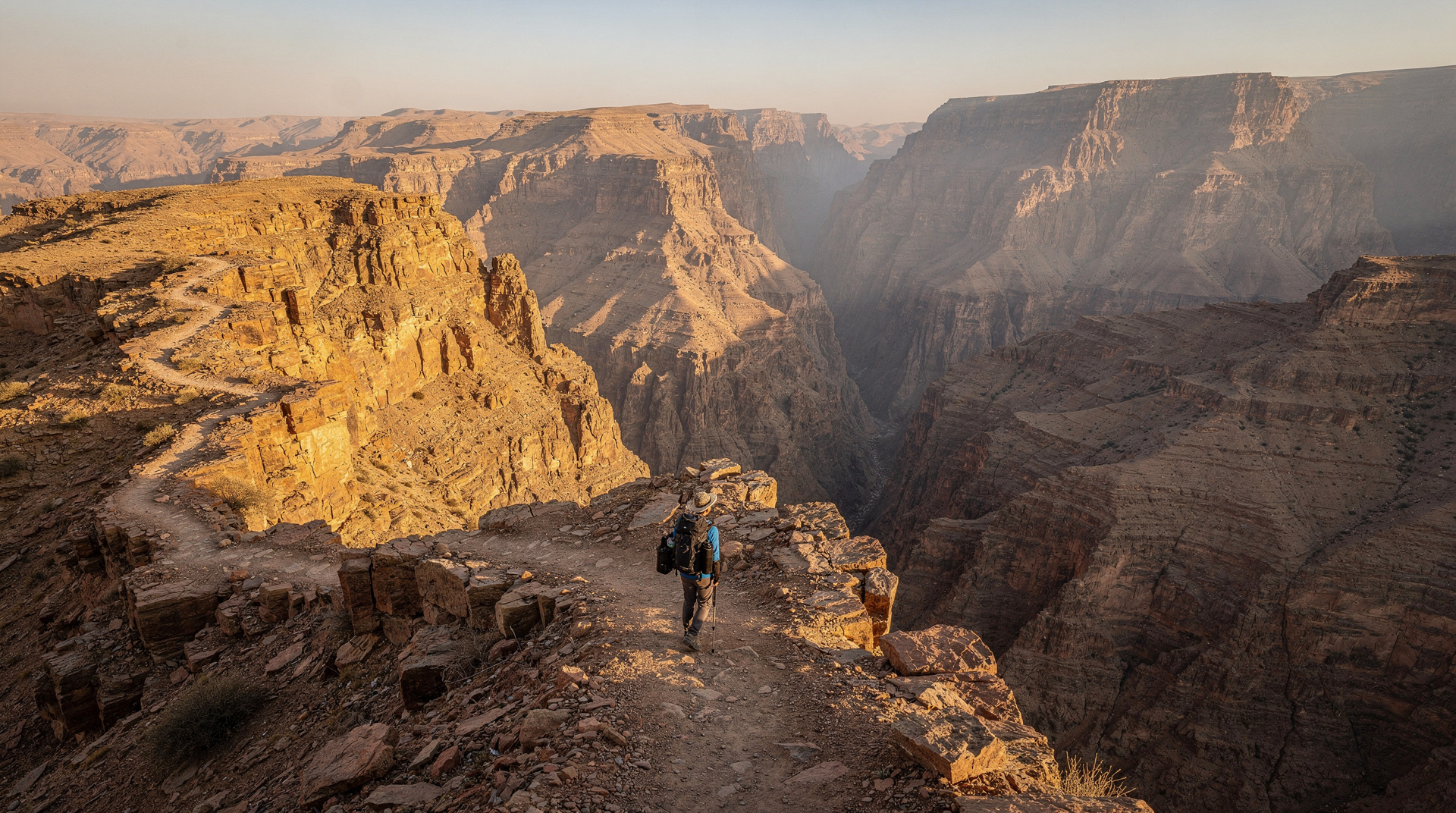
With a 4WD, drive the full 17 km of the wadi road. Stop at the viewpoints overlooking the valley — the perspective from above reveals the full scale of the terracing system and the brilliant turquoise of the wadi pools far below.
Several short trails lead down from the road to pools and falaj channels in the middle section of the canyon. Local knowledge of the best access points is helpful here — drivers hired locally or guided tour drivers know the best stops.
The road eventually reaches a village at the upper canyon where the valley narrows into near-vertical limestone walls. The turnaround point offers some of the most dramatic rock scenery in eastern Oman.
Village Trail Between Mibam and Wiriyah
A footpath connects the villages of Mibam (lower canyon) with Wiriyah (mid-canyon), following the ancient route used before the road was built. This trail passes through actively farmed terraces, past numerous falaj channels, and through two small hamlets. The route is approximately 4 km one way and takes 2-3 hours.
This is not a marked tourist trail — it is a working agricultural path. Treat it accordingly: stay on established paths, do not enter private gardens, and greet locals with the customary “As-salamu alaykum.”
The Swimming Pools
Wadi Tiwi’s pools are fed by natural springs and seasonal flooding. The water quality is exceptional — clearer even than Wadi Shab’s famous pools on most days, partly because the lower visitor volume means less disturbance of the pool floor sediment.
The main accessible pools are in the lower canyon, reachable on foot without a 4WD. Water temperature stays between 20-23°C year-round. Depth varies by pool — the lower pool is around 2 metres deep at the centre; the upper pools are shallower.
Swimming note: This is a natural environment with no lifeguards. Assess depth before diving. Rocky outcrops beneath the surface can be concealed by the colour of the water. Wade in from the shallow edges before committing to deeper areas.
Combining Wadi Tiwi With Wadi Shab and Bimmah
The three sites sit within 15 km of each other along the coastal highway, making them natural companions for a single day of eastern Oman exploration.
A logical order:
-
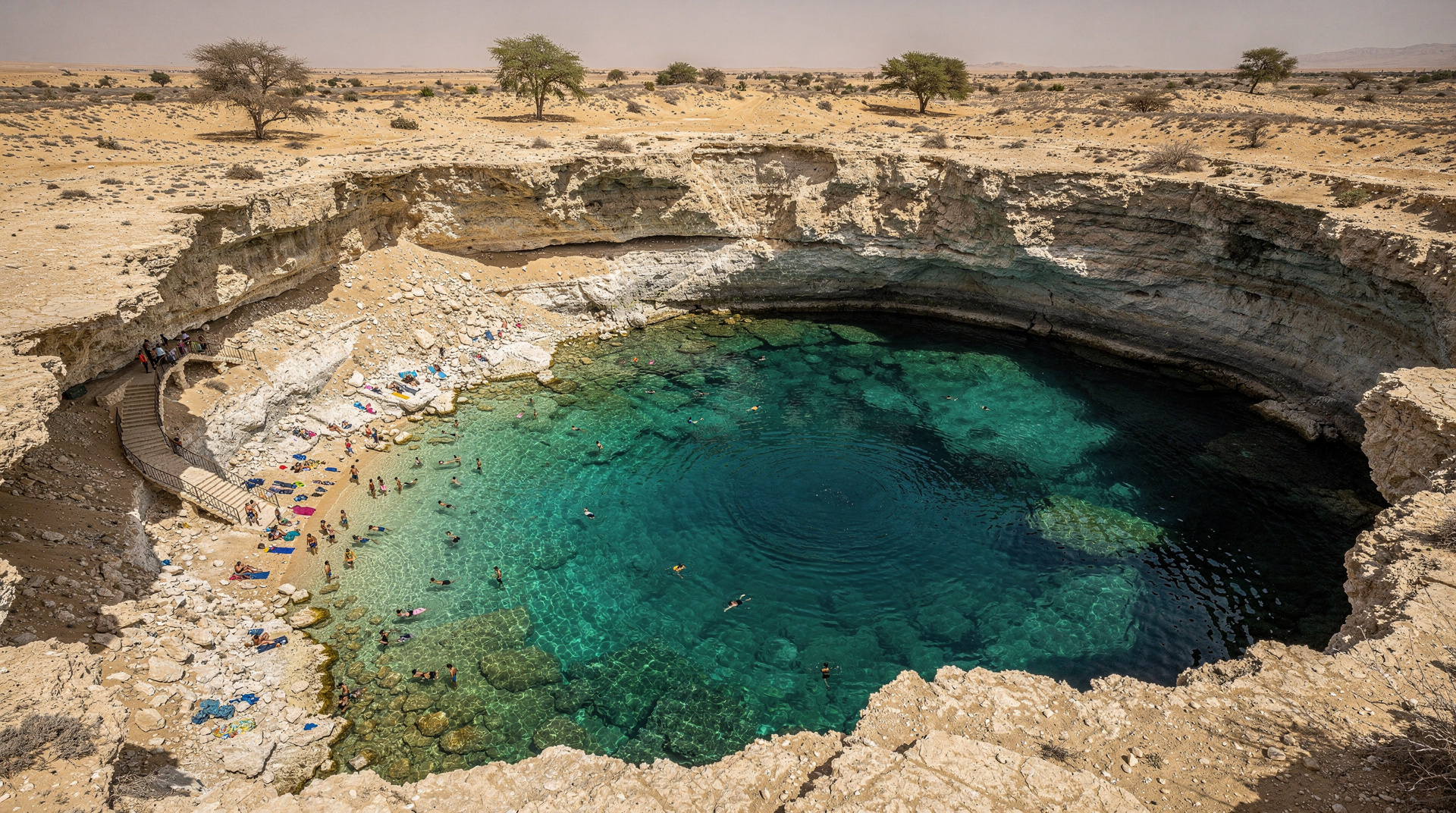
Bimmah Sinkhole (9 km north of Wadi Shab car park) — 20-30 minutes. Visit early before tour groups arrive. Full details in the Bimmah Sinkhole guide.
-
Wadi Tiwi (2 km north of Wadi Shab) — 2-3 hours for the lower canyon walk and swimming.
-
Wadi Shab — afternoon, when morning tour groups have largely departed. Hike to the main pools and cave if energy allows.
This order works particularly well because Bimmah sees the biggest morning crowds. Visiting Wadi Tiwi first lets the Bimmah crowds clear, and then Wadi Shab in the afternoon gives better light for canyon photography.
The Muscat to Wadi Tiwi, Fins Beach and Bimmah Sinkhole adventure tour covers all three highlights of the eastern coastal area in a single guided day trip. This tour also includes Fins Beach, one of Oman’s finest stretches of coastline just south of Wadi Shab. Cost: from around 40 OMR per person from Muscat.
If you are building a broader eastern Oman itinerary, consider adding the Wadi Bani Khalid year-round oasis as a second-day stop before heading into the Wahiba Sands. The Jebel Shams Balcony Walk makes a compelling mountain counterpoint to the coastal wadi experiences. Underground contrast is provided by the Al Hoota Cave with its blind fish and stalactite chambers near Nizwa.
For the dramatic north, the Jebel Harim mountain safari offers a completely different mountain landscape in Musandam. The Jebel Akhdar Green Mountain rose gardens and terraced villages represent inland Oman at its most serene. And the Bimmah Sinkhole, just 2 km north of Wadi Tiwi on the highway, is the most dramatic and concentrated natural water feature on the coast.
Planning a Complete Eastern Coast Day
Wadi Tiwi sits at the heart of the most rewarding single-day coastal drive in Oman. Within 15 km along Route 17, you have access to five distinct natural and cultural highlights that can be combined into a highly satisfying long day from Muscat.
A suggested order starting from Muscat:
- 7am: Arrive at the Bimmah Sinkhole before tour groups arrive
- 8:30am: Drive 13 km south to Wadi Tiwi
- 9am-noon: Lower canyon walk and swimming (3 hours)
- 12:30pm: Drive 2 km south to Wadi Shab car park
- 1-5pm: Hike to Wadi Shab pools and cave (full details in the Wadi Shab complete guide)
- 5:30pm: Drive north, stop at Fins Beach for sunset
- 8pm: Return to Muscat
This is a long day (approximately 14 hours) but covers an extraordinary range of experiences. For a more relaxed version, stay overnight in Sur or Quriyat and split the day into two.
Fins Beach: The Bonus Stop
Just 3 km south of the Wadi Shab car park, Fins Beach is one of the most beautiful and least-visited beaches in Oman. A crescent of pale sand sits at the foot of dramatic limestone cliffs, accessible via a rough track from the highway. The snorkelling around the rocky headlands is excellent, with clear water and abundant reef fish.
Fins Beach has no facilities whatsoever — no toilets, no food, no shade structures. Bring everything you need. This contributes to its pristine state.
Getting There
By car from Muscat
Follow Route 17 south toward Sur. After the mountain tunnels and Quriyat, continue south. Wadi Tiwi is approximately 142 km from Muscat — about 2 hours 10 minutes. The wadi entrance is clearly signposted from the highway.
For the upper canyon, a 4WD is mandatory beyond the 6 km mark. If driving a standard car, park at the lower canyon entrance and explore on foot.
By organised tour
Most tours in this region focus on Wadi Shab with Bimmah Sinkhole as the standard combination. Wadi Tiwi is covered by specialist operators who target visitors seeking the less-crowded alternative. The Wadi Tiwi adventure tour is the most comprehensive guided option, pairing the wadi with Fins Beach and Bimmah Sinkhole.
Best Time to Visit
October to April — ideal temperatures for hiking and comfortable swimming.
November to March — the clearest water and best light for photography.
Summer (May-September) — the shade deep in the canyon keeps temperatures more bearable than open desert, and the pools are wonderfully cooling. The main risk is flash flooding during the September-October transition.
Avoid: During or within 24 hours of significant rainfall anywhere in the Eastern Hajar range. Wadi Tiwi is a deep canyon and water levels can rise very quickly.
What to Bring
Wadi Tiwi demands even more self-sufficiency than Wadi Shab, since the visitor infrastructure is essentially zero:
- Water: 2-3 litres per person minimum
- All food and snacks
- Water shoes — the wadi floor is rocky and slippery
- Dry bag for phone and camera near the pools
- Cash (there are no card payment facilities anywhere near the wadi)
- First aid kit
- Downloaded offline maps (Google Maps and Maps.me both cover the road)
Local Etiquette
Wadi Tiwi is a working community. More than at Wadi Shab, you are a guest in a place where people live and farm. Key points:
- Ask before photographing local people or their homes
- Do not enter or disturb farmland or falaj channels
- Drive slowly through villages — children and animals use the same road
- Keep noise low, especially near mosques at prayer times
- Do not swim in areas that are obviously used for irrigation water supply
The warmth and hospitality of Oman’s mountain communities is genuine — a respectful approach will almost always be met with friendliness, tea offers, and local knowledge about the best pools further up the valley.
The Terraced Agriculture of Wadi Tiwi
The most visually compelling aspect of Wadi Tiwi — beyond the turquoise pools and limestone cliffs — is the agricultural terracing that covers virtually every available slope in the inhabited sections of the canyon. Generations of farmers built retaining walls of dry stone across steep hillsides to create flat planting areas, then connected each terrace to the wadi’s irrigation system via small gravity channels.
The crops grown here reflect the wadi’s microclimate: cool enough at altitude for crops that struggle in coastal heat, but sheltered from the harshest mountain cold. Limes are the primary commercial crop — Oman’s lime orchards are famous regionally and Wadi Tiwi limes have a concentrated acidity prized by cooks throughout the Gulf. You will smell them before you see them in harvest season (October-January), the whole canyon carrying a faint citrus sharpness.
Tomatoes, aubergines, and various gourds fill the smaller terrace plots closer to the village houses. Banana trees grow in the sheltered lower sections near the main water flow. Date palms fill the wadi floor itself, growing in the gravel where the root system can access the shallow water table year-round.
The terracing represents a massive collective investment of human labour — one that took not years but generations to accumulate. Each stone wall was lifted by hand, each channel carved by hand tools. The maintenance of this system is ongoing; a single flash flood can damage sections of terrace wall that took years to build. Community maintenance of the terracing and irrigation system is a social obligation as much as a practical necessity — families whose plots benefit from a shared channel are obligated to contribute labour to its upkeep.
Walking slowly through this working landscape — watching a farmer redirect water from a channel to a specific terrace plot, or seeing the evidence of recent wall repair where a flood scoured the hillside — connects you to agricultural traditions that pre-date Islam, pre-date the written historical record of this region, and continue today with minimal mechanisation.
Planning a Complete Eastern Oman Loop
If you are combining Wadi Tiwi with other eastern Oman highlights, the most efficient structure from Muscat is a loop that avoids backtracking:
Going south (coastal highway): Start with the Bimmah Sinkhole, then Wadi Tiwi, then Wadi Shab. Continue south to Sur.
From Sur (inland highway): Drive to Wadi Bani Khalid for swimming. Continue to the Wahiba Sands for a desert camp night.
Return to Muscat (inland): Drive through the desert interior via Ibra and Al Qabil. Optional stop at Jebel Akhdar or Al Hoota Cave if time permits.
This loop takes 3 comfortable days and covers the full range of eastern and central Oman’s landscapes without any significant backtracking.
Rock Scenery and Geology
Wadi Tiwi cuts through the same Eastern Hajar limestone that defines the geology of the entire coastal mountain belt. But the canyon section of Wadi Tiwi — particularly the middle reaches where the walls press closest — reveals the limestone in some of its most dramatic forms.
The canyon walls here are almost vertical, rising 200-400 metres from the wadi floor to the plateau rim. The rock is pale cream to honey-coloured in dry conditions, deepening to gold and amber when the canyon walls catch morning or evening light. At the waterline and in sections that are seasonally submerged, the rock takes on a distinctive rust-orange patina from iron minerals deposited by the flowing water.
Look closely at the canyon walls and you will see the layering that reflects the geological history: alternating bands of harder and softer limestone, each band representing a different period of ancient seabed deposition. The harder bands jut slightly from the wall surface where erosion has picked away the softer rock around them. In some sections, these protruding layers create natural ledges that local people have historically used as paths between villages — essentially a pre-road transport system written into the geology itself.
In the upper canyon, where the road climbs toward the highest villages, you enter a different rock type — a darker, more metamorphic limestone that indicates greater depth of burial in the ancient ocean floor. This rock weathers differently, breaking into sharp angular fragments rather than the smooth rounded shapes of the lower canyon. The views from the upper road across this terrain give a powerful sense of the scale and age of the geological forces that built these mountains.
Who Should Choose Wadi Tiwi Over Wadi Shab
Wadi Tiwi rewards travellers who value solitude and a working landscape over a headline attraction. If your priority is the famous cave-swim, go to Wadi Shab instead — Wadi Tiwi has no equivalent. But if you have already done Wadi Shab, are visiting in peak season and want to avoid the crowds, or simply prefer villages and terraced farmland to a well-trodden tourist trail, Wadi Tiwi is the better choice. It also pairs naturally with a broader look at Oman’s canyon country in the guide comparing Oman’s wadis and the wadi swimming guide, both useful before deciding which wadis to prioritise on a short trip.
For those road-tripping the eastern coast independently, the car rental guide and scenic drives guide cover the practicalities of self-driving Route 17 and beyond, including what to expect on unpaved sections like the upper Wadi Tiwi road.
Accommodation Near Wadi Tiwi
There is no accommodation at or immediately near Wadi Tiwi. The nearest options are:
Sur (75 km south): The regional hub with hotels from 25-60 OMR per night. A practical base for multi-day eastern Oman exploration combining the wadis, Ras al Jinz turtle reserve, and Sur’s own dhow-building heritage.
Quriyat (40 km north): A coastal town with basic accommodation and good seafood restaurants. Good for an early-morning start.
Muscat (140 km north): Most visitors do this as a day trip from the capital.
Comparison: Wadi Tiwi vs Wadi Shab
| Feature | Wadi Tiwi | Wadi Shab |
|---|---|---|
| Crowds | Very low | High (peak season) |
| Cave waterfall | No | Yes |
| 4WD needed | For upper canyon | No |
| Swimming pools | Excellent, less visited | Excellent, busy |
| Village character | Authentic working communities | Limited — more tourist-oriented |
| Length of exploration | 17 km canyon road | 4-5 km hike |
| Difficulty | Easy lower section, moderate upper | Moderate overall |
Frequently asked questions about Wadi Tiwi: Oman’s Hidden Canyon Alternative to Wadi Shab
Do you need a 4WD for Wadi Tiwi?
For the lower canyon only — no. A standard car can reach the first couple of kilometres and parking areas. For the upper canyon villages and best viewpoints, a 4WD is essential. The road deteriorates significantly after the 6 km mark and has steep, loose sections that are genuinely dangerous in a 2WD.
Are there swimming pools in Wadi Tiwi?
Yes. Natural pools fed by underground springs and seasonal flooding are found throughout the lower and middle canyon. The most accessible are within 20-30 minutes on foot from the highway. The water is exceptionally clear and cool year-round.
Is Wadi Tiwi suitable for families?
The lower canyon walk is suitable for families with children comfortable on uneven terrain. The rocky wadi floor requires care and water shoes are essential for safety. The pools have shallow entry points that work well for children. The upper canyon driving route with viewpoints is suitable for all ages.
How crowded is Wadi Tiwi compared to Wadi Shab?
On a typical day, Wadi Tiwi sees perhaps 5-10% of the visitors that Wadi Shab receives. On a busy weekend at Wadi Shab you might share the main pools with 200+ people. At Wadi Tiwi on the same day, you might have the equivalent pools entirely to yourself.
Can you combine Wadi Tiwi and Wadi Shab in one day?
Yes, very comfortably. They are 2 km apart. Allow 3 hours for Wadi Tiwi’s lower canyon exploration and 4-5 hours for Wadi Shab including the cave swim. Combined with a brief Bimmah Sinkhole stop, a 6am departure from Muscat gets you back by 7pm.
Is there food available near Wadi Tiwi?
No. There are no restaurants, cafes or food vendors at or near the wadi. A small general store is in the town of Tiwi at the canyon entrance but its opening hours are unpredictable. Bring all food and water from Muscat or Quriyat.
Which is better for a first visit, Wadi Tiwi or Wadi Shab?
For a first-time visitor with only one wadi day, Wadi Shab is generally the better single choice because of the cave-swim experience unique to that canyon. Wadi Tiwi is the natural second visit — either later on the same trip or as the highlight for returning visitors who have already done Wadi Shab.
Do I need a guide for Wadi Tiwi?
Not for the lower canyon walk, which follows an obvious wadi-floor path. A guide becomes useful for the upper canyon 4WD route, where local knowledge of the best viewpoints and pool access points saves significant time, and for the Mibam-Wiriyah village trail, where a guide adds cultural context.