Jebel Shams — Oman's Grand Canyon & Highest Peak
Explore Jebel Shams, Oman's highest mountain and the Grand Canyon of Arabia — dramatic gorge views, the Balcony Walk trail, and unforgettable sunrises.
Quick facts
- Best time to visit
- October – March (avoid July–August heat)
- Days needed
- 1–2 days
- Getting there
- 3 hrs from Muscat, 4WD required
- Budget per day
- OMR 20–35 (camping) / OMR 50–90 (chalet)
Where Arabia Drops into the Abyss
Jebel Shams — Mountain of the Sun — earns its name not from warmth but from perspective. At 3,009 metres, it is the highest point in Oman and the entire Arabian Peninsula’s eastern ranges. But what draws travellers from across the world is not the summit itself. It is Wadi Ghul: a gorge that drops roughly 1,000 metres into the earth with a vertiginous drama that has earned it the title of the Grand Canyon of Arabia.
The comparison to the American Grand Canyon is more than marketing. The scale is genuinely comparable in terms of the visual shock it delivers — the sudden appearance of an immense void, the canyon walls striated with hundreds of millions of years of geological time, the silence broken only by wind and the occasional wheeling eagle. Oman’s version lacks the tourist infrastructure of its American counterpart, which is precisely what makes it worth the drive.
Jebel Shams sits in the Ad-Dakhiliyah governorate, roughly 240 kilometres from Muscat and about 75 kilometres northwest of Nizwa. It is typically visited as part of a wider Al Hajar Mountains circuit, often combined with Jebel Akhdar and a day in Nizwa.
| At a glance | |
|---|---|
| Where | Ad-Dakhiliyah governorate, around 240km from Muscat, near Al Hamra |
| Cost | Around OMR 20-35/day camping; OMR 50-90/night for a resort chalet |
| Time needed | 1-2 days; overnight on the plateau is needed to catch sunrise at the rim |
| Getting there | 4WD required for the final ascent, around 3 hrs from Muscat |
| Best time | October to March; avoid the July-August heat |
Getting There
As with Jebel Akhdar, a 4WD vehicle is essential. The final ascent to the gorge rim follows a rocky mountain road that would defeat a standard car. From Muscat, the drive takes approximately three hours via the Muscat-Nizwa expressway, then northwest through Al Hamra toward the mountain.
Al Hamra itself is worth a brief stop — its traditional mud-brick architecture is among the best-preserved in Oman, and the Bait Al Safah living museum provides an absorbing glimpse into traditional Omani domestic life (entry OMR 2 in 2026).
If you prefer not to drive, guided day trips from Muscat are available. This Jebel Shams day trip from Muscat covers the eight-hour return journey with an English-speaking guide and stops at the key viewpoints.
Day tours from Al Hamra are also available — this Jebel Shams day trip departing Al Hamra is ideal for travellers already based in the Nizwa area, and typically costs OMR 30–45 per person in 2026.
For a broader tour that pairs the mountain with a curated selection of Oman’s interior highlights, the Jebel Shams and Treasures of the Interior combines the gorge with the historic towns and landscapes of the Ad-Dakhiliyah region in a single guided day from Muscat.
For those wanting to experience the mountain properly without a rushed day return, the From Muscat: Nizwa, Al Hamra and Jebel Shams with Night Stay tour includes an overnight stay on the mountain — the only way to experience sunrise at the gorge rim, which is Jebel Shams at its most extraordinary.
The Balcony Walk: W4 Trail
The Balcony Walk is one of Oman’s most celebrated hikes. Officially designated trail W4, it follows a narrow ledge path along the northern wall of Wadi Ghul, passing above a dramatically situated abandoned village and offering continuous views directly down into the gorge below.
The trail runs approximately 5.5 kilometres from the Jebel Shams Resort car park to a designated turning point, with the option to continue to an abandoned village for those who want a longer outing. The total round-trip distance is 11 kilometres, with around 350 metres of elevation change. Allow four to five hours at a comfortable pace.
The path itself is not technically difficult — no ropes, no scrambling, no specialist equipment needed. But it does hug the edge of a sheer cliff for sustained stretches, and a fall would be fatal. Stay on the marked path, avoid the edge when windy (the gusts here can be sudden and strong), and do not attempt the trail in wet or icy conditions, which occasionally occur in January and February.
The section that passes above the ghost village of Sab Bani Khamis is the trail’s emotional peak. The abandoned stone houses cling to the cliff face hundreds of metres below the rim, connected to nothing apparent — their inhabitants are believed to have accessed them via rope ladders and paths that have since eroded. The visual effect of a lived community suspended above an abyss is deeply affecting.
Start the walk at sunrise for the best light, the coolest temperatures, and the greatest chance of having the viewpoints to yourself.
The Gorge Views and Summit Road
Even without walking the Balcony Walk, the drive along the rim of Wadi Ghul delivers extraordinary viewpoints accessible from the car. Several marked pulloffs allow you to step out and look straight down into the canyon from positions where the scale becomes visceral rather than abstract.
The road continues past the resort to a high plateau used as a telecommunications relay station. This upper section, at around 2,800 metres, offers a 360-degree panorama on clear days that takes in the Al Hajar range stretching to the horizon in every direction, with the Wahiba Sands visible as a red haze to the east on exceptional days.
The summit itself (3,009m) is on military land and access is restricted, but the approach road and the relay station plateau provide everything a visitor needs in terms of views and mountain atmosphere.
Sunrise and Night Sky Photography
Jebel Shams is one of Oman’s premier locations for both sunrise photography and stargazing. The altitude and distance from significant light pollution combine to create conditions that are rare in the Arabian Peninsula.
For sunrise, position yourself at the main gorge viewpoint near the resort before first light — around 5:45–6:15am depending on the month. As the sun clears the eastern mountains, the western canyon walls ignite in shades of amber and ochre while the gorge floor remains in deep shadow. The contrast lasts only fifteen to twenty minutes at its most intense, so arrive early.
For astrophotography, the plateau above 2,500 metres is exceptional. The Milky Way is clearly visible with the naked eye from October through March on moonless nights. A wide-angle lens, a tripod, and a remote shutter release are sufficient to produce images of professional quality. The Jebel Shams Resort and the nearby campsite both have minimal artificial lighting, which helps preserve the darkness.
Accommodation: Camping and Chalets
Jebel Shams offers a pleasing range of accommodation, from wild camping on the plateau to comfortable resort chalets with canyon views.
The Jebel Shams Resort operates a collection of stone chalets positioned directly above the gorge. Standard chalets run from OMR 55–80 per night in 2026, while the premium rim-facing units with private terraces cost OMR 90–130. The on-site restaurant serves a reasonable Omani-inflected menu — the machboos (spiced rice and meat) is reliable, and the sunset dining terrace is arguably the best meal experience on the mountain. Book well ahead for peak-season weekends.
Sama Heights Resort, slightly lower on the approach road, offers newer facilities at comparable prices with an emphasis on adventure packages including guided hikes and via ferrata experiences (OMR 60–100 per chalet).
Wild camping is permitted on the plateau in designated areas, and is extremely popular with Omani families especially on winter weekends. Facilities are limited to basic toilet blocks at the main parking area. Bring all food and water — there are no shops above Al Hamra. Temperatures at the summit can fall to near zero in January, so a quality sleeping bag rated to at least -5 degrees Celsius is essential.
Al Hamra and Misfat Al Abriyyin
Two villages at the base of Jebel Shams deserve as much attention as the mountain itself.
Al Hamra is a ghost town in the most picturesque sense — its labyrinthine mud-brick old town has been largely abandoned since the 1970s as residents moved to modern housing, but the buildings remain standing and are open to respectful exploration. The Bait Al Safah museum, staffed by local women, demonstrates traditional crafts including bread-making, weaving, and basket work. Entry costs OMR 2 and the experience is one of Oman’s most authentic cultural encounters.
Misfat Al Abriyyin, seven kilometres from Al Hamra, is a living village set in a bowl of date palms and fruit terraces irrigated by ancient falaj channels. The village alley ways are narrow enough to touch both walls simultaneously. A resident watchman manages access for tourists and asks visitors to dress modestly and to stay on the marked paths through the plantations — OMR 1 donation is customary and helps maintain the site. The contrast between the tight organic architecture of the village and the vast mountain flanks above it makes for some of Oman’s most intimate photography.
Connecting Jebel Shams to the Wider Region
Jebel Shams pairs naturally with several nearby destinations. Nizwa (75km southeast) is the logical base for those not staying overnight on the mountain, and combining a morning at Nizwa Fort and souk with an afternoon drive up to Jebel Shams gives a full and varied day.
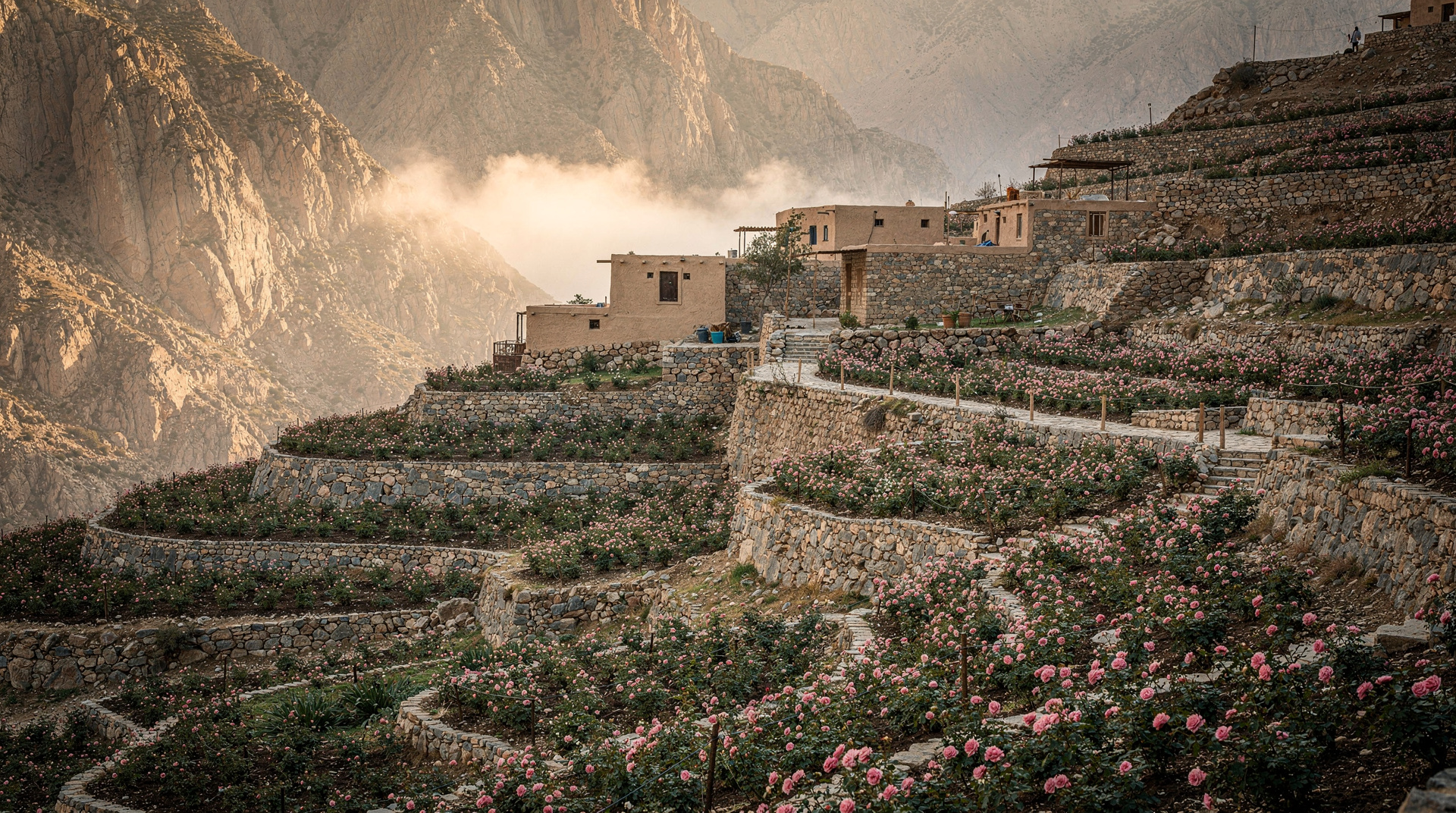
The two great mountains of the Ad-Dakhiliyah region complement each other well. Jebel Shams offers the grandest canyon scenery and the most dramatic single viewpoint in Oman; Jebel Akhdar provides rose gardens, village culture, and luxury resort options. Plan two to three days to do both justice — see the Ad-Dakhiliyah region guide for a suggested circuit itinerary.
For those combining this with eastern Oman, the one-week Oman road trip and the Muscat to Nizwa drive guide both include Jebel Shams as a key waypoint.
What to Pack
The temperature differential between Muscat and the Jebel Shams summit is significant year-round. Even in October, the plateau can be 15 degrees cooler than the coast. Pack:
A warm mid-layer and windproof shell jacket even for day visits. Walking boots with ankle support for the Balcony Walk (trail shoes are acceptable but not ideal). Sun protection including hat, sunglasses, and high-SPF cream — at altitude, UV exposure is more intense than at sea level. At least two litres of water per person for the Balcony Walk. A headtorch if arriving before sunrise.
Jebel Shams by Season
| Season | Conditions | Crowds | Notes |
|---|---|---|---|
| October-December | Mild days, cool nights, clear skies | Moderate, busier at weekends | Good all-round window, comfortable camping |
| January-February | Cold nights (2-5°C), occasional frost | Moderate | Best stargazing; pack a warm sleeping bag |
| March | Mild, warming | Moderate | Good hiking weather before the summer heat |
| April-June | Warming toward summer heat | Lower | Balcony Walk still comfortable in early morning |
| July-August | Hot even at altitude | Lowest for international visitors | Not recommended for hiking; some Omani weekend traffic |
Jebel Shams vs the Wahiba Sands: A Different Kind of Big Landscape
Travellers planning an interior Oman circuit sometimes weigh Jebel Shams against a detour to the Wahiba Sands. They are not substitutes for each other — Jebel Shams is a cool, high-altitude canyon experience, while Wahiba is a hot, low desert dune experience — but both require a 4WD and reward an overnight stay rather than a rushed pass-through. If your route allows it, doing Jebel Shams in the cooler morning hours and the desert dunes at golden hour on a different day gives you Oman’s two most photogenic landscapes without either feeling like an afterthought.
Practical Information for 2026
Entry: No fee to access the mountain road. Resort car parks are free. Camping in designated areas requires no permit but fires are prohibited.
Fuel: Fill up in Nizwa or Al Hamra — there are no petrol stations above the town.
Mobile signal: Intermittent on the plateau, very limited in the gorge.
Nearest hospital: Nizwa Hospital, approximately 90 minutes from the summit car park.
Frequently asked questions about Jebel Shams — Oman’s Grand Canyon & Highest Peak
Is Jebel Shams the same as Jebel Akhdar?
No — they are two separate mountains in the same Al Hajar range, about 75 kilometres apart. Jebel Shams (3,009m) is Oman’s highest peak and is famous primarily for the Wadi Ghul gorge, known as the Grand Canyon of Arabia. Jebel Akhdar (2,980m) is famous for its rose gardens, terraced villages, and luxury resorts. Both require a 4WD to visit and are commonly combined in a two-to-three-day Al Hajar Mountains circuit.
How difficult is the Balcony Walk on Jebel Shams?
The W4 Balcony Walk is moderate in terms of fitness demands — it covers around 11 kilometres return with 350 metres of elevation change and takes four to five hours at a steady pace. The challenge is psychological rather than technical: the path follows the edge of a cliff above a 1,000-metre drop for extended stretches. No ropes or specialist equipment are needed, but a head for heights is essential. Appropriate footwear (boots or trail shoes with grip) is strongly recommended.
Can I visit Jebel Shams without a 4WD?
Technically, the road as far as Al Hamra and Misfat Al Abriyyin is accessible in a standard car. However, the final ascent to the gorge rim and the Balcony Walk trailhead requires a 4WD. The road becomes a rocky, steep mountain track after the village of Ghul. If you do not have a 4WD, a guided day tour from Muscat or Nizwa is your most practical option.
Is camping at Jebel Shams cold in winter?
Yes — it can be genuinely cold. January and February nights on the plateau regularly drop to 2–5 degrees Celsius, with occasional frost and very rare ice. A sleeping bag rated to -5 degrees Celsius is recommended for January and February camping. October through December and March are milder but still require a bag rated to at least 5 degrees. The elevation (around 2,000–2,800m in camping areas) means conditions are alpine rather than desert — dress and equip accordingly.
What is the best time of day to photograph the gorge?
Sunrise provides the most dramatic light, with the eastern sun striking the western canyon walls in intense amber and gold. The first 15–20 minutes after the sun clears the eastern ridge are the most photogenic. Late afternoon (around 4–5pm) is the second-best option. Midday light flattens the canyon’s depth and is the least interesting for photography. For Milky Way photography, aim for the new moon period between October and March.
Are there facilities at the Jebel Shams summit area?
Basic toilet facilities exist at the main car park near the Jebel Shams Resort. The resort itself has a restaurant and small shop. Beyond that, there are no facilities on the mountain — no fuel stations, no markets, no ATMs. Bring all food, water, and supplies from Nizwa or Al Hamra before beginning the ascent. Mobile signal is intermittent, so download offline maps (Maps.me or Google Maps offline) before leaving the lowlands.
Should I visit Jebel Shams or Jebel Akhdar first?
If you can only pick one, Jebel Shams gives the bigger single-view payoff for a shorter visit, while Jebel Akhdar suits a longer, slower stay with village culture and resort comfort. With two to three days, most travellers combine both via Nizwa as the connecting base.
Do I need a guide for the Balcony Walk?
No — the W4 trail is well-marked and can be walked independently by anyone comfortable with exposed heights. A guide is worthwhile if you want to extend beyond the marked turning point to the abandoned village, or if you’re combining the walk with wider trekking routes on the plateau.