7-Day Classic Oman: The Complete Northern Circuit
One Week Across Northern Oman
Seven days is the ideal amount of time to experience Oman’s northern region at a comfortable pace — enough to linger at the places that deserve it, skip nothing major, and still return home feeling rested rather than exhausted. This route forms a complete loop from Muscat, covering the interior mountain heartland, the vast Wahiba Desert, the dramatic coast of Sur, and the legendary Wadi Shab on the return.
Total driving: approximately 1,100 km over 6 driving days. The only road that requires a 4WD is the optional detour to Jebel Shams summit or down into Wadi Nakhr — the main itinerary route uses paved roads throughout. A standard SUV or saloon car handles all roads comfortably.
Route overview:
- Days 1–2: Muscat
- Day 3: Muscat — Nizwa (165 km)
- Day 4: Nizwa — Jebel Shams — back to Nizwa or onward to Bahla (200 km roundtrip)
- Day 5: Nizwa/Bahla — Wahiba Sands (150 km)
- Day 6: Wahiba Sands — Sur — Wadi Shab (190 km)
- Day 7: Wadi Shab — Muscat (150 km)
At a Glance
| Region covered | Muscat, Nizwa/interior, Jebel Shams, Wahiba Sands, Sur, Wadi Shab |
| Total driving | around 1,100 km over 6 driving days |
| Vehicle | standard SUV or saloon; 4WD only needed for the Jebel Shams summit/Wadi Nakhr detour |
| Rough cost | mid-range budget; see the day-by-day price notes below |
| Best time to go | October to April; January-February for the coolest mountain mornings |
| Getting there | fly into Muscat International Airport (MCT), collect a rental car on Day 1 |
For a shorter version of the same core route, see the 5-Day Oman Highlights.
Day 1: Muscat Arrival and Grand Mosque
Land in Muscat and collect your rental car. Car rental from the airport typically runs 18–30 OMR per day for a standard SUV; book at least two weeks ahead for best rates from companies like Europcar, Hertz, or local operator Mark Tours.
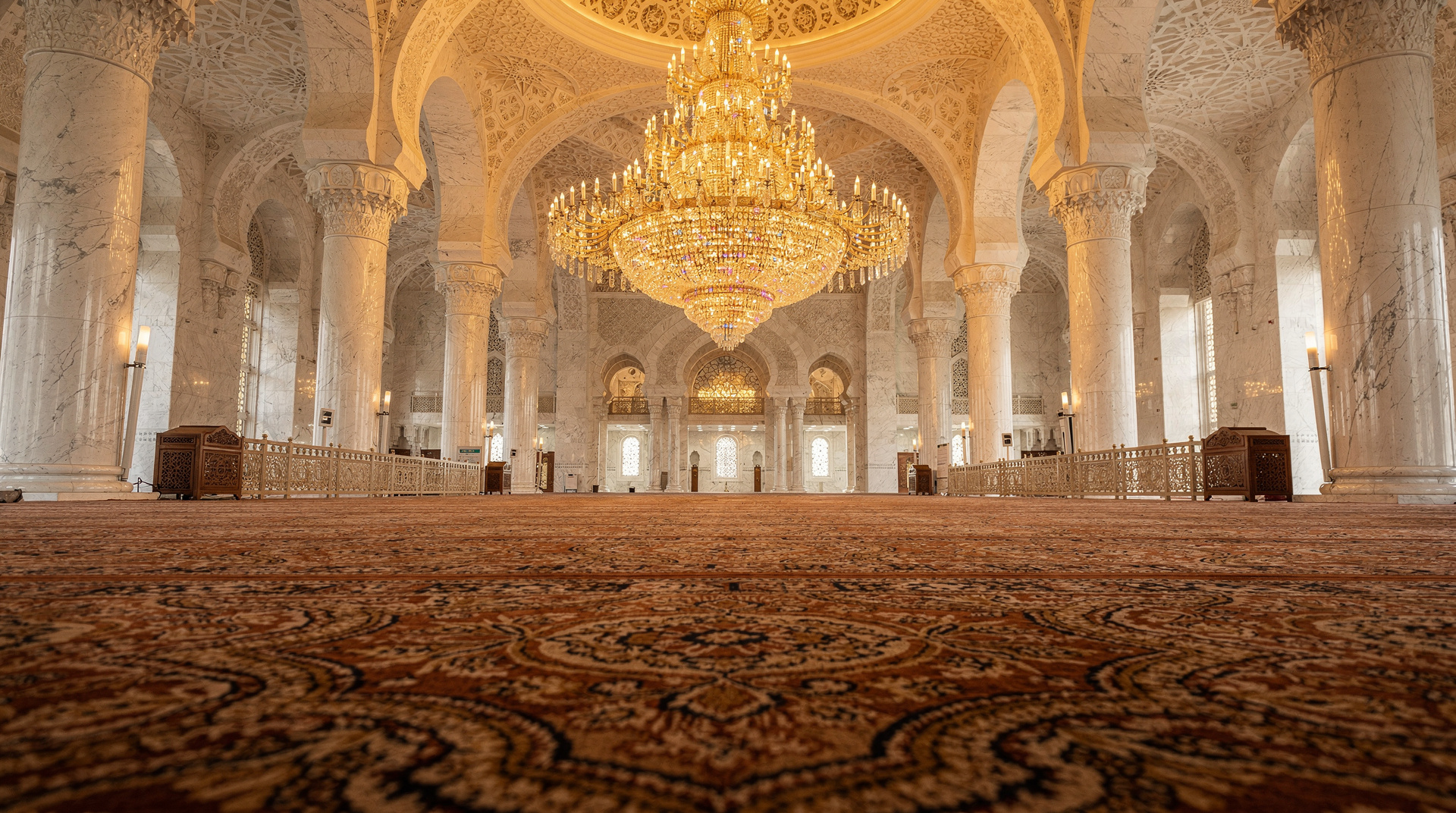
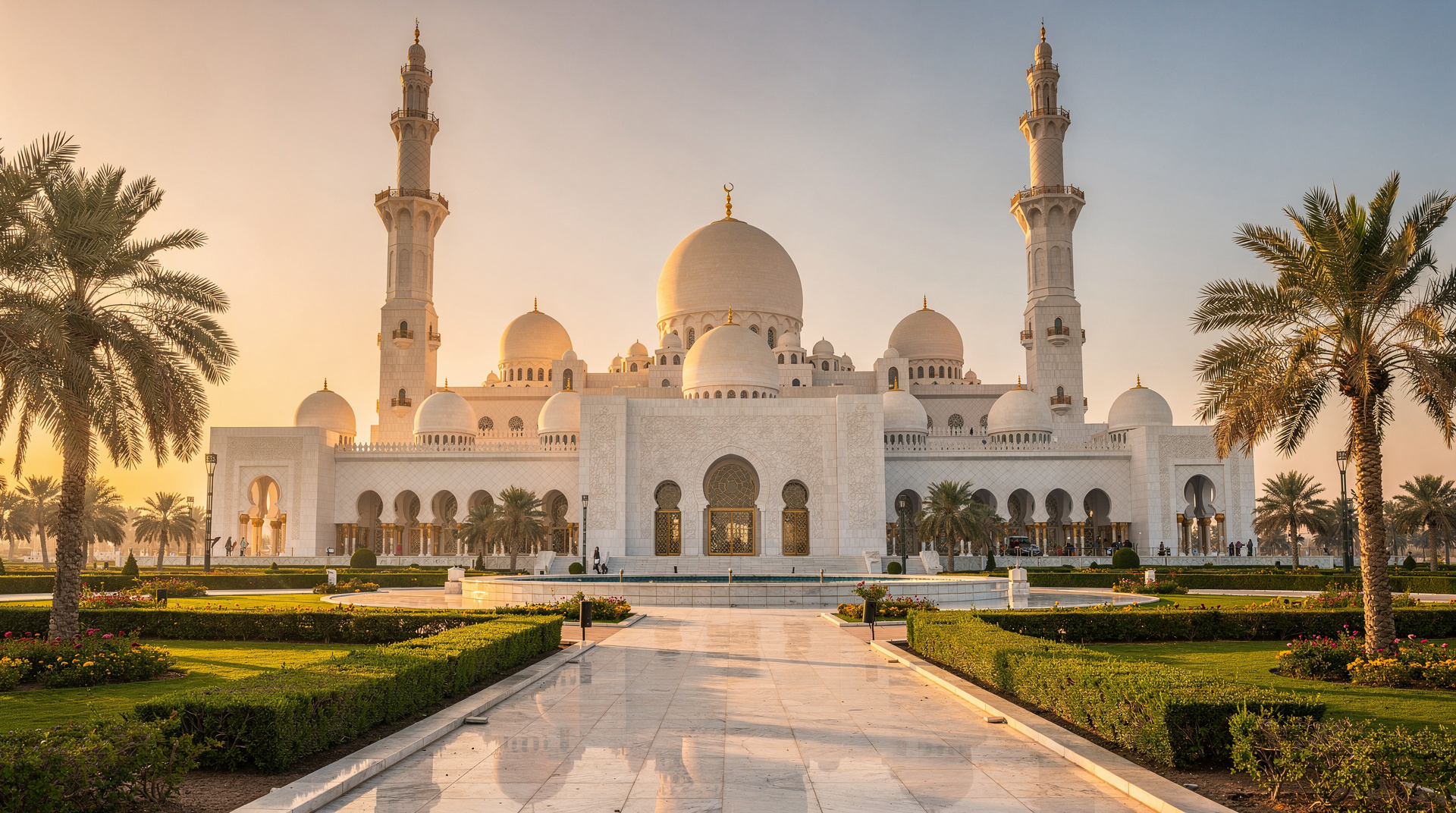
The afternoon is best spent at the Sultan Qaboos Grand Mosque (open to visitors until 11 AM, so if arriving in the morning go straight there). The mosque is Oman’s most important landmark — six years to build, completed in 2001, housing a Persian carpet of 1.7 billion hand-tied knots. Entry is free; dress modestly.
After checking into your hotel, take a taxi or drive to the Qurum district for dinner. Bait Al Luban serves exemplary Omani food — shuwa, mashuai (whole roasted kingfish with lemon rice), and harees — in a traditional setting for 8–15 OMR per person.
Stay: Crowne Plaza Muscat OCEC (45–65 OMR/night) or the excellent mid-range Golden Tulip Muscat (35–50 OMR/night).
Day 2: Muscat In Depth — Muttrah, Old City, Corniche
Spend a full second day in Muscat. Begin at Muttrah Corniche at 8 AM — the most photogenic waterfront in Oman, best in the soft morning light before the tour buses arrive. Walk the length of the Corniche (about 1.5 km) and then plunge into Muttrah Souq.
The souq is ancient, atmospheric, and genuinely commercial — stallholders sell frankincense resin, Omani silver, embroidered textiles, and handicrafts. The inner section beyond the tourist lane has hardware shops, tailors, and spice merchants serving Muscat’s Indian and Pakistani communities, a fascinating parallel world.
Continue to Al Alam Palace for the ceremonial facade photographs, then the adjacent Mirani and Jalali Forts viewpoint. The Bait Al Zubair Museum nearby (entry 5 OMR) has the finest collection of Omani costumes, weapons, and household artifacts in the country — allow 90 minutes.
For a comprehensive guided experience covering all these sites, book the Half-Day Muscat City Tour (from 20 USD per person, 2026).
Evening: the sunset dhow cruise from Muttrah harbour is a perfect way to close your Muscat days — gliding past the illuminated corniche with mountains behind as the sun drops into the Gulf of Oman. Book ahead: Sunset Dhow Cruise in Muscat (from 25 USD, 2026).
Day 3: Muscat to Nizwa — Forts and the Mountain Interior
Drive: Muscat to Nizwa (165 km, 2 hours)
Depart by 7:30 AM. Route 15 climbs through the Al Hajar mountains via the spectacular Wadi Al Kabir pass before descending into the Nizwa basin. The drive is one of the most scenic in Oman — mountain villages perched on ridges, ancient falaj irrigation channels carrying water across the plains, date palm plantations stretching into the haze.
Nizwa Fort
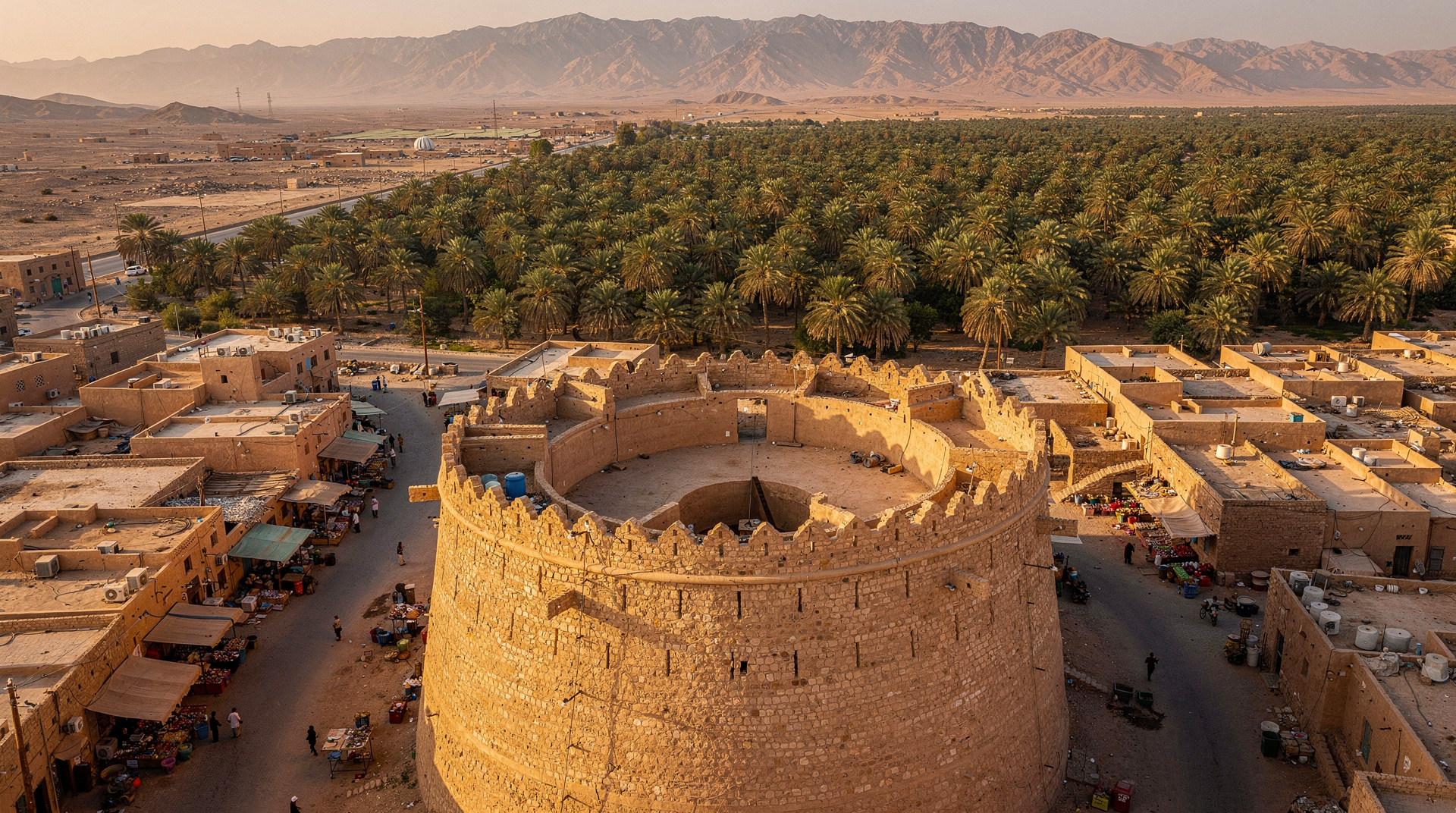
Nizwa Fort (entry 5 OMR) is the emblem of the Omani interior. The massive circular tower — 40 metres in diameter, built in the 1650s — houses an ingenious series of defensive traps including trapdoors, boiling oil channels, and false doors to confuse attackers. Climb to the roof for a panoramic view over the old city and the surrounding oasis.
Nizwa Souq
Walk five minutes from the fort to the souq. Friday mornings bring the cattle and goat market — an event straight from another century — but the souq is interesting any morning. Silver Khanjar daggers are the signature purchase here; expect to spend 40–200 OMR for a genuine handmade piece.
Afternoon: Jabreen Castle
Drive 30 minutes southwest to Jabreen Castle (entry 5 OMR), the most artistically extraordinary fortification in Oman. Built in 1670 as a royal palace and center of learning, its painted wooden ceilings, carved arches, and labyrinthine rooms are remarkably well preserved. The guided fort-tour from Muscat covers both Nizwa and Jabreen: Full-Day Tour: Forts of Nizwa and Jabreen (from 55 USD, 2026).
Stay in Nizwa: Noor Arjaan by Rotana Nizwa (55–75 OMR/night) or Nizwa Hotel (30–40 OMR/night).
Dinner: The restaurant at Noor Arjaan has reliable Omani-Arabic fare. For local atmosphere, the small restaurants near the fort gate serve grilled meats and rice dishes for 2–4 OMR — look for where the taxi drivers eat.
Day 4: Jebel Shams — Oman’s Grand Canyon
Drive: Nizwa to Jebel Shams (100 km, 1.5 hours)
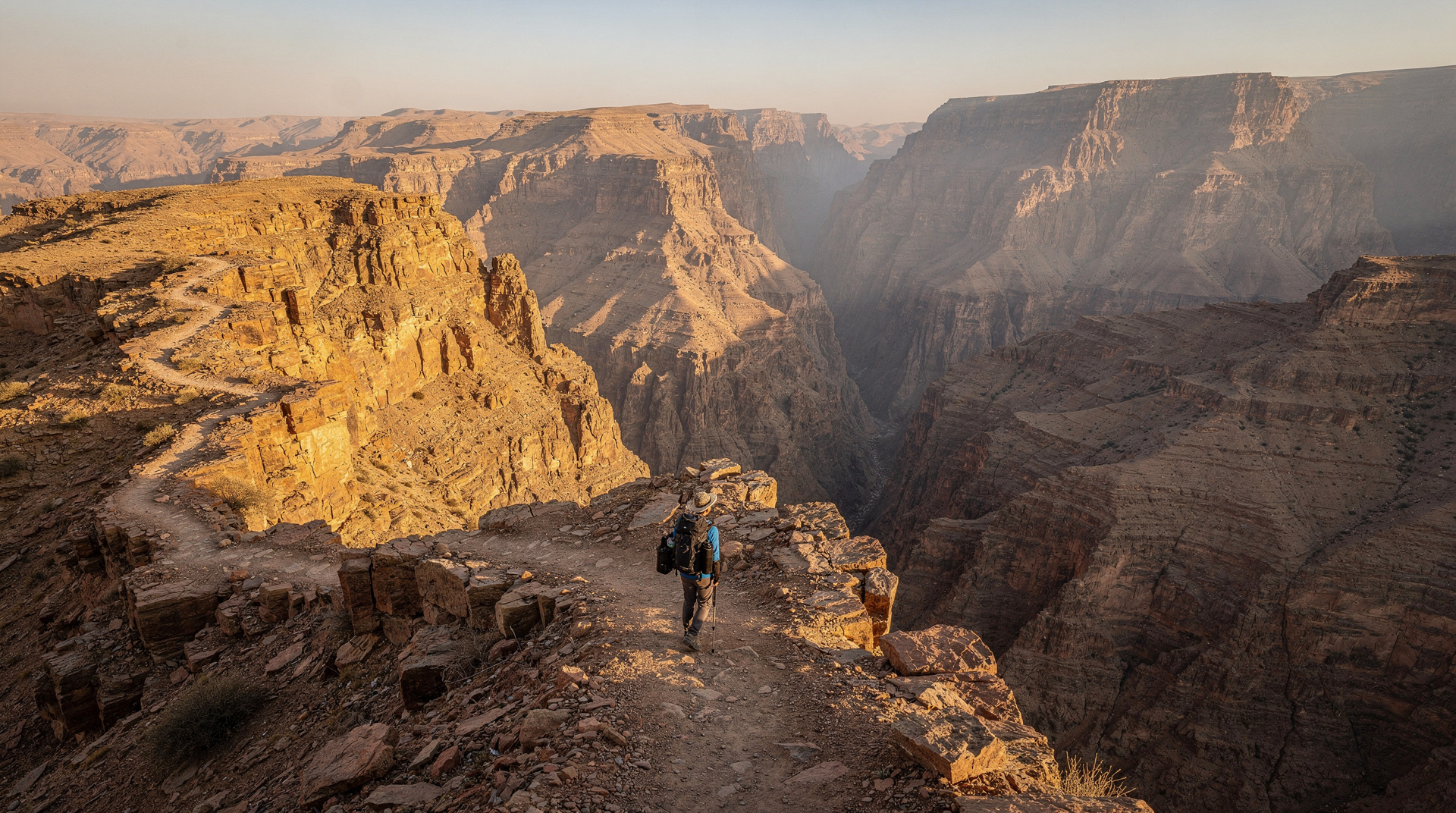
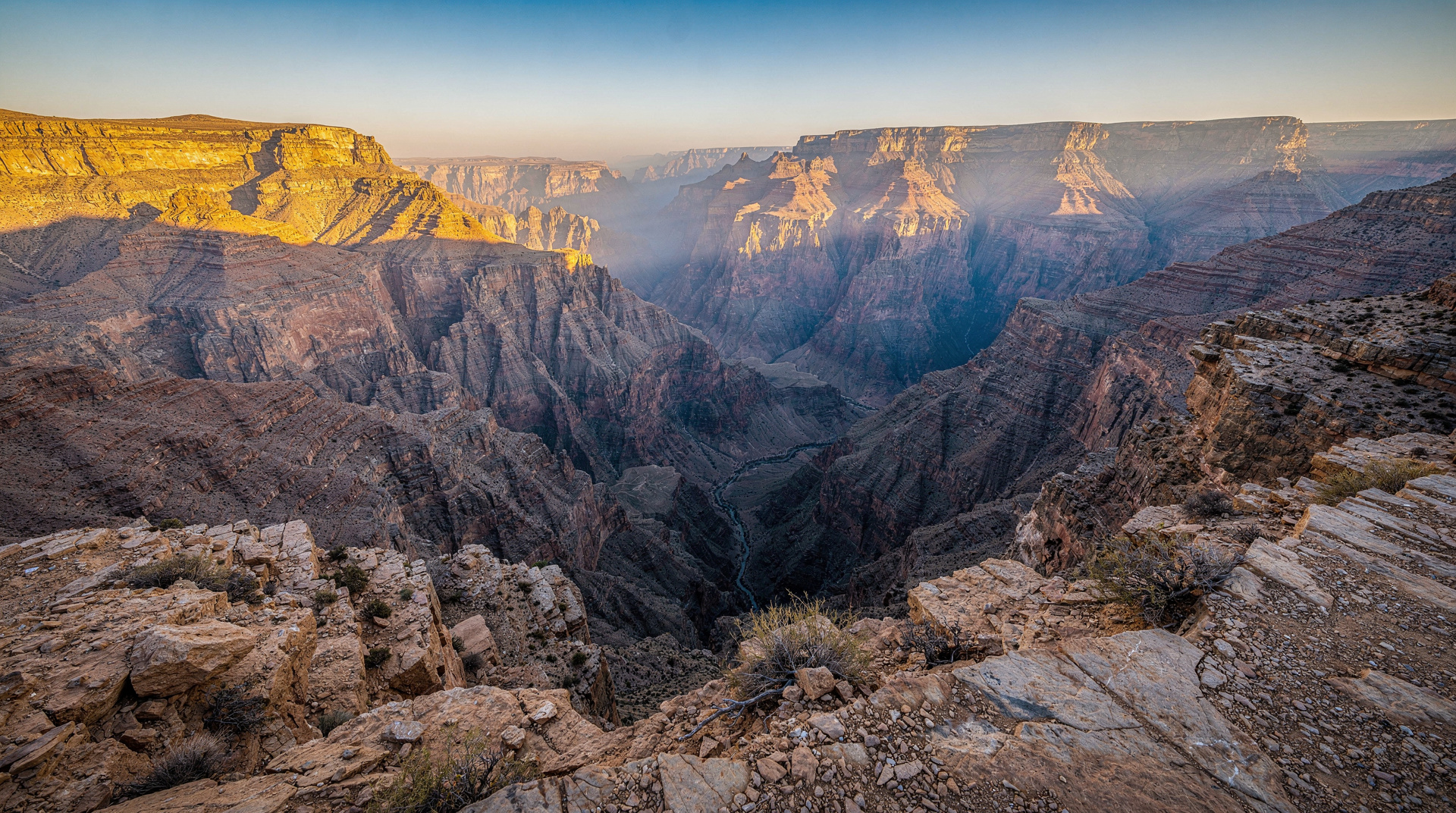
This is the most dramatic day of the itinerary. Jebel Shams, at 3,009 metres above sea level, is Oman’s highest peak, and the canyon below it — Wadi Nakhr — is 1,000 metres deep and sometimes called the Grand Canyon of Arabia. The access road from the town of Al Hamra to the Jebel Shams plateau is paved and navigable in a 2WD, though steep and winding.
The Balcony Walk
The Balcony Walk (W6 Trail) is the signature experience at Jebel Shams. This 9-km return trail follows a narrow path cut into the canyon rim, passing the ruins of Ghul Village — an abandoned settlement clinging to the cliff face — before reaching a dramatic viewpoint over the full depth of Wadi Nakhr. The walk takes 3–4 hours return and involves some scrambling. It is rated moderate; the trail is not technical but the drops are significant and you should have reasonable fitness.
Start early: Begin the walk by 7 AM at the latest. Temperatures on the plateau are pleasant even in summer (the altitude keeps it cool), but the sun by midday is fierce and there is no shade on the trail. Bring 2 litres of water per person, snacks, and a hat.
For those who prefer a guided approach to the mountain: Jebel Shams Day Trip from Muscat — Oman’s Grand Canyon (from 65 USD per person, 2026, including transport and guide).
Lunch at the Summit
Rest House Restaurant at the top of Jebel Shams serves simple grills and Omani staples with a canyon-edge terrace — surreal setting for a chicken shawarma. Budget 3–5 OMR.
Afternoon: Al Hamra Village and Misfat Al Abriyeen
Descend from the mountain and stop at Al Hamra, one of the best-preserved traditional mudbrick towns in Oman. Bait Al Safah within Al Hamra is a living heritage house where elderly Omani women demonstrate traditional crafts and cooking — entry with guide 4 OMR.
Just 3 km from Al Hamra, the village of Misfat Al Abriyeen clings to a clifftop above terraced gardens and falaj channels. Walking down through the old village to the gardens takes 30 minutes and is entirely free — one of the most peaceful places in Oman.
Return to Nizwa or stay on the mountain: Two excellent lodges operate near the Jebel Shams summit. Jebel Shams Resort (70–110 OMR/night) and the simpler Sama Jebel Shams (40–60 OMR/night) both offer memorable stargazing from the plateau.
Day 5: Nizwa to Wahiba Sands via Sinaw
Drive: Nizwa to Wahiba Sands (150 km, 2 hours)
Head east from Nizwa toward Sinaw on Route 23. Sinaw Market on Thursday mornings is one of Oman’s most authentic traditional markets — livestock, silverware, textiles, and pottery traded in the old manner. If your timing aligns, it is worth a 90-minute detour.
Continue east to the edge of the Wahiba Sands. The sands begin abruptly — flat gravel plains dissolving into enormous terracotta dunes at the horizon. A standard car can manage the first few hundred metres on the sand, but to go deeper and dune-bash, you need a 4WD (available for hire through camps).
A guided overnight desert experience from Muscat: Private Desert Safari with Overnight Camping — from Muscat (from 120 USD per person, 2026, including transport, dinner and breakfast).
Desert Camp Afternoon and Evening
1000 Nights Camp, Desert Nights Camp, and Nomadic Desert Camp are the most reliable mid-range options, all priced at 70–120 OMR per night including dinner and breakfast. Activities included or available for extra charge: dune bashing, sandboarding, camel rides, falconry demonstrations, and stargazing.
Sunset on the Wahiba dunes is a quintessential Oman experience. The light turns the sand from orange to deep crimson in the 20 minutes before dark — photograph it, but also just stand and watch.
Day 6: Wahiba Sands to Sur, Wadi Bani Khaled, Wadi Shab
Morning: Wadi Bani Khaled
Leave camp early (7 AM) and drive north then east to Wadi Bani Khaled — a permanent freshwater wadi with spectacular turquoise pools. Unlike most wadis which dry up seasonally, Bani Khaled flows year-round from a mountain spring. Swimming in the main pool is delightful; more adventurous walkers can continue 30 minutes further into the canyon to find deeper, quieter pools.
Sur: Dhow Building Yards and Turtles
Continue east 75 km to Sur, Oman’s most historic port town. Sur was the great maritime trading hub of the Arabian Sea, and its dhow-building yards still operate as working businesses — traditional wooden vessels constructed entirely by hand. The yard is open to visitors and the craftsmen are used to curious onlookers. Entry is free; tips are appreciated.
Ras Al Jinz Turtle Reserve is 25 km south of Sur and is the most important green turtle nesting site in the Indian Ocean. Guided night tours depart from 9 PM (book ahead at rasaljinz.com; 12 OMR per person) to observe turtles laying eggs or hatchlings emerging. The experience is deeply moving and entirely unlike anything else in Oman.
Stay in Sur: Sur Plaza Hotel (45–60 OMR/night) — the most comfortable option in town, with a good pool.
Day 7: Wadi Shab and Return to Muscat
Morning: Wadi Shab
The crown jewel of coastal Oman. From Sur drive 100 km north to Wadi Shab on Route 17. A short boat ferry crosses the lagoon at the mouth of the wadi (1 OMR), then a 45–60 minute walk through the canyon floor — crossing the shallow river multiple times over stepping stones, through palm groves and past cliff faces — reaches the famous emerald green swimming pools.
The most determined swimmers continue through a final pool into a cave behind a small waterfall. It is completely dark inside and you swim through with the rock inches above you — extraordinary. Strong swimmers only, and leave your phone behind.
Bimmah Sinkhole is 15 km further north — a collapsed limestone cavern filled with turquoise brackish water, accessible by steps and open for swimming (1 OMR entry).
Return to Muscat (130 km, 1.5 hours)
Arrive in Muscat by mid-afternoon. Final dinner at The Beach Restaurant at The Chedi Muscat if budget allows (30–50 OMR per person) — fresh seafood on a beachfront terrace at one of Oman’s finest hotels. A perfect closing note to the week.
Where to Stay: Full Circuit
| Location | Hotel | Price/night |
|---|---|---|
| Muscat | Crowne Plaza Muscat OCEC | 45–65 OMR |
| Nizwa | Noor Arjaan by Rotana | 55–75 OMR |
| Jebel Shams | Jebel Shams Resort | 70–110 OMR |
| Wahiba Sands | 1000 Nights Camp | 75–120 OMR |
| Sur | Sur Plaza Hotel | 45–60 OMR |
Practical Notes
Visa: e-Visa available online, approximately 20 OMR. Most nationalities approved within 24–48 hours.
Car rental: Book a 4WD if your budget allows — not required for this itinerary’s paved routes but opens up optional detours. Budget 25–40 OMR/day for a 4WD SUV.
Fuel: Petrol stations are plentiful on all main routes. Fuel is inexpensive in Oman (approximately 0.19 OMR/litre as of 2026). Always fill up before heading into mountain or desert areas.
Mobile data: Omantel and Ooredoo SIM cards with data are available at the airport from 5 OMR. Coverage is excellent on all main routes and in towns.
For detailed information on individual destinations, visit our Jebel Akhdar guide, Jebel Shams Balcony Walk guide, and Muscat destination page.
Seven Days in Oman: What to Expect Each Day
Understanding the rhythm of a week-long Oman road trip helps you arrive with realistic expectations and the right mindset. Here is an honest picture of what each day feels like.
Days 1–2 (Muscat) are easy, urban, and well-serviced. Traffic is manageable. English is widely spoken. Air-conditioned restaurants, reliable wi-fi, and convenient supermarkets make everything accessible. This is a confidence-building period before the more remote days.
Day 3 (Mountain drive to Nizwa) is the transition. The moment Route 15 begins climbing into the Hajar range, Oman’s character shifts completely. Villages appear on hillsides, the air cools slightly, and the landscape becomes genuinely spectacular. The drive itself is a highlight. Nizwa Fort is busy on weekday mornings but never overwhelming.
Day 4 (Jebel Shams) is the most physically demanding day if you do the Balcony Walk, and also the most rewarding. Starting at 7 AM is genuinely important — not just because of heat, but because the morning light in the canyon is extraordinary and by 10 AM tour groups from Muscat start arriving. Reaching the final viewpoint before 10 AM means having it almost to yourself.
Day 5 (Wahiba Sands) is the day that most travelers say was their favourite. The transition from driving through flat, featureless plains to the sudden arrival of the dunes is visceral. The camp environment — communal meals, shared fires, shared stars — creates a sense of temporary community that is warm and memorable.
Day 6 (Sur and coast) covers the most ground of the week but the scenery on the coastal road Route 17 is worth every kilometre. Sur’s dhow yards are an unexpected delight — genuinely working businesses, not tourist theatre.
Day 7 (Wadi Shab — Muscat) is bittersweet. Wadi Shab tends to produce a feeling of disbelief — that this much beauty exists so close to a modern airport — and the return to Muscat feels like re-entering the world after a week somewhere else entirely.
Eating Well on the 7-Day Northern Circuit
Oman’s food scene has developed significantly in recent years, particularly in Muscat. The interior and coast are more limited but still offer excellent eating with the right knowledge.
Muscat Restaurant Highlights
Ubhar (Al Khuwair, Muscat): The most acclaimed Omani restaurant in the capital. Traditional recipes elevated with fine dining technique — try the harees (slow-cooked wheat and meat), shuwa (underground slow-roasted lamb), and Dhofari halwa. Reservation recommended. 12–20 OMR per person.
Kargeen Caffe (Al Mouj and other locations): Open-air courtyard setting under string lights and palm trees. Excellent Omani mezze, grilled meats, and the best fresh juices in the city. 6–10 OMR per person.
Bait Al Luban (Ruwi): Classic, no-frills Omani restaurant beloved by locals and those who find it. Generous portions of rice dishes, grilled fish, and traditional sweets. 4–8 OMR per person.
The Beach at The Chedi (Al Ghubra): Best seafood restaurant in Muscat for a special evening. On the beach with good wine list (Oman does permit alcohol in licensed restaurants). 30–50 OMR per person.
Interior and Coast Eating
Nizwa area: The cluster of simple restaurants near the fort gate serve outstanding breakfast — Omani bread (khubz ragag) with honey, cheese, and eggs for 1–2 OMR. Local biryani at lunch runs 2–3 OMR. Ask your hotel for their recommended local lunch spot.
Wahiba Sands camps: All quality camps include dinner (a spread of Omani and Arabic dishes) and breakfast in the room rate. Camp breakfasts are generous — eggs, bread, fruit, juice, and Omani halwa with kahwa coffee.
Sur waterfront: The Corniche road in Sur has several fish restaurants where the catch comes off the boats a few hundred metres away. A whole grilled hamour (orange-spotted grouper) with rice and salad costs 5–7 OMR — outstanding value.
En route: The Al Maha petrol station chain operates excellent roadside cafeterias with clean facilities, fresh sandwiches, dates, and good Arabic coffee. These are reliable pit stops across all routes.
Seven Days in Oman: Month-by-Month Guide
October: Excellent. Temperatures dropping from summer peaks, dropping to 25–32°C in Muscat, cool in the mountains. Some wadis still have water from summer rain. Light tourist numbers early in the month, building toward high season.
November: Peak season begins. Near-perfect conditions — warm days, cool evenings, no rain. Hotels and camps start filling up; book accommodation 6–8 weeks in advance.
December: Peak season and increasingly popular with European winter-escape travelers. Christmas and New Year periods book out completely — plan 3–4 months ahead for December 20–January 5.
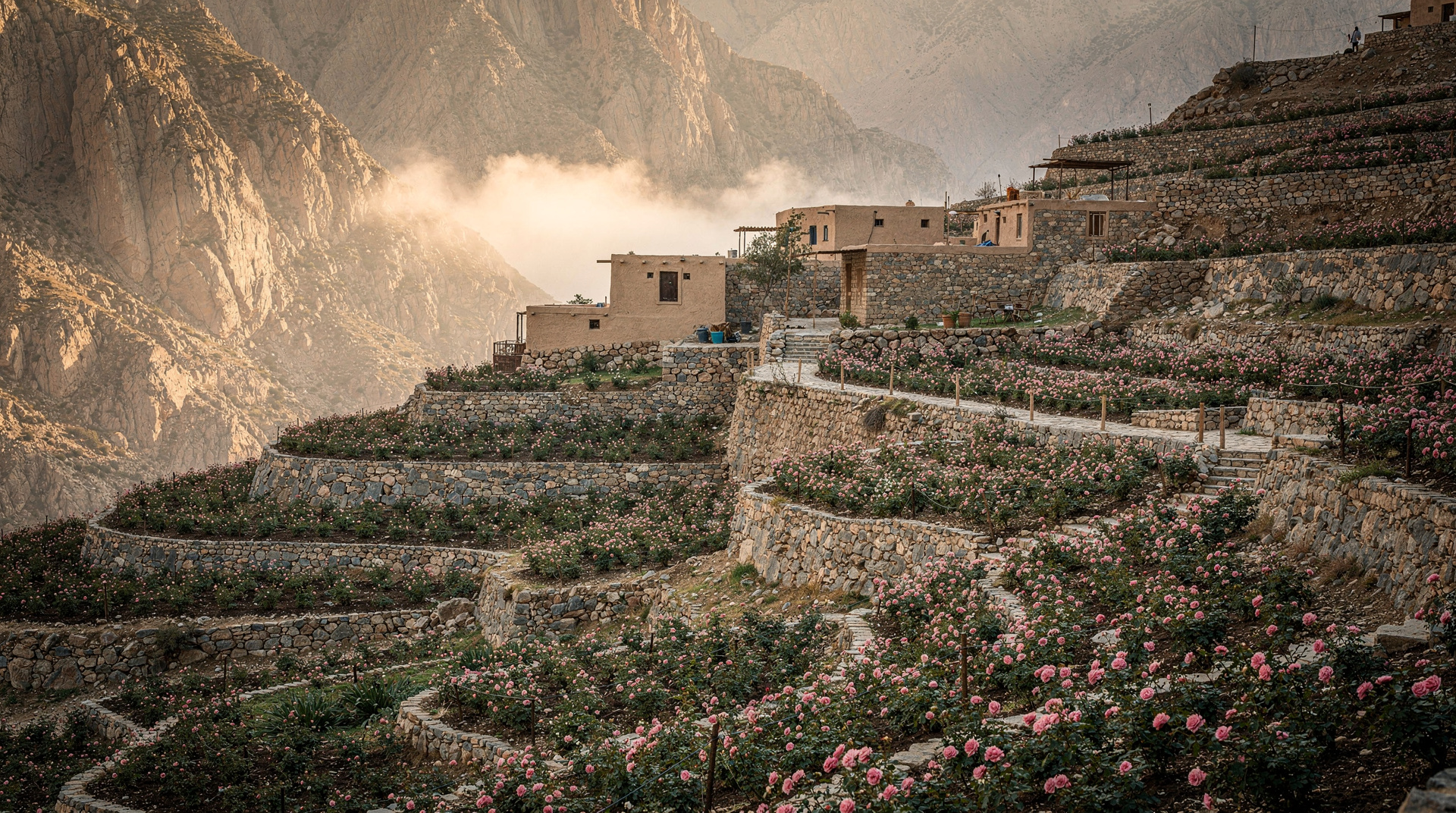
January–February: The finest months. Mountain temperatures can drop to 5–10°C at Jebel Shams and Jebel Akhdar — bring a warm layer. The Balcony Walk in winter morning light is spectacular. Jebel Akhdar rose gardens begin flowering from late January.
March: Still excellent. Temperatures rising but evenings remain pleasant. High season rates continue.
April: Transitional. Muscat and coastal areas heating up (35–38°C); the mountains remain comfortable. A good budget month as rates drop and crowds thin.
May–September: Summer. Temperatures in Muscat reach 40–45°C. Coastal wadis can still be visited in early morning, but extended outdoor activities are impractical. Jebel Shams and Jebel Akhdar remain relatively cool due to altitude. The Wahiba Sands in summer requires air-conditioned camp facilities. Not recommended for this itinerary unless you have specific reasons and significant heat tolerance.
Wildlife Encounters on the Seven-Day Circuit
One of the pleasant surprises of an Oman road trip is the wildlife. The country protects its fauna seriously and encounters are genuine, not managed.
Arabian oryx: Reintroduced to the wild in the 1980s after hunting drove them to extinction. The Arabian Oryx Sanctuary (a UNESCO World Heritage Site) is not on this route, but oryx have expanded their range and are occasionally seen near the Wahiba Sands edge.
Sea turtles: Green turtles and hawksbill turtles are commonly seen snorkeling at the Daymaniyat Islands. Ras Al Jinz near Sur is the Indian Ocean’s most important green turtle nesting beach — the overnight turtle tour (12 OMR) offers near-guaranteed encounters.
Dolphins: Spinner dolphins, Indo-Pacific bottlenose dolphins, and common dolphins are resident in Muscat’s coastal waters and regularly seen on boat trips from Muttrah and Bandar Jissah.
Humpback whales: Less reliable but present in Omani waters October through February. Some dhow operators spot them on longer coastal routes.
Arabian leopard: Critically endangered and extremely rare. Jebel Shams is part of historical leopard territory. You will not see one, but knowing they are out there in the mountains somewhere is quietly remarkable.
Desert wildlife at the Wahiba Sands: After dark, camp guides sometimes spot sand cats, Arabian sand gazelles, and desert foxes. The dune scorpion (non-lethal but uncomfortable) comes out at night — shake out shoes in the morning, a routine precaution.
Birdlife: Oman sits on a major bird migration route. The Qurm Mangrove Reserve in Muscat and the coastal wadis are excellent for waders and migratory birds in autumn and spring. The Hudhud (Hoopoe) — Oman’s national bird — is frequently spotted in gardens and open areas throughout the country.
Is This Itinerary Right for You?
Frequently asked questions about 7-Day Classic Oman
Is a 4WD necessary for the full 7-day route?
No — every stage of this itinerary as written uses paved roads, and a standard SUV or saloon is sufficient. A 4WD only matters if you want to detour off the summit road at Jebel Shams into Wadi Nakhr itself, which is not part of the core route.
Can this itinerary be done without a rental car?
It is difficult. Muscat and Nizwa can be linked by taxi or organized transfer, but Jebel Shams, the Wahiba Sands camps, and Sur are far more practical, and cheaper, with your own car. Travelers who prefer not to self-drive should look at the guided day-tour links throughout this itinerary or consider a private-driver package instead.
Related Reading
Begin your planning with the Muscat destination guide for the capital, then drill down to the Sultan Qaboos Grand Mosque visitor guide for Day 1’s centerpiece. The Jebel Akhdar guide covers the Green Mountain as an optional extension or replacement for Day 4’s Jebel Shams route. The definitive route description for the week’s most demanding hike lives in the Jebel Shams Balcony Walk guide.
For a shorter version of this trip, the 5-Day Oman Highlights itinerary covers the core experiences in less time. For a longer version adding the Musandam Peninsula, see the 10-Day Grand Tour. The complete Oman experience including Salalah is in the 14-Day Ultimate Oman itinerary.
Families should use the Family Oman version, and those focused on 4WD adventure have the dedicated Adventure Road Trip itinerary. For the finest hotels and private experiences, the Luxury Oman itinerary covers Anantara, Six Senses, and The Chedi.