Wadi Darbat Waterfall: Salalah's Most Spectacular Natural Wonder
When does the Wadi Darbat waterfall flow?
Wadi Darbat's waterfall flows during and just after Oman's khareef monsoon season, typically from late June through September. The falls are most dramatic in August and can persist into October.
Oman’s Green Secret
Most people picture Oman as a land of golden dunes and arid mountains — and for most of the country, that image is accurate. But in the far south, in the Dhofar governorate that surrounds the city of Salalah, something extraordinary happens every summer. The Indian Ocean monsoon arrives, cloaking the Dhofar mountains in cloud and rain, and transforms the landscape into something almost unrecognisable: rolling green hills, waterfalls thundering from cliff faces, herds of cattle grazing in thick mist, and ancient fig trees dripping with moisture.
Wadi Darbat is the centrepiece of this monsoon transformation. Located in the mountains east of Salalah, the wadi is a broad, lush valley carved from limestone by millennia of seasonal water flow, lined with flowering shrubs and inhabited by cattle, wild camels, and a fascinating array of birdlife. At its head, where the mountain plateau drops away in dramatic escarpment cliffs, the Wadi Darbat waterfall pours in a long white ribbon into the valley below — one of the most striking natural sights in the entire Arabian Peninsula.
At a glance
| Where | Dhofar mountains, around 30 km east of Salalah, near Taqah |
| Cost | Free to walk the valley; a fee applies for boat rides on the khawr pools when operating; guided safaris are around OMR 25-40 per person |
| Time needed | Around 3-4 hours; a full day combined with Khor Rori and Mughsayl |
| Getting there | Around 45 minutes by car from Salalah; standard car adequate in dry conditions, 4x4 recommended in monsoon |
| Best time | Late June-September for the waterfall (khareef), October-April for quieter walking and birdwatching |
The Khareef: Understanding Dhofar’s Monsoon Season
The khareef (an Arabic word meaning autumn, but used locally to describe the monsoon period) is one of the most climatically unusual phenomena in the Arab world. While the rest of the Gulf bakes in temperatures exceeding 45 degrees Celsius, Dhofar is transformed into something resembling a Scottish highland in midsummer — cool, misty, green, and impossibly lush.
The monsoon arrives from the southwest in late June, driven by the same atmospheric system that brings rain to the Indian subcontinent. The Dhofar mountains act as a barrier that intercepts the moisture-laden air, causing it to rise and cool, releasing rain on the seaward-facing slopes and wrapping the highlands in persistent cloud and drizzle. The monsoon typically intensifies through July, peaks in August, and gradually retreats through September, with the last rains usually falling in early October.
The effect on the landscape is extraordinary. In May, the Dhofar mountains are dry and brown, covered in sparse scrub and scattered frankincense trees. By mid-July, the same hills are a rich, saturated green — grass thick enough to swish against your legs as you walk, streams running in gullies that are bone-dry for the other nine months, and the air carrying the scent of wet earth and wild herbs.
For Oman’s urban population, the khareef is a beloved annual holiday period. Families from Muscat, Abu Dhabi, and Riyadh descend on Salalah throughout July and August to escape the heat of the Gulf, fill the city’s restaurants and hotels, and drive the winding mountain roads to picnic in the mist. Wadi Darbat is the most popular excursion, and on peak weekends the valley can be surprisingly crowded.
Wadi Darbat: The Valley and Its Features
The wadi extends for several kilometres inland from the main coastal road, gradually rising toward the plateau edge where the waterfall is located. The floor of the valley is relatively flat and broad, dotted with natural freshwater pools — called khawr — that persist well beyond the end of the monsoon, sometimes holding water through to March. These pools attract wildlife: African paradise flycatchers hunt insects above the water surface, goliath herons stand in the shallows, and occasional Dhofar cattle egrets attend the cattle that graze the lush valley floor.
The limestone walls flanking the valley are home to breeding populations of feral camels — a sight unusual enough to stop most visitors in their tracks. These are not the managed camels of the desert regions but genuinely wild animals that have lived in the Dhofar mountains for generations, adapted to the rocky terrain and seasonal vegetation. Watching a group of camels picking their way along a cliff face while a waterfall thunders in the background is distinctly surreal.
The waterfall itself, at the head of the wadi where the plateau edge drops sharply away, is typically around 30 to 40 metres in height, though the exact character of the falls varies significantly with the intensity of the monsoon rains in any given year. In a good rain year, the falls are dramatic and multi-stranded, with spray creating a permanent rainbow in the morning light. In a drier year, the flow may be reduced to a series of cascades rather than a single coherent fall, though even then the setting is spectacular.
The East Salalah Safari: The Best Way to See Wadi Darbat
For visitors without a 4x4 or local knowledge of the mountain roads, a guided safari is the recommended way to experience Wadi Darbat and the broader east Salalah region. The East Salalah Wadi Darbat Waterfall and Mountain Safari Tour combines the wadi itself with other highlights of the east Salalah area, including the ancient city of Sumhuram, the Khor Rori lagoon, the Taqah castle, and the coastal cliffs and blowholes at Mughsayl.
The safari format — typically in a comfortable 4x4 or minibus with a knowledgeable local guide — is particularly valuable because the mountain roads can be slippery and confusing during the monsoon, some viewpoints require off-road access, and a good guide provides essential context for the cultural and natural history of the region.
Getting to Wadi Darbat Independently
For independent travellers with a 4x4 or high-clearance vehicle, Wadi Darbat is approximately 30 kilometres east of central Salalah. The main access road runs from the coastal highway near the town of Taqah, heading north into the mountains. The road is surfaced for most of its length but can become slippery when wet — which it frequently is during the monsoon.
Several viewpoints along the mountain road above the wadi offer spectacular panoramic views of the valley and the waterfall, and these can be reached without descending to the valley floor. The descent into the wadi itself involves a rough track that is significantly easier with 4x4 traction.
A small car park at the valley floor is the starting point for walks along the wadi. There are no formal trails, but the valley floor is easy to explore on foot, with the waterfall approximately 2 kilometres from the car park. Plan to spend at least three hours in the valley to do it justice.
Beyond the Waterfall: East Salalah Highlights
The area east of Salalah is extraordinarily rich in natural and historical interest, and combining Wadi Darbat with other sites in the region makes for a genuinely exceptional day or multi-day experience.
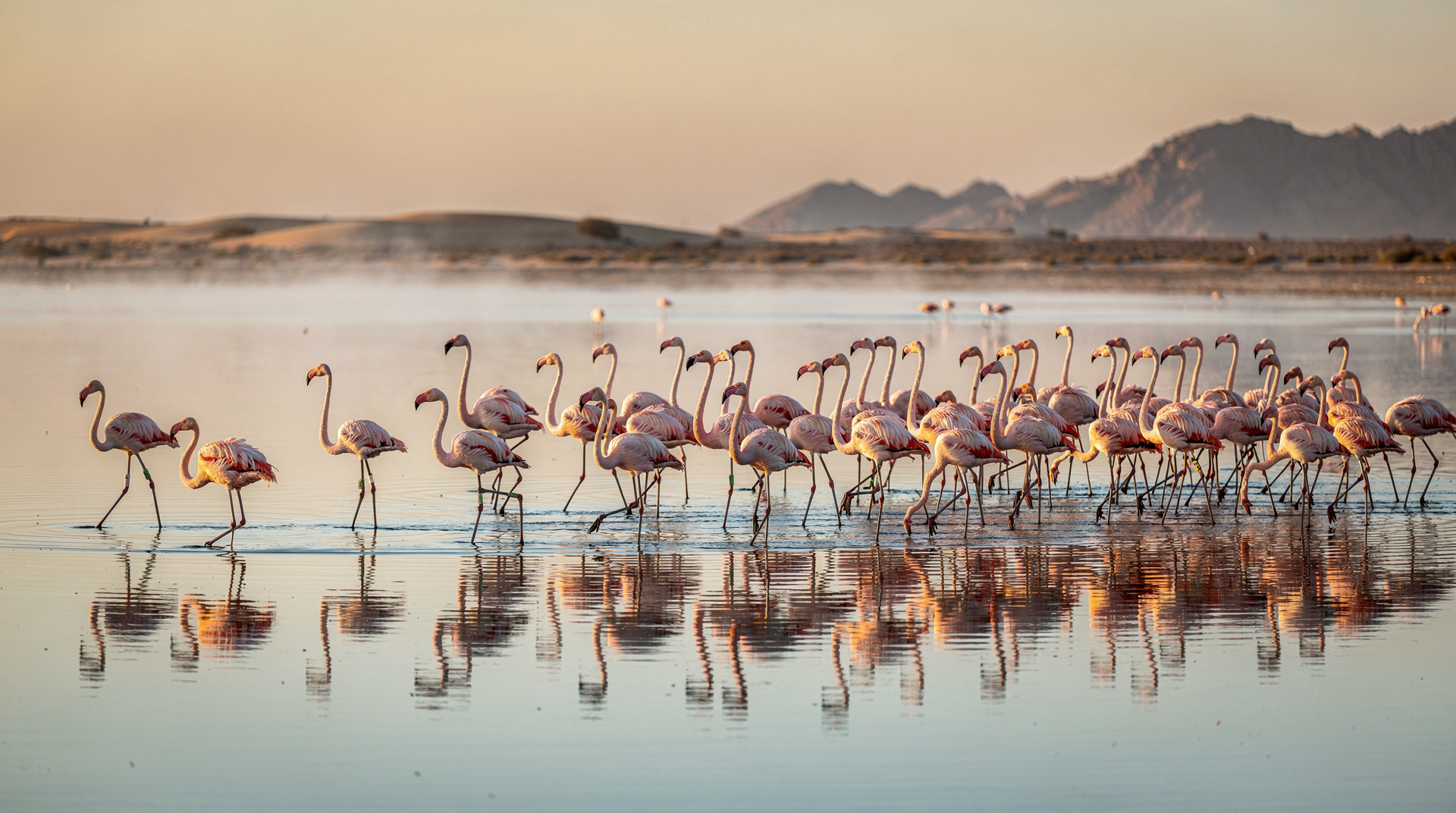
Khor Rori, the coastal lagoon just south of the wadi access road, is one of the most important waterbird sites in Arabia. Flanked by the extensive ruins of the ancient frankincense trading city of Sumhuram — a site of UNESCO World Heritage significance — the lagoon holds flamingos, herons, spoonbills, and large numbers of waders throughout the year. The ruins themselves, set on a rocky promontory overlooking the lagoon mouth, are among the most evocative archaeological sites in Oman.
The blowholes at Mughsayl, 40 kilometres west of Salalah along the coastal road, are a remarkable geological feature — holes in the coastal limestone through which compressed seawater erupts in geysers when waves strike the underwater caves below. During the monsoon, when sea conditions are rough, the geysers can shoot water 15 to 20 metres into the air with a booming report that can be heard from considerable distance.
The Dhofar mountain plateau above Wadi Darbat — accessible via a road that climbs steeply from the valley floor — is worth exploring in its own right. The plateau is used for cattle grazing, dotted with ancient stone tombs and settlements, and provides spectacular views south toward the Indian Ocean on clear days.
Wildlife of Wadi Darbat
The combination of fresh water, lush vegetation, and the unique Dhofar habitat supports a wildlife community quite unlike anything found elsewhere in Oman. The birdwatching in Dhofar section covers the regional avifauna in detail, but Wadi Darbat deserves special mention for its accessibility and productivity.
Common sightings during the monsoon season include African paradise flycatcher, little green bee-eater, Abyssinian white-eye, grey heron, purple heron, goliath heron, yellow wagtail, and various flycatchers and warblers. The waterfall area in particular attracts swifts — including the Dhofar-endemic Forbes-Watson’s swift — that hawk insects in the spray zone.
Mammals include the feral camels mentioned above, hamadryas baboons visible on the upper escarpment cliffs, Arabian gazelle on the plateau, and the nocturnal Arabian leopard — almost certainly present in the Dhofar mountains based on recent camera trap evidence, though sightings are extraordinarily rare.
The fresh water pools in the valley floor are good for dragonflies and damselflies, including species characteristic of tropical Africa rather than Arabia, reflecting Dhofar’s biogeographic links to the Ethiopian region.
Visiting Outside the Monsoon Season
Wadi Darbat is worth visiting outside the monsoon season, though the character of the experience changes significantly. Without the flowing waterfall and the lush green vegetation, the valley reveals its underlying geology more clearly — the limestone formations, caves, and ancient erosion patterns become more visible when not hidden under greenery.
The pools in the valley floor typically hold water through the winter months, maintaining wildlife interest through November and beyond. February to April, before the heat intensifies, is a pleasant time for walking in the wadi, with comfortable temperatures and good conditions for birdwatching during the spring migration period.
Practical Information for Visitors
Salalah is served by daily flights from Muscat on Oman Air, with a flight time of approximately 90 minutes. Salalah Airport has good car rental facilities, and a 4x4 is recommended for independent exploration of the Dhofar mountains, though a standard saloon car is adequate for the main Wadi Darbat access road in dry conditions.
During the khareef season, accommodation in Salalah can be heavily booked — particularly in July and August, when Omanis and Gulf visitors come en masse. Book hotels three to four months in advance for peak season visits. The city has a good range of accommodation from budget guesthouses to international five-star hotels, and food is plentiful and excellent throughout.
The Dhofar monsoon, while transformative, also means fog, drizzle, and cool temperatures. Pack a light waterproof layer and walking shoes rather than sandals for wadi exploration. Leeches are occasionally present in the wettest parts of the valley in peak monsoon — not dangerous but an unpleasant surprise if you are not expecting them.
Wadi Darbat Month by Month
The character of the valley changes dramatically across the year, and knowing what to expect from each period helps set the right expectations before booking flights.
| Period | Waterfall | Landscape | Crowds |
|---|---|---|---|
| Late Jun-Jul | Building, increasingly reliable | Turning from brown to green | Rising, especially weekends |
| Aug | Peak flow, most dramatic | Fully lush, rolling green hills | Very high — Gulf holiday peak |
| Sep | Still flowing, tapering | Green, occasional clearer skies | High, easing late month |
| Oct | Usually stopped or reduced to a trickle | Greenery starting to fade | Moderate |
| Nov-Apr | Dry falls, but valley pools persist | Brown/scrubland, geology exposed | Low |
| May | Dry, hottest pre-monsoon month | Driest of the year | Low |
For a broader sense of what the khareef feels like beyond this one valley, see the guide to Salalah in khareef and the wider khareef season overview. Travellers weighing up whether the monsoon crowds are worth it against a quieter, drier visit may also find the magical summer khareef piece useful for the atmosphere, not just the logistics.
Planning Around Salalah
Wadi Darbat is one stop within a Dhofar region dense with things worth seeing, and most visitors base themselves in Salalah itself for several days rather than day-tripping in from Muscat. Where you stay matters more here than in most of Oman: khareef season books out well ahead, and the where to stay in Salalah guide covers the trade-offs between beachfront resorts and central hotels closer to the mountain roads.
Travellers combining north and south Oman in one trip should also weigh the Muscat to Salalah drive — a genuinely long overland route — against flying, which most visitors ultimately choose given the distance involved.
Frequently asked questions about Wadi Darbat Waterfall: Salalah’s Most Spectacular Natural Wonder
Does Wadi Darbat have the only waterfall in Oman?
No — Oman has several seasonal waterfalls, including impressive examples in Wadi Shab, Wadi Bani Khalid, and the Hajar mountains near Muscat. However, Wadi Darbat is the most dramatic and reliable of them, fed by the Dhofar monsoon in a way that the northern wadis, which depend on infrequent desert rainstorms, are not.
Is it safe to swim in the Wadi Darbat pools?
Swimming in the natural pools in the valley floor is generally safe, and local families regularly do so. However, during the peak monsoon when water levels are high and the pools are being actively replenished by heavy rain, currents can be unexpectedly strong. Exercise caution near the waterfall base, where falling water and submerged rocks create hazards.
How long does a visit to Wadi Darbat take?
A thorough visit to the wadi itself — descending to the valley floor, walking to the waterfall, exploring the pools, and spending time observing wildlife — takes three to four hours minimum. Combined with the drive from Salalah and time at other east Salalah sites like Khor Rori and Sumhuram, a full day is appropriate.
Can I visit Wadi Darbat with a standard rental car?
The main access road to the valley is paved and manageable in a standard car in dry conditions. During the monsoon season, rain can make the road slippery, and the track descending to the valley floor requires a high-clearance vehicle. If in doubt, join a guided safari tour, which uses appropriate vehicles and experienced local drivers.
What should I wear when visiting during the monsoon?
Light waterproof clothing is essential, along with closed shoes or light hiking boots with grip. The mist and drizzle of the khareef can be deceptive — it rarely feels very wet at any given moment, but over two or three hours in the valley you will become thoroughly damp without adequate protection. Temperatures during the monsoon are genuinely cool by Omani standards, hovering around 18 to 24 degrees Celsius in the valley.
Are there facilities at Wadi Darbat?
Basic facilities — a car park, some food and drink stalls operated by local vendors during the monsoon season, and basic toilet facilities — are available at the main access point to the valley. There is no restaurant or formal visitor centre. Bring adequate water, sun cream for non-monsoon visits, and any food you require for an extended stay.
Is Wadi Darbat accessible for people with limited mobility?
The valley floor can be accessed from the car park along relatively level ground, with some uneven surfaces from the natural terrain. The walk to the waterfall involves moderate terrain. The viewpoints above the valley on the main road are accessible from the car without significant walking. For visitors with very limited mobility, the mountain road viewpoints provide excellent panoramic views of the wadi and falls without the need to descend.
Is Wadi Darbat worth visiting if I can only see it outside khareef season?
Yes, with adjusted expectations. Without the waterfall running, the valley still offers birdwatching around the persistent khawr pools, exposed limestone geology, and far smaller crowds than the July-August peak. It should not be the sole reason for a trip in that case, but it remains a worthwhile stop alongside Khor Rori and Sumhuram.
How does Wadi Darbat compare to the northern Oman wadis like Wadi Shab?
The northern wadis (Wadi Shab, Wadi Bani Khalid) have permanent spring-fed water and turquoise pools year-round, while Wadi Darbat’s waterfall depends entirely on the khareef monsoon. Wadi Darbat’s draw is the seasonal transformation of an entire mountain landscape rather than a single canyon pool, and it comes with wildlife — feral camels, baboons, migratory birds — that the northern wadis do not have.