Multi-Day Tours in Oman: 3, 4 and 5-Day Itineraries Compared
What is the best multi-day tour for a first visit to Oman?
A 4-day tour from Muscat covering Nizwa, Wahiba Sands, Wadi Shab, and the coast gives the best overview of Oman's main landscapes — mountains, desert, wadi, and coast — in a manageable timeframe with all logistics handled.
At a Glance
| Typical duration | 2 to 5 days, departing from Muscat |
| Typical cost | Around 150-350 OMR per person, depending on tour length and group vs private |
| Best for | First-time visitors, solo travellers, anyone who prefers not to self-drive |
| Booking lead time | A few days to a few weeks ahead in peak season (October-March) |
| Best time to go | October through April, when daytime temperatures are comfortable |
The Case For and Against Organised Tours in Oman
The first planning decision facing visitors to Oman is not which tour to book but whether to book a tour at all. Oman is an exceptional self-drive destination — roads are excellent, signage is clear, and the freedom to stop at an unmarked wadi or divert to an unscheduled village is one of the genuine pleasures of the country. The organised tour trades this freedom for a different set of advantages.
Understanding what each approach actually delivers, and for whom, makes the choice straightforward rather than agonising.
What organised multi-day tours do well:
- Eliminate all logistics — no car hire, no navigation decisions, no fuel planning, no accommodation booking anxiety
- Provide a guide with deep local knowledge who can explain what you are seeing rather than reading a sign
- Access certain sites more easily — particularly desert camps, where getting in and out without experience or local knowledge is genuinely difficult
- Create a social experience if you are travelling solo or as a couple and enjoy sharing the experience with a small group
- Are often more economical than independent travel for solo travellers, who bear all car hire and accommodation costs alone
What organised tours cannot replicate:
- The freedom to stop anywhere, spend as long as you want at something unexpected, or completely change direction
- The deep immersion that comes from navigating and experiencing a country under your own steam
- Easy accommodation in midrange and budget properties rather than the specific hotels contracted by tour operators
- The ability to stay longer at places that captivate you and skip those that do not
The most honest assessment: first-time visitors with limited time, solo travellers, couples who prefer not to drive in unfamiliar territory, and anyone who finds the idea of navigating a foreign country in an unfamiliar hire car stressful — for all of these, an organised multi-day tour is the better choice. Experienced independent travellers who have planned their itinerary and are comfortable with self-drive will get more from going alone.
The 3-Day Oman Tour: Nizwa, Desert, and Wadi
The most compressed version of an Oman multi-day tour concentrates on the three landscape types within reasonable reach of Muscat: the mountain and heritage landscape around Nizwa, the Wahiba Sands desert, and the wadi scenery of the Sharqiyah coast.
The 3-day tour from Muscat covering Nizwa, the desert, turtle beach, and Wadi Shab packages this efficiently — Nizwa fort and souq on day one, an overnight desert camp in Wahiba Sands on day two, and Wadi Shab on day three before returning to Muscat. The combination delivers Oman’s headline experiences without requiring more than three days away from the city.
For those based in Sur, the 4-day Wadi, Sur, desert, and Nizwa to Muscat tour offers an interesting alternative structure — beginning on the eastern coast and working inland and back to the capital, covering wadis, desert, and the Nizwa heritage sites in a logical eastward-to-westward arc.
Another strong four-day option is the 4-day tour covering Jebel Shams, Wahiba Sands, and Ras al Hadd, which combines Oman’s Grand Canyon with the desert and the turtle reserve in a circuit that covers three of the country’s most distinctive landscapes.
A compact two-day itinerary that packs an extraordinary amount into 48 hours is the 2-day tour from Muscat combining Wadi Shab, Ras al Jinz, and Wahiba Sands — covering the canyon swim, the turtle reserve, and a desert camp in a well-managed two-day schedule.
What the 3-Day Tour Typically Includes
Day 1 — Muscat to Nizwa and surrounds: Departure from Muscat in the morning, drive to Nizwa with stops at significant sites en route. Nizwa Fort (one of the finest in the country), the traditional souq, and often Al Hamra or Misfat villages in the afternoon. Overnight in a guesthouse or small hotel in the Nizwa area.
Day 2 — Desert: Drive to Wahiba Sands entry point, 4WD transfer into the dunes, dune bashing, sandboarding, camel riding, and a traditional Bedouin lunch. The afternoon in the desert, with a sunset dune climb. Overnight in a desert camp — under the stars or in a comfortable tent cabin depending on the camp booked.
Day 3 — Coast and Wadi Shab: Dawn in the desert, breakfast, drive to Wadi Shab. The wadi walk and swim — one of the most spectacular experiences in Oman — followed by a stop at Bimmah Sinkhole. Return to Muscat in the evening, typically arriving by 7-8pm.
If the heritage part of the route is what draws you most, the guides to Nizwa Fort and souq and to Al Hamra and Misfat villages explain what you will be looking at, so the guide’s commentary on the day builds on something you already know. The Wahiba Sands desert safari guide does the same for the dunes.
What the 3-Day Tour Does Not Cover
Three days is insufficient for Musandam, Salalah, Jebel Shams, or the Sur coast. It is a highlights tour in the truest sense — the greatest hits within the tightest practical timeframe. Visitors who have already seen Nizwa or who are specifically interested in a different combination should look at four or five-day options.
Who the 3-Day Tour Suits
Travellers with a total Oman stay of five to seven days who want to see the country’s interior and are based in Muscat for the remainder. Business travellers adding a long weekend of exploration to a Muscat work trip. Visitors returning to Oman who have already done Muscat and want an efficient interior route.
The 4-Day Oman Highlights Tour: The Recommended Option
The four-day tour is the most popular format for first-time visitors to Oman and with good reason. It adds one day to the three-day format in a way that makes a meaningful difference — the extra day either allows a significantly more relaxed pace, or it opens up an additional major destination.
The 4-day Oman highlights tour from Muscat covers the country’s essential experiences in a format that avoids the feeling of being constantly on a bus with no time at each location.
Typical 4-Day Itinerary Structure
Day 1 — Muscat orientation and Nizwa: Either a morning in Muscat’s Grand Mosque, old Mutrah, and Al Alam Palace before departing for Nizwa, or departure straight to Nizwa depending on whether the visitor has had prior Muscat time. Nizwa Fort, souq, and surrounding area. Overnight near Nizwa.
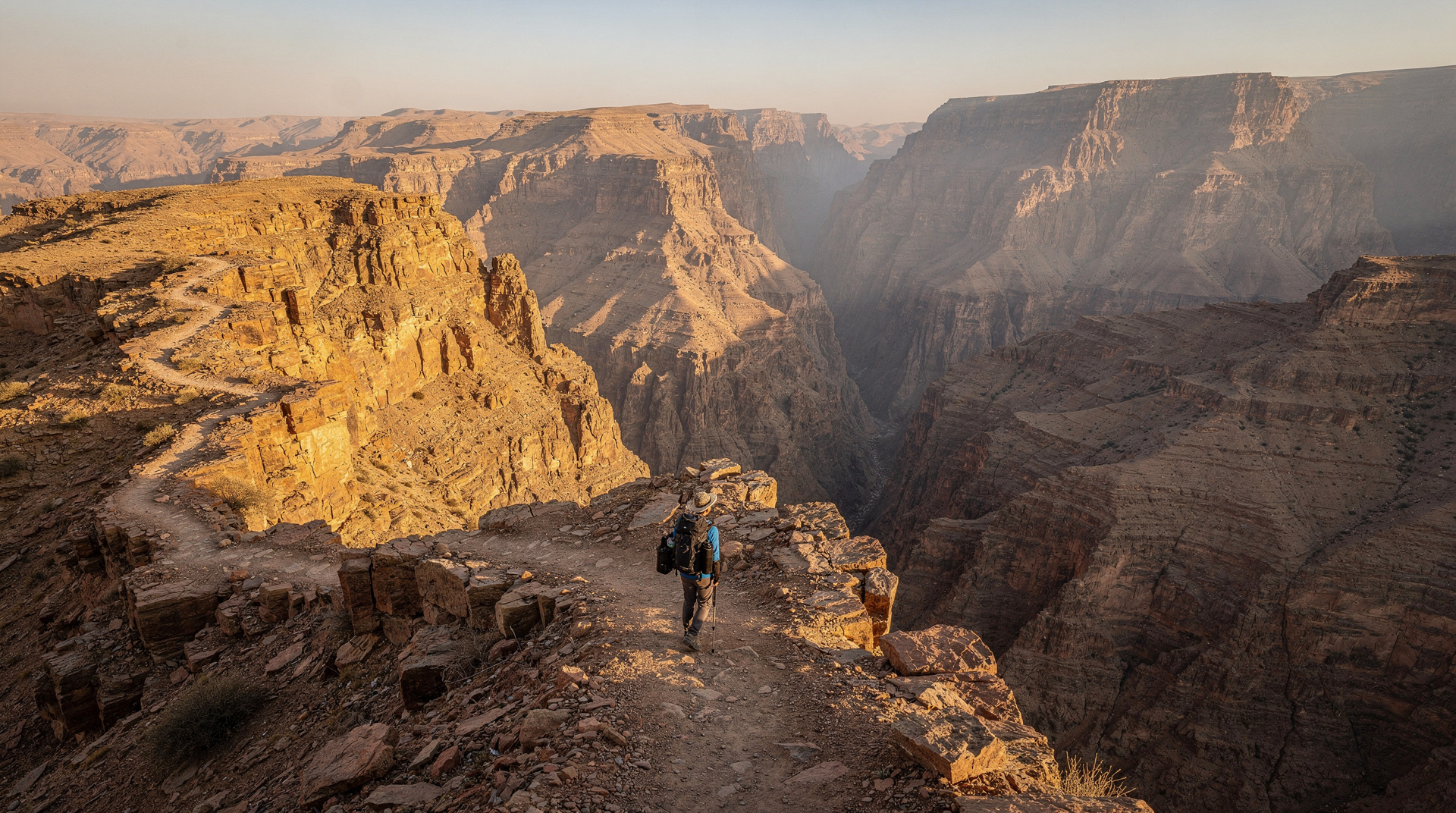
Day 2 — Jebel Akhdar and mountain villages: The extra day in a four-day versus three-day itinerary is often used here. Jebel Akhdar (the Green Mountain) at 2,000 metres is dramatically different from the desert lowlands — its rose gardens, terraced villages, and stunning canyon views reward a full day. The drive up the mountain road is itself part of the experience. This day can alternatively be used for Jebel Shams (highest peak in Oman) and the Grand Canyon-like Wadi Ghul.
Day 3 — Desert and overnight camp: Drive to Wahiba Sands, full desert afternoon with dune activities, sunset viewing, traditional dinner, and overnight in a desert camp.
Day 4 — Wadi Shab and return: Morning drive to the coast, Wadi Shab walk and swim, Bimmah Sinkhole stop, return to Muscat.
Variations on the 4-Day Format
Some four-day tours incorporate the turtle watching at Ras Al Jinz instead of or in addition to Wadi Shab — the sea turtle nesting and hatching beach is one of Oman’s most significant wildlife experiences and is genuinely moving. The Ras Al Jinz reserve operates with limited visitor numbers and a booking requirement, but tour operators manage this access as part of their package.
Other variations include a night in Sur (the dhow-building city) to break the journey differently, or a route that goes south to Salalah for tours with a full week’s duration.
For the mountain day, it helps to read ahead. The Jebel Akhdar guide covers the plateau and its terraced villages, and the Jebel Shams Balcony Walk guide describes the canyon rim path if that is the option your tour takes. Those who want to see how the tour compares with a fixed route of their own can look at the 5-day Oman highlights itinerary.
What Makes the 4-Day Tour the Right Length
Four days is long enough that each day has a genuine character — you are not trying to fit three major experiences into a single day. It is short enough that the logistics do not become tiring. The combination of one mountain, one desert, and one wadi experience within four days is a satisfying cross-section of what Oman offers.
The 5-Day Incredible Oman Tour
Five days allows the tour to expand meaningfully — either adding entirely new destinations or slowing the pace considerably for travellers who want depth over breadth.
The 5-day incredible Oman guided tour uses the additional time to incorporate experiences that the shorter formats must skip.
What Five Days Adds
Musandam: The northern enclave of Oman — physically separated from the main territory by UAE land — is one of the most dramatic landscapes in the Arabian Peninsula. Norwegian-style fjords (khors) cut through limestone mountains, traditional dhow boats navigate narrow channels, and the landscape is entirely different from anywhere else in Oman. Including Musandam in a five-day tour typically means a dedicated day and overnight in Khasab.
Extended desert time: Two nights in a desert camp rather than one transforms the experience. The second morning in the desert — when you wake before dawn and climb a dune for the sunrise without the pressure of loading bags and moving on — is categorically different from a single overnight.
Salalah extension: For five-day tours that run south rather than north, the Dhofar region around Salalah becomes accessible. Frankincense trees, the ancient Ubar ruins, the Empty Quarter, and the entirely different landscape of Dhofar justify a dedicated southern itinerary.
Jebel Shams and Wadi Ghul: The Grand Canyon of Arabia and Oman’s highest peak both deserve more than a passing visit. A five-day itinerary can incorporate a full hiking day on the Balcony Walk or summit approach.
Each of these extensions has its own detailed guide. The Musandam and Khasab guide describes the northern enclave, the Salalah complete guide covers the south, and the Ras al Jinz turtle watching guide explains how an evening at the reserve works. Reading the one that matches your route before you book makes it easier to judge whether a tour gives each place enough time.
Typical 5-Day Structure (Northern Focus)
Day 1: Muscat orientation — Grand Mosque, Muttrah Souq, Corniche. Day 2: Drive to Nizwa via Bahla Fort and Jabrin Castle; Nizwa Fort and souq in the afternoon. Day 3: Jebel Akhdar or Jebel Shams full day; overnight in the mountains. Day 4: Drive to Wahiba Sands; full desert afternoon, overnight camp. Day 5: Wadi Shab, Bimmah Sinkhole, return to Muscat.
Typical 5-Day Structure (Southern Focus)
Day 1: Muscat to Nizwa; fort and souq. Day 2: Wahiba Sands; overnight desert camp. Day 3: Sur and Ras Al Jinz; dhow building and turtle beach. Day 4: Coastal drive south with stops; arrive Salalah. Day 5: Salalah and Dhofar — frankincense trees, Wadi Darbat, return to Muscat by flight.
Travellers weighing a longer trip than any of these tours can compare them with the 7-day classic Oman itinerary or the 10-day grand tour, both of which show how the same landscapes stretch out over more days.
Group Tours vs. Private Tours
The organised multi-day tour market in Oman offers both group departures (joining other travellers) and private tours (dedicated vehicle, driver, and guide for your party exclusively).
Group tours: Lower cost, scheduled departure dates (not always flexible), social experience with other travellers, group pacing that may not suit everyone perfectly. Typically run in 7-16 seat vehicles. The experience depends significantly on the group composition — a good group enhances the journey, a difficult one constrains it.
Private tours: Higher cost but full flexibility within the itinerary, departure date and time set to your requirements, ability to adjust the programme day-by-day based on interest, and a personal guide relationship that develops over several days. For couples or families, private tours are often the better value once the per-person cost of a group tour is multiplied by the party size.
Most operators offer both formats. The cost premium for private tours over group tours is typically 30-60 percent per person for a comparable vehicle quality.
What Organised Tours Include and Exclude
Understanding what the tour price covers prevents unpleasant surprises.
Typically included:
- Transport in an air-conditioned 4WD or minibus
- Guide/driver (often combined)
- Accommodation as specified (guesthouse or mid-range hotel; specify if you need a particular standard)
- Desert camp overnight including dinner and breakfast
- Entrance fees to major sites (Nizwa Fort, Ras Al Jinz reserve, etc.)
- Activity fees included in the programme (dune bashing, camel rides, boat trips where scheduled)
Typically excluded:
- Flights to and from Muscat
- Travel insurance
- Meals not specifically mentioned (lunches on driving days are often at your own expense)
- Personal spending in souqs
- Tips for the driver/guide (10-15 percent of the tour cost is appreciated and typical for good service)
- Alcoholic beverages
Budget-minded travellers will find the Oman budget guide useful for judging what a tour price really covers, and the Oman travel insurance guide explains what cover to look for. Always read the specific inclusions list before booking. The best operators are explicit about what is and is not covered. If a critical question is not answered in the listing, ask before committing.
Comparing Organised Tours to Self-Drive
For a clear-eyed comparison, consider a solo traveller doing the 4-day highlights itinerary.
Self-drive costs might include: hire car (25-35 OMR per day for a 4WD, so 100-140 OMR total), fuel (approximately 15-25 OMR for the circuit), two nights guesthouse accommodation (20-30 OMR per night, total 40-60 OMR), desert camp overnight (35-55 OMR), Nizwa Fort entrance (5 OMR), Bimmah Sinkhole (1 OMR), and Ras Al Jinz (15 OMR if included). Total approximately 211-301 OMR without meals.
A guided group tour for the same itinerary typically costs 150-250 OMR per person including accommodation and most activities, but excluding meals. The cost comparison is close for solo travellers, with the tour potentially cheaper when all vehicle-related costs are included.
For two people sharing a hire car, self-drive becomes notably more economical than two tour seats. For a family of four, self-drive is significantly cheaper once four tour seats are priced.
For complete practical planning information on the self-drive alternative, see the road trip planning guide. For logistics on specific route options, the Muscat to Salalah drive guide and the getting around Oman guide provide detailed practical information.
Choosing Between a 3, 4, and 5-Day Tour
The right length depends less on budget and more on how much of Oman you actually want to see beyond the Muscat-Nizwa-desert-wadi core. A useful way to decide: count the destinations on your must-see list and match them to the itinerary that covers them without rushing.
If your list is Nizwa, one desert night, and one wadi — three days is genuinely enough, and a fourth day spent purely resting in Muscat is not a bad use of time either. If Jebel Akhdar or Jebel Shams is on the list, four days is the minimum that fits it in without cutting the desert or wadi portion short. If Musandam or an extension into the Sharqiyah coast around Sur matters to you, five days is the realistic floor.
A common mistake is booking the shortest tour to save money and then discovering, after the fact, that it skipped a destination that mattered. Read the day-by-day itinerary of any tour listing carefully before booking, not just the headline title — two “4-day highlights” tours from different operators can cover meaningfully different ground.
Packing and Preparing for a Multi-Day Tour
Even with logistics handled by the operator, a few preparation steps make a real difference. Bring a proper swimsuit and quick-dry towel for the wadi stop — Wadi Shab in particular involves a genuine swim, not a paddle. Bring layers: desert nights can drop to single digits Celsius in winter even though the daytime is warm. A headtorch is useful for the desert camp, where lighting is minimal after dinner. Modest clothing (covering shoulders and knees) is expected at Nizwa Fort and any village stop, regardless of gender. For the Wadi Shab walk specifically, water shoes make the rocky sections far more comfortable than bare feet or flip-flops. The Oman packing list covers the rest of the kit, and the Oman dress code guide and etiquette and culture guide explain what is expected at forts, villages and mosques.
Frequently asked questions about multi-day tours in Oman
What should I pack for a multi-day Oman tour?
A swimsuit and quick-dry towel for wadi stops, a warm layer for desert nights, modest clothing for forts and villages, comfortable walking shoes, sun protection, and a headtorch for the desert camp. Most operators provide a packing list specific to their itinerary — read it, as camp-specific gear (sleeping bags versus bedding provided) varies by operator.
Is it better to book a multi-day tour before arriving or once in Oman?
Booking in advance, ideally a few weeks ahead in peak season (October-March), secures the better-reviewed small-group departures and the exact dates you want. Last-minute booking on arrival is possible in Muscat but limits choice and can mean settling for whatever has availability rather than the best-fit itinerary.
What is the best time of year for a multi-day Oman tour?
October through March is the optimal window. Temperatures are comfortable (20-30 degrees Celsius during the day), rain is rare but possible, and all sites are accessible. April begins to warm significantly. May through September is very hot — tours still operate but require careful heat management and the experience is compromised.
Do I need prior fitness for a multi-day Oman tour?
Standard multi-day tours involve moderate walking — typically one to three kilometres at historical sites, a wadi walk of two to four kilometres, and some optional dune climbing. No special fitness is required. The Balcony Walk at Jebel Shams (if included) is more demanding — eight kilometres with significant elevation change — and some fitness helps. Clarify specific walking requirements with your operator before booking.
Can multi-day tours accommodate dietary requirements?
Yes, with advance notice. Vegetarian and vegan options are available at most restaurants and desert camps visited by tour operators. Halal food is the default everywhere in Oman, which matters for Muslim travellers. Severe allergies should be discussed specifically with the operator rather than assumed to be accommodated.
Are multi-day tours suitable for older travellers?
Most standard tours are accessible to healthy adults of all ages. The desert camp experience involves some negotiating of soft sand on foot, which can be challenging for those with mobility limitations. Desert vehicles involve significant movement — relevant for those with back or neck conditions. Discuss any limitations directly with the operator who can advise on which activities to adapt or skip.
How small are the group sizes on standard departures?
Group tours in Oman typically run with 6-16 participants in minibuses or 4-8 participants in 4WD vehicles for more remote itineraries. Desert camp experiences are sometimes combined with other groups for the camp activities while keeping your tour group together for transport.
Can I customise a multi-day tour itinerary?
Private tour operators will customise itineraries extensively — they are building a programme specifically for you and most can accommodate requests for different sites, adjusted pacing, or specific activities. Group tour operators work to fixed itineraries. If customisation matters to you, the choice is private tour versus self-drive.
Is Wi-Fi and mobile connectivity available during multi-day tours?
Mobile coverage in Oman is good on major highways and in towns but absent in deep wadis, remote desert areas, and some mountain locations. Desert camps typically have Wi-Fi, often of limited speed. Planning for connectivity gaps of a few hours to half a day on certain itinerary days is realistic. A local SIM from Omantel or Ooredoo (purchased at Muscat airport) gives the best coverage.
What happens if weather conditions affect the tour?
Rain is rare in Oman but occasional flash flooding can close wadi access or affect desert roads. Reputable operators have contingency plans — alternative sites or adjusted schedules — when conditions require it. Extreme heat in summer months leads to modified itineraries that shift outdoor activities to early morning and late afternoon. Full refunds for operator-initiated cancellations are standard. For the best time to visit Oman, including seasonal considerations that affect multi-day tour experiences, see the dedicated seasonal guide.