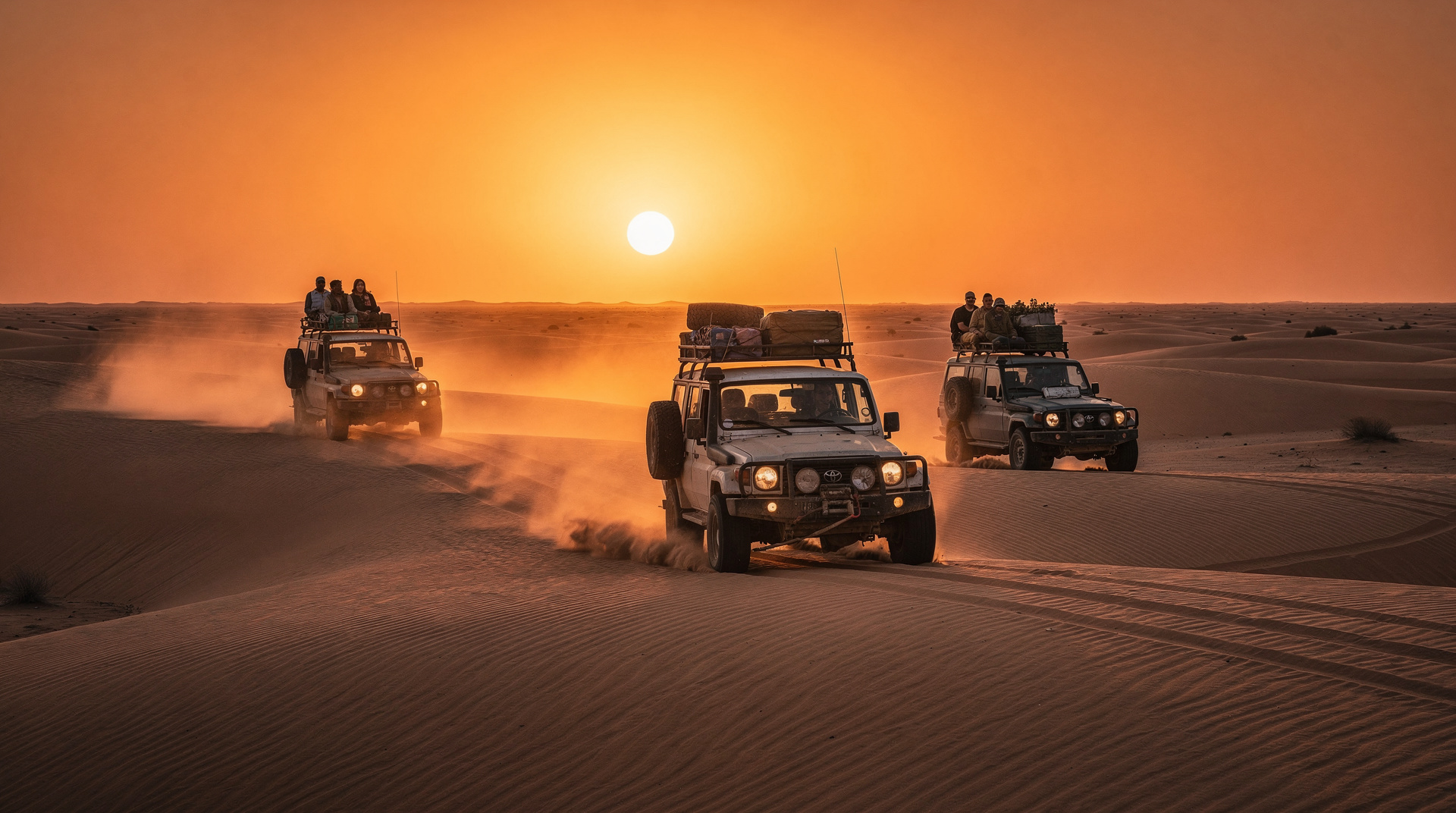
Oman Road Trip Planning: The Complete Practical Guide
From Muscat: 4-day Oman highlights tour
Duration: 4 days
- Free cancellation
- Hotel pickup
- English guide
Is Oman good for a self-drive road trip?
Oman is outstanding for self-drive road trips. Roads are well-maintained, signage is clear, fuel is inexpensive, and the diversity of landscapes within reachable driving distances is remarkable. A 4WD is needed for wadis and desert but not for main highways.
Oman Is Built for Road Trips
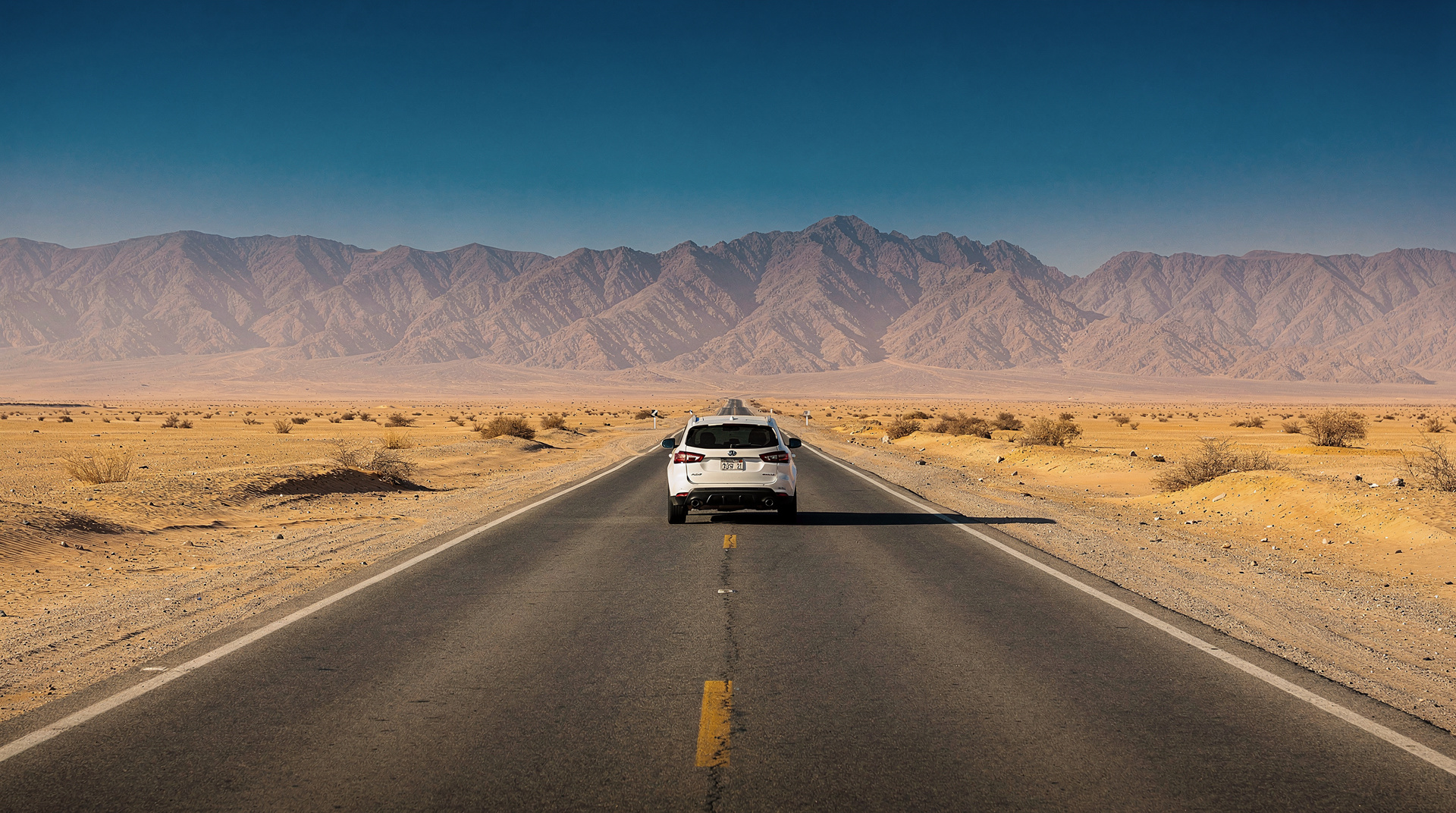
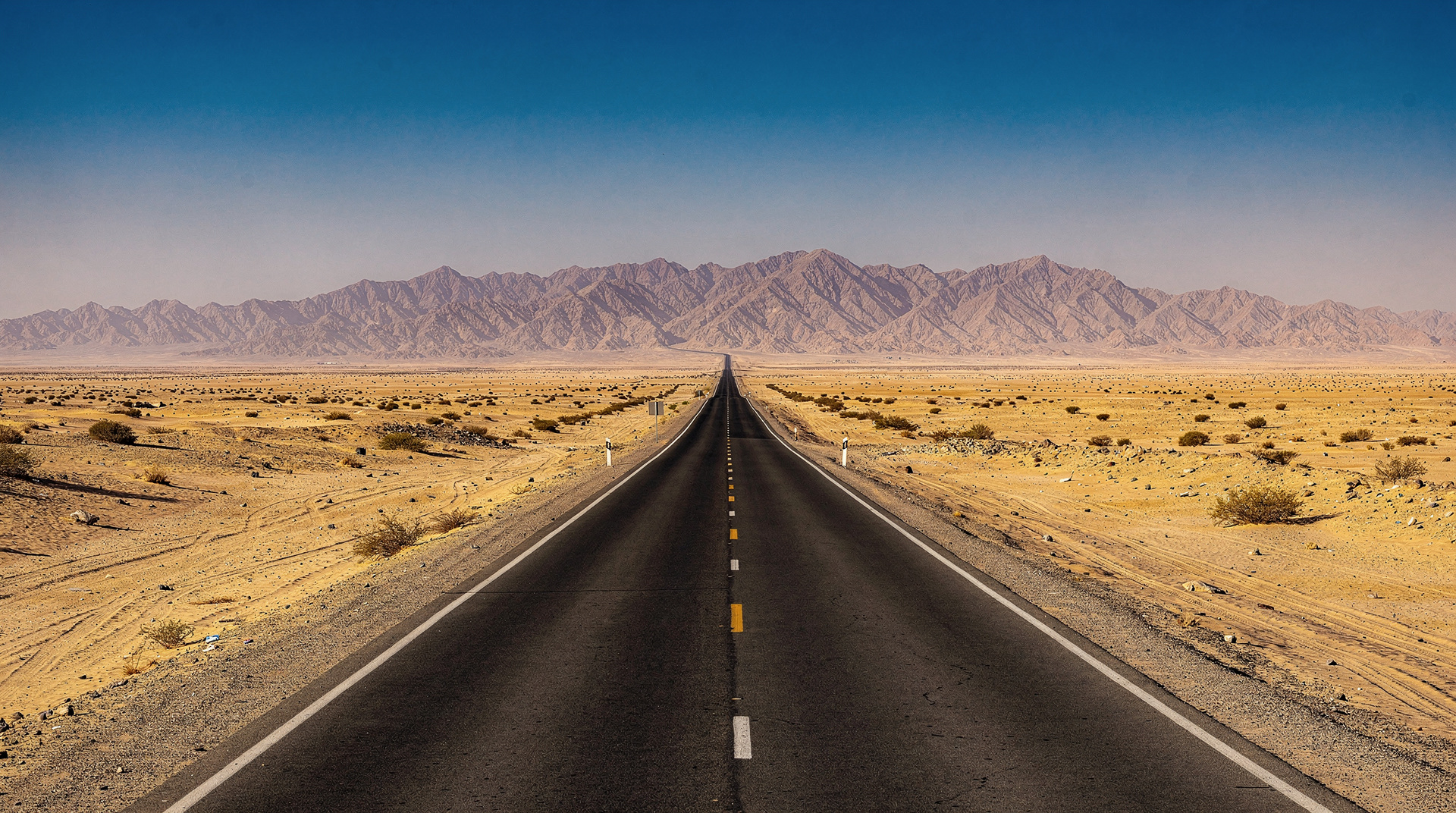
The self-drive road trip is arguably the best way to experience Oman. The country’s geography — a narrow coastal plain backed by dramatic mountain ranges, wadis cutting through limestone gorges, and vast desert expanses — rewards exploration by car in a way that no other transport method matches. Distances between major attractions are significant but manageable, the roads between them are consistently among the best in the Middle East, and the experience of pulling off the highway to investigate a wadi or a fort that appears on no tourist map is one that organised tours fundamentally cannot replicate.
What this guide covers is the practical infrastructure of road-tripping: the things that guidebooks and travel blogs often omit because they assume knowledge that first-time visitors simply do not have. Fuel station distribution, the realities of night driving, what happens at police checkpoints, how to handle a breakdown in a remote area, and what the different road categories actually mean for planning. The information here reflects current conditions as of early 2026.
Before booking anything, it helps to settle the bigger questions that shape a route: when to visit Oman changes both the driving conditions and which areas are comfortable, and the visa guide covers entry formalities that come before any hire car pickup. If you want a ready-made skeleton to adapt, the adventure road trip itinerary and the 7-day classic Oman itinerary show how the pieces can fit together.
At a Glance: Oman Road Trips
| Best vehicle | Saloon car for highways/cities; 4WD required for Jebel Akhdar, wadis, desert tracks |
| Fuel cost | Around 0.17–0.19 OMR/litre — genuinely inexpensive |
| Tolls | None on Omani roads |
| Realistic daily distance | Around 200–350 km depending on terrain |
| Getting there | Fly into Muscat International Airport (MCT); collect hire car at arrivals |
| When to avoid rural night driving | Camel-crossing zones after dark, especially inland and desert-approach roads |
Saloon vs 4WD: Which Do You Need?
| Route or activity | Saloon car | 4WD |
|---|---|---|
| Main highways (Muscat, Nizwa, Salalah) | Fine | Not required |
| Jebel Akhdar ascent | Turned back at checkpoint | Required |
| Wadi Shab interior / Wahiba Sands entry | Not suitable | Required |
| Graded desert/mountain tracks | Risk of damage | Recommended |
| Coastal towns and Muttrah | Fine | Not required |
| Overall recommendation | Coastal-only, short trips | Any circuit including mountains or desert |
Car Hire: The Foundation Decision
What Type of Vehicle
The single most consequential decision before any Oman road trip. The answer depends on your itinerary, but the matrix is roughly this:
A standard saloon or compact car covers all highway driving, all cities, and paved mountain roads including most of the Al Hajar range routes accessible to tourists. It will not manage unpaved wadi tracks, soft sand, or the off-road sections to certain desert campsites.
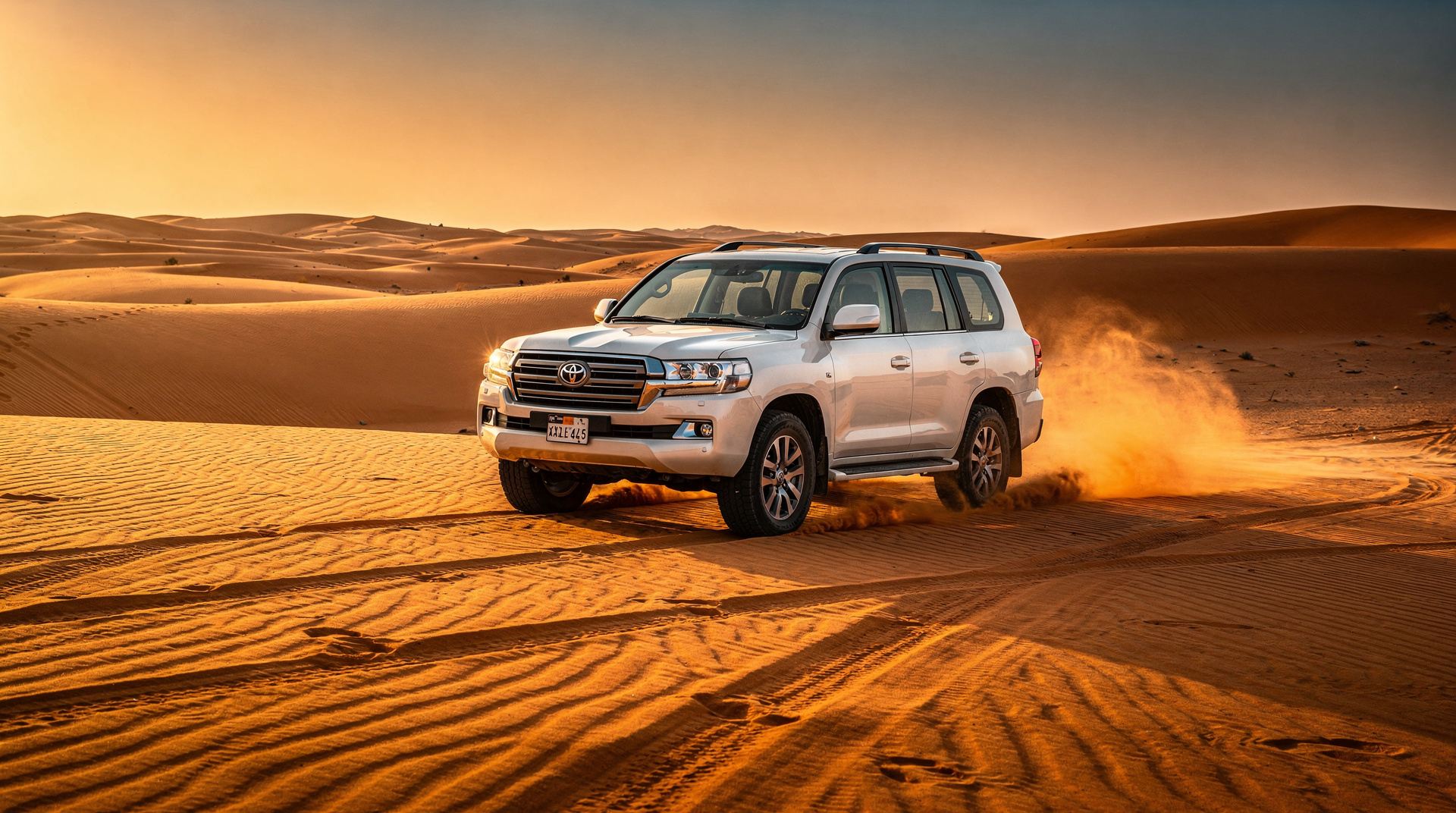
A 4WD (in Oman typically a Toyota Land Cruiser, Prado, or similar) opens up the full country. Wadi Shab’s interior, Wahiba Sands entry routes, the Sharqiyah coast tracks, Jebel Harim’s summit road, and dozens of smaller diversions become accessible. If your itinerary includes any serious off-road element, a 4WD is essential rather than optional. The incremental cost over a standard hire car is around 20-30 OMR per day and is consistently worth it.
Hire Car Companies and Considerations
International companies (Hertz, Avis, Budget, Europcar) all operate from Muscat airport. Local companies offer lower prices but with variable customer service if problems arise. For a road trip covering remote areas, the slightly higher cost of a company with genuine roadside assistance infrastructure is worthwhile.
Key questions to ask before confirming any hire:
- Does the insurance cover off-road driving? (Many standard policies explicitly exclude it)
- What is the excess/deductible on the policy?
- Is there 24-hour roadside assistance and what does it actually cover in remote areas?
- Are additional drivers included on the policy?
- What is the fuel policy (full-to-full is standard and preferred)?
An international driving licence is required alongside your national licence for citizens of most non-GCC countries. Confirm your specific country’s requirements before travel.
For a fuller walkthrough of the hire process itself, from comparing offers to the pickup inspection, the car rental guide goes step by step, and the why rent a 4x4 in Oman article explains the reasoning behind choosing a more capable vehicle. Insurance for the trip as a whole, separate from the car’s own cover, is discussed in the travel insurance guide.
Understanding Oman’s Road Types
Dual Carriageway Highways (Route 1, Route 17, Route 31, etc.)
The backbone of Oman’s road network. These are high-quality, well-maintained divided highways with clearly marked exits and consistent signage in both Arabic and English. Speed limits are typically 120 km/h in open country, reducing to 80 km/h near cities. Surface quality is excellent. Lane discipline is generally good but overtaking norms are more aggressive than Northern European standards — give way to vehicles moving at speed in the outside lane.
Mountain Roads
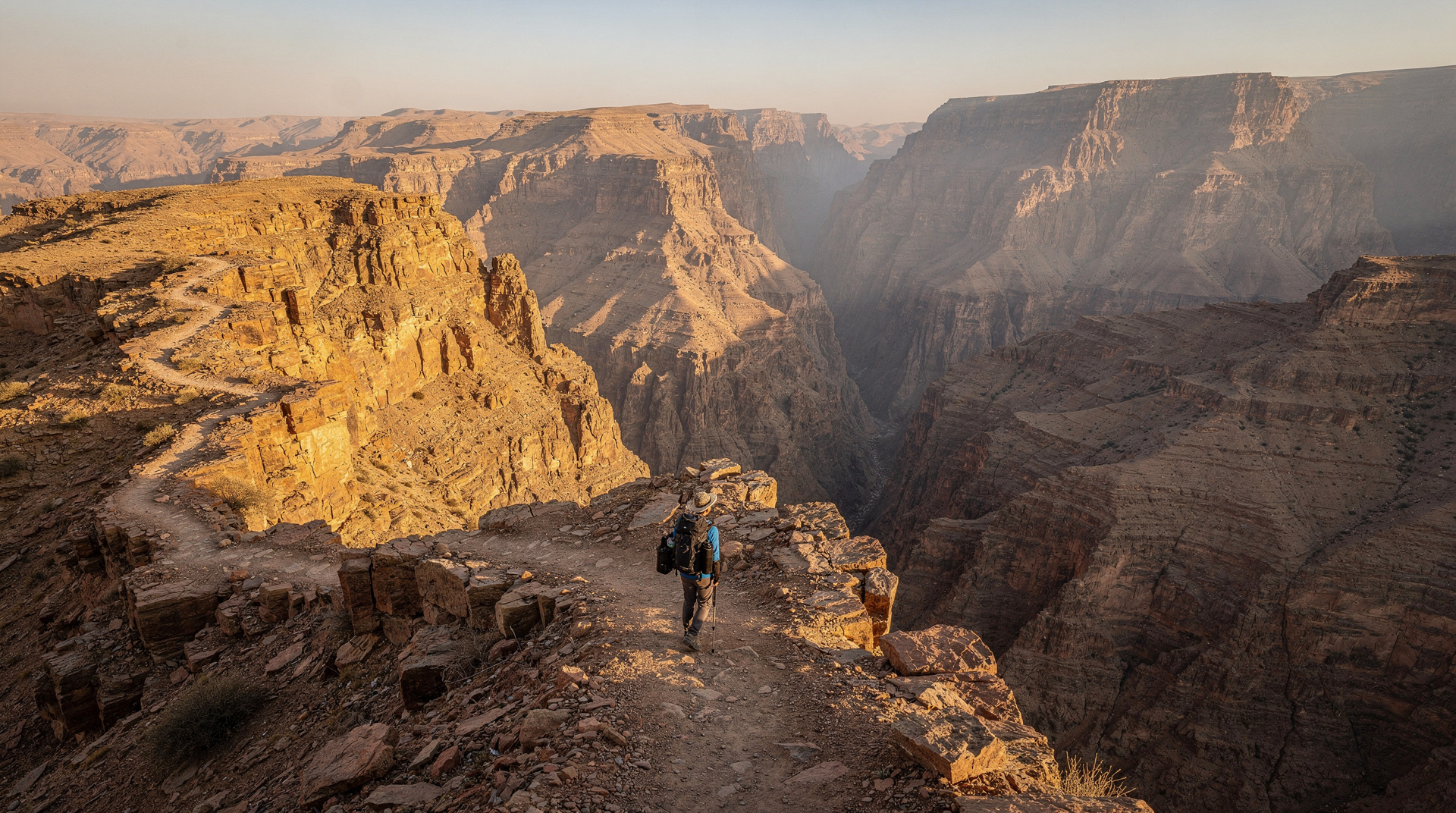
The roads accessing the Al Hajar mountains, including routes to Jebel Akhdar, Jebel Shams, and Wadi Bani Awf, are sealed but narrow and winding, with gradients that challenge vehicles with small engines. Hairpins are frequent and some are tight enough to require a multi-point turn in a long-wheelbase 4WD. Speed is self-limiting. The views from mountain roads are frequently spectacular.
Jebel Akhdar access: The checkpoint at the base of the main ascent road requires a 4WD vehicle. Saloon cars are turned back regardless of their occupants’ intentions. This rule is consistently enforced.
Graded Tracks
A large proportion of interesting Oman requires driving on graded (compacted earth) tracks rather than sealed roads. These vary enormously — some are as smooth as sealed roads in dry conditions, others become deeply rutted after rainfall or in sandy sections. A 4WD with some clearance is necessary for graded tracks. Standard saloon cars will be damaged.
Navigation on graded tracks using GPS is generally reliable, though maps occasionally show tracks that have been rerouted or that are currently impassable. Offline maps downloaded in advance (Maps.me or Google Maps offline mode) provide a useful backup to mobile data.
Soft Sand (Desert Roads)
The Wahiba Sands and the Empty Quarter cannot be safely driven without both a 4WD and experience with sand driving technique. Tyre deflation to 18-20 PSI, recovery equipment (boards, rope, shovel), and ideally a second vehicle are necessities. Visitors without desert driving experience should either take an organised tour or hire a driver for desert sections.
Fuel: Stations, Prices, and Remote Driving
Fuel Prices
Fuel in Oman is heavily subsidised and inexpensive by international standards. Prices in early 2026 are approximately 0.17 OMR per litre for regular petrol and 0.19 OMR per litre for premium. These prices make fuel an essentially negligible cost element even on a long trip.
All vehicles available through standard hire car companies run on regular or premium unleaded petrol. Diesel vehicles are less common in the hire car fleet but available on request.
Station Distribution
On main highways between major cities, fuel stations appear frequently enough that running out is essentially impossible if you maintain basic awareness of your fuel level. The Muscat to Nizwa highway, the Nizwa to Salalah highway (Route 31, the main inland route), and the coastal Route 17 all have stations at intervals of 60-120 kilometres.
In remote areas — the Musandam Peninsula, the Dhofar interior, the Empty Quarter approaches, and the more isolated parts of the Sharqiyah region — intervals between stations can extend to 200 kilometres or more. Carrying a 20-litre jerry can of fuel is advisable on any itinerary that ventures significantly off the main highway network.
The most critical fuel planning route: The section between Haima and Thumrait on Route 31 (roughly 370 kilometres of near-total emptiness) is the longest stretch between reliable fuel services on any main Omani highway. Fill up completely at Haima before proceeding south.
Payment
Credit cards are accepted at most branded petrol stations (OmanOil, Shell, Total). More remote stations and smaller independents are cash-only. Carrying 20-30 OMR in cash specifically for fuel is sensible on any remote itinerary.
A hire car for the Route 31 run
Fuel is cheap, so the real planning question is the car itself. A long drive south through Haima and Thumrait, with cash-only pumps further out, rewards a vehicle you have chosen calmly in advance. Check that the car takes regular or premium unleaded, since diesel is only available on request, and ask whether the boot has room for a jerry can.
Look at the pick-up location and the fuel policy before paying, then compare the options through DiscoverCars for your Oman route.
Night Driving: Genuine Hazards to Understand
Night driving in Oman on highways is legal and common. The highway infrastructure handles night driving adequately — roads are well-lit between major cities and the road quality is good enough that the darkness itself is not a hazard.
The specific hazards of Oman night driving are:
Camels: This is not a cliché. Dromedary camels wander onto roads in rural areas at night, particularly in the inland regions, Wahiba Sands approaches, and parts of the Sharqiyah coast. A camel is dark-coloured, stands over two metres tall at the hump, and reflects almost no light from headlamps until you are very close. Hitting a camel at highway speed is frequently fatal. Highway warning signs featuring camels indicate areas of genuine risk, not tourist decoration.
The safest approach: avoid driving on rural highways at night entirely, or if necessary, reduce speed to 80 km/h or below and maintain maximum alertness. The risk is concentrated on non-illuminated rural stretches and is essentially absent on illuminated city roads.
Vehicles without lights: Older vehicles, agricultural equipment, and very occasionally pedestrians are encountered on rural roads without adequate lighting. This is not common but it happens.
Fog: Coastal fog in the Muscat area is a seasonal phenomenon, particularly in winter and early spring. The corniche and airport road can become suddenly thick with fog with very little warning. Reduce speed, use fog lights, and increase following distance dramatically.
Flooding: After heavy rain (infrequent but possible in winter), wadis cross roads at low points and can flood without warning. Warning signs indicate flood-prone crossing points. Never attempt to drive through standing water of unknown depth — wadis can carry sudden surges that overturn vehicles instantly.
Police Checkpoints: What to Expect
Police checkpoints are a routine feature of Omani roads and are not a source of anxiety for law-abiding travellers. They are staffed by Royal Oman Police and occasionally by army personnel at specific strategic locations.
What typically happens: You slow, the officer looks at the vehicle and its occupants, and waves you through. The entire interaction lasts three to five seconds. Checkpoints are primarily looking for overloaded trucks, unregistered vehicles, and occasionally checking for specific items (during certain regional events, alcohol is checked for).
When you are stopped for documentation: This happens occasionally, particularly at the checkpoint outside Salalah and at the Musandam entry checkpoint. Have your passport and hire car documentation accessible but not out of the vehicle until requested. Remain calm, respond directly to questions, and be polite. Travellers with valid documentation, legal vehicles, and normal behaviour are waved through without incident.
What to never do: Do not attempt to drive through a checkpoint that has not waved you through. Do not be aggressive or argue. Do not film or photograph checkpoint officers or their procedures. Do not have open alcohol visible in the vehicle.
Location awareness: Checkpoints are present at the entry point to Musandam (passport check, as Musandam is physically separated from the rest of Oman by UAE territory), on the main road south of Muscat, and at various points along Route 31 between the north and Dhofar.
Handling Breakdowns in Remote Areas
Despite Oman’s excellent road quality, breakdowns happen. In a remote wadi or desert area, the response to a breakdown requires some preparation.
Prevention: Before any remote drive, ensure tyre condition (including the spare), fluid levels, and that the vehicle’s age and service status are appropriate for the terrain. Hire car companies are not always diligent about this — do a basic pre-departure check yourself.
Recovery kit for remote driving: A tow rope, basic tool kit, jumper cables, and tyre pressure gauge are minimum. For desert driving, add sand recovery boards, a shovel, and additional water. A physical vehicle manual (usually in the glove compartment) can resolve many simple issues.
Communication: Mobile coverage in Oman is better than most visitors expect — Omantel and Ooredoo networks cover all major highways and towns — but drops to zero in deep wadis and remote desert. A local SIM card purchased at Muscat airport (inexpensive and straightforward) ensures maximum coverage. For extended remote travel, a satellite communication device is a sensible additional precaution.
If you break down: Move the vehicle to the hard shoulder or road edge. Activate hazard lights. Place any available warning triangle behind the vehicle (many hire cars carry these). Call the hire car company’s roadside assistance number — keep it saved in your phone before departure. On main highways, you will typically see other traffic within minutes and assistance will arrive within one to two hours.
Water: A genuine emergency supply of five litres of water per person for Oman road trips is not overcaution — it is basic sense. In summer temperatures that can exceed 45 degrees Celsius, a stranded vehicle without water is a medical emergency.
Staying connected makes most of these situations easier to handle, and the SIM card and eSIM guide explains the options in more detail. For general precautions beyond the road itself, the safety tips guide is a useful companion read.
Speed Cameras and Traffic Fines
Oman uses automated speed cameras extensively on all major highways. The cameras are not hidden — they are mounted visibly on overhead gantries and marked by signs in advance. Fines are issued automatically against the hire car’s registration and are typically charged to your card by the hire car company at or after return.
The speed limits are consistently enforced:
- 120 km/h on open highway
- 100 km/h in some intermediate zones
- 80 km/h approaching urban areas
- 60 km/h within towns and cities
Lane change without indicating, using a mobile phone while driving, and not wearing a seatbelt are also camera-enforced offences at certain locations. Oman’s driving fines are not trivial — treating them as a background cost of speedy driving is an expensive assumption.
Insurance Excess and What Happens After an Accident
Most standard hire car insurance in Oman carries an excess (deductible) of several hundred OMR, meaning that in the event of an accident you may be liable for repair costs up to that amount even with basic cover in place. Reducing or waiving the excess through a top-up policy — either through the hire company or a third-party provider bought before departure — is worth the modest daily cost for anyone planning mountain, wadi, or desert driving, where minor scrapes and punctures are more common than on highways.
If you are involved in any accident, however minor, Omani procedure generally requires contacting the Royal Oman Police before moving the vehicles (unlike some countries where minor bumps are settled informally). Do not move your car from the accident location until police have attended and issued a report, since insurers will typically require this report to process a claim. Keep your hire agreement and insurance documents in the vehicle at all times, and photograph any damage before police arrive if it is safe to do so.
Route Planning: Getting the Balance Right
The most common planning mistake on Oman road trips is underestimating drive times and overestimating how much can be comfortably fitted into a day. Distances between major attractions are greater than they appear on a map that shows the whole Arabian Peninsula.
Realistic daily driving maximums:
- Highway driving, minimal stops: 350 km per day is comfortable
- Mountain and wadi driving with stops: 200 km per day is realistic
- Mixed highway and off-road: 250 km per day is sensible
The classic five-day Oman circuit (Muscat, Nizwa, Wahiba Sands, Wadi Shab, coast back to Muscat) covers approximately 800-1000 kilometres and involves a mix of driving types. It is achievable without feeling rushed at five days; at three days it becomes a series of drives with minimal stop time.
For families or travellers who prefer not to self-drive, the 4-day Oman highlights tour from Muscat covers the major circuit destinations with professional transport and guiding included, removing the logistical planning entirely.
Several stops along such a circuit deserve their own preparation: the Wahiba Sands destination page, Wadi Shab and Nizwa are the usual anchors, and the scenic drives guide suggests roads worth choosing for the journey itself rather than only the destination. For a longer take on routes, see also the best road trip routes article.
For route-specific information, the Muscat to Salalah drive guide covers the 1,000 km southern highway in detail, while the multi-day tours guide compares self-drive versus organised tour options. For broader getting-around context, see the Oman transport guide. Families driving with children will find additional specific preparation tips in the family desert experience guide.
Frequently asked questions about road trip planning in Oman
Do I need a 4WD for an Oman road trip?
Not necessarily — it depends entirely on your itinerary. If you plan to stay on sealed roads (all main highways, most towns, most coastal routes), a standard car is fine. If your route includes wadi drives, Jebel Akhdar, Wahiba Sands entry points, or any off-road sites, a 4WD is required.
Is it safe to drive in Oman as a foreign tourist?
Yes, with awareness of the specific local hazards: camel crossings at night, aggressive overtaking on highways, and flash flood risk at wadi crossings after rain. Oman’s road fatality rate is improving but historically higher than Western European norms. Driving defensively and avoiding night rural driving reduces risk substantially.
Can I drive from Oman into the UAE?
Yes, but hire car cross-border permissions must be confirmed with your hire company before departure. Not all companies allow it, and insurance coverage changes at the border. The most complex crossing is the Musandam Peninsula route, which passes through UAE territory — ensure your documentation covers this specific route if you plan it.
How much does fuel cost for a week-long Oman road trip?
A week-long road trip covering 1,500-2,000 kilometres in a 4WD consuming approximately 12 litres per 100 km will use roughly 180-240 litres of fuel. At current prices of around 0.17-0.19 OMR per litre, total fuel cost is approximately 30-45 OMR — genuinely negligible by the standards of any long-distance driving destination.
Are there tolls on Omani roads?
No toll roads exist in Oman as of early 2026. This is one of the significant practical advantages of road-tripping in the country — the highway network is entirely free to use.
What happens if I get a speeding fine in a hire car?
The fine is registered against the vehicle’s licence plate and the hire car company receives notification. They will charge the fine amount plus an administration fee (typically 5-15 OMR) to the credit card on file. Fines are not waived or reduced by explaining you were a tourist or unaware of the limit.
Can I wild camp during an Oman road trip?
Wild camping is permitted on most public land in Oman away from private property and protected areas. Many Omanis camp regularly and the culture of roadside camping in wadis and beside beaches is well-established. The main considerations are taking all rubbish with you, not camping in agricultural areas, and being aware of flash flood risk in wadis. For an organised alternative, see our overnight desert camping guide.
What documents do I need in the car at all times?
Keep your passport, hire agreement, insurance documents, and international driving permit accessible in the vehicle throughout the trip, particularly for checkpoints at Musandam’s entry point and the road south toward Salalah. Digital copies saved offline on your phone are a sensible backup in case originals are misplaced.
Is a road trip better than an organised tour in Oman?
It depends on your priorities. A self-drive road trip offers total flexibility and the ability to stop wherever interests you, which suits confident drivers comfortable with mountain roads and off-road sections. An organised tour removes all logistics — driving, navigation, fuel planning — and suits travellers who prefer to relax and let a guide handle the route. See our multi-day tours in Oman guide for a fuller comparison of both options.
Top experiences
Bookable activities with verified prices and instant confirmation on GetYourGuide.
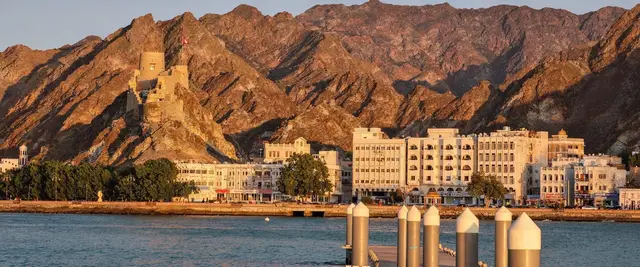 📍 Oman
 From Muscat: 4-day Oman highlights tour
- Free cancellation
- Hotel pickup
- English guide
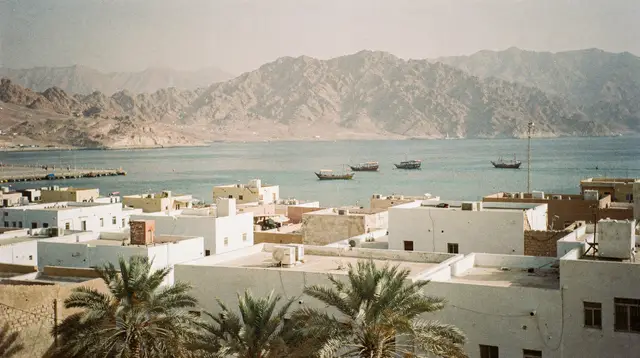 📍 Muscat
 Muscat: half-day city tour
- Free cancellation
- Instant confirmation
- Hotel pickup
 📍 Muscat
 Muscat: 2-hour sunset dhow cruise
- Instant confirmation
- Free cancellation
- Best seller
 📍 Salalah
 Salalah: sunset desert safari - Rub Al Khali - Empty Quarter
- Free cancellation
- Hotel pickup
- Small group