Scenic Drives in Oman: 8 Roads That Will Steal Your Breath Away
What is the most scenic drive in Oman?
The Jebel Akhdar mountain road from Nizwa to the Green Mountain plateau is widely considered Oman's most dramatic drive, combining steep switchbacks, ancient terraced villages, and panoramic gorge views. The road to Jebel Shams adds raw scale, while the coastal Muscat–Quriyat road delivers turquoise-sea drama.
Eight Drives That Define Oman’s Landscape
Oman is made for road trips. The country packs mountain plateaus, deep wadis, sweeping desert plains, dramatic fjord-like coastlines, and ancient incense-trading towns into a relatively compact geography — and a well-maintained modern highway network threads through all of it. Renting a car and driving yourself is not just the most practical way to explore; it is often the point of the journey itself.
These eight routes are ranked not just for scenery but for the full driving experience — road quality, what you can stop and do, how long you actually need, and where to fill your tank in remote areas. Prices listed for fuel and accommodation reflect 2026 rates.
| At a glance | |
|---|---|
| Where | Routes fan out from Muscat across the Hajar Mountains, the coast, the interior, and as far as Musandam and Dhofar |
| Cost | Fuel is inexpensive (around 220 baisa/litre); a rental 4WD from roughly OMR 30-80 per day is the main cost |
| Time needed | From 15 minutes (Al Hamra to Misfat) to a multi-day trip (Nizwa to Salalah) |
| Getting there | Self-drive is the only way to do these routes properly; a 4WD is required for several of them |
| Best time | October-April for most routes; July-September only for the Salalah khareef descent |
Route 1: Muscat to Nizwa via Snake Gorge — The Grand Canyon Circuit
Distance: 175 km one way | Drive time: 3 hours without stops | Best season: October–April
The most popular day trip from Muscat rewards drivers who take the inland Route 15 rather than the faster motorway. Leaving Muscat’s Al Ghubra district, the dual carriageway climbs steadily through the Hajar foothills, passing the Qurm interchange and the well-signed turn for Al Awabi. At the village of Wadi Bani Auf, the tarmac narrows and the scenery dramatically transforms.
The Snake Gorge stretch — locally called Wadi Bani Auf — is a 30-km unpaved track requiring a 4WD and basic off-road confidence. The gorge walls squeeze to 5 metres at some points while the track weaves through a stream bed populated with date palms and ancient falaj irrigation channels. Allow 2–3 hours for this section alone. The reward at the end is Bilad Sayt village, a cluster of mud-brick houses clinging to the cliff face that appears entirely unchanged from photographs taken 50 years ago.
From Bilad Sayt, a dirt track connects back to the main road for the final push to Nizwa (around 90 minutes on good tarmac). The ancient fort, the famous goat souk on Friday mornings, and the warren of the old date souk make Nizwa a natural lunch stop.
Fuel stop: Al Hamra town, roughly halfway. Next station is in Nizwa itself.
Photo spots: The first view of Bilad Sayt from the ridge above is the money shot — pull over at the small layby on the left, around 2 km before descent.
Road condition: Wadi Bani Auf section requires a proper 4WD; the rest is smooth dual carriageway or good single-lane tarmac.
Route 2: Nizwa to Jebel Akhdar — Mountain Switchbacks to the Green Plateau
Distance: 45 km | Drive time: 1.5 hours | Best season: Year-round (check road closure during heavy rain)
This is arguably Oman’s single most dramatic road. From the roundabout at Al Hamra, the mountain route climbs through increasingly spectacular terrain before the approach to the Al Akhdar Plateau begins in earnest at the checkpoint just past Birkat al Mauz. Here, an army checkpoint verifies you are in a 4WD before allowing access — standard saloon cars are not permitted above this point, a rule enforced not for bureaucratic reasons but because the gradients and switchback angles require 4WD capability.
Above the checkpoint, the road becomes extraordinary. Forty-three numbered switchbacks — tight hairpins with sheer drops on the outer edge — wind up 2,000 metres in elevation over just 20 km of tarmac. Early morning drives reward you with cloud inversions filling the valleys below while you cruise above them in sunshine. Late afternoon drives catch golden light igniting the russet-red cliff faces.
At the plateau, the road forks toward Saiq and the rose gardens of the ancient village of Al Ayn. In March and April, the Damascus roses bloom in terraced gardens that have been cultivated here for centuries, their petals harvested each dawn for distillation into rosewater and rose oil sold throughout the Gulf.
Fuel stop: Fill up completely in Nizwa before departure. There are no fuel stations on Jebel Akhdar — the Alila Jabal Akhdar resort shop sells bottled water at resort prices.
Photo spots: Wadi Ghul viewpoint (signposted 6 km past the plateau entry) delivers a near-vertical 1,000-metre drop into what is often described as Oman’s Grand Canyon. Dawn light entering from the east creates the most dramatic contrast.
Accommodation: Alila Jabal Akhdar offers cliff-edge villas from OMR 250 per night in 2026. Anantara Al Jabal Al Akhdar Resort competes with similar pricing and equally spectacular canyon views.
Route 3: Muscat to Quriyat and the Coastal Road South
Distance: 110 km to Quriyat; extendable to Fins/Bimmah (170 km) | Drive time: 2 hours to Quriyat, 3 hours to Bimmah | Best season: October–May
The coastal road east of Muscat is the easy, accessible version of Oman’s driving beauty — smooth tarmac, no 4WD required, and payoffs that start within 40 minutes of leaving the capital. Leaving through the Qurum industrial zone, the road hugs the coast almost immediately after the Sultan Qaboos University bypass, revealing a shoreline of volcanic black rock against clear turquoise water that is immediately distinctive.
At Sur Al Hadid, small dhow workshops still operate by the roadside — traditional wooden fishing boats being built using skills passed down through generations. Pull over and watch craftsmen at work; they are generally welcoming of interested visitors.
Quriyat itself is a small fishing town with a crumbling Portuguese fort, a lively morning fish market (arrive before 7 am for the full experience), and excellent grilled fish restaurants along the seafront. Al Waha Restaurant serves whole grilled hammour for around OMR 6–8 in 2026.
South of Quriyat, the road becomes more technical — steep descents into wadi crossings, sudden sharp bends — before reaching the famous Bimmah Sinkhole, a turquoise pool in a limestone collapse just metres from the ocean. From here, Wadi Shab is 20 minutes further — the most spectacular wadi swimming experience in the country.
Fuel stop: Quriyat town centre. Next reliable fuel is at Tiwi, 60 km south.
Photo spots: The cliff-top viewpoint 15 km south of Quriyat where the road clings to the mountainside above the sea; dawn light on the Bimmah Sinkhole (arrive before the tour buses at 9 am).
Route 4: Muscat to Sur via the Coastal Highway
Distance: 340 km | Drive time: 4 hours | Best season: October–April
The full coastal run from Muscat to Sur is the Oman road trip most travellers remember longest. After passing Quriyat and Bimmah (detailed above), the road continues south through increasingly remote terrain — scattered fishing villages, long empty beaches, the dramatic gorge entry to Wadi Tiwi, and the broad gravel plains of the Sharqiyah coast.
Wadi Tiwi deserves a stop. The paved road follows the wadi bottom through 12 villages built into the cliff faces over 15 km, each connected by a network of falaj water channels. The road narrows severely past the fifth village; beyond that point you need a 4WD and local knowledge.
Sur itself, the ancient dhow-building capital, rewards those who time their arrival for the following morning. The dhow yard at Souq Sur is one of the last places on Earth where large traditional wooden vessels are still constructed entirely by hand, the craftsmen using no blueprints — only generations of accumulated knowledge.
Fuel stops: Quriyat, Tiwi (small station), and Sur town. The 120-km stretch from Tiwi to Sur has no fuel — fill up in Tiwi.
Photo spots: The ridge viewpoint above Wadi Tiwi where all 12 villages are visible simultaneously; the dhow yard in Sur at golden hour when the varnished hulls catch warm light.
Overnight option: Al Ayjah Plaza Hotel in Sur charges from OMR 35 per night with harbour views. The rooftop terrace is an excellent sunset spot.
Route 5: Nizwa to Salalah via the Empty Quarter Edge
Distance: 1,050 km | Drive time: 10–12 hours | Best season: October–April
The full overland run from Oman’s interior to the south is not a day trip — it is a multi-day adventure, and one of the most memorable long drives in the Arabian Peninsula. The highway south from Nizwa crosses the Hajar Mountains at Ibri, descends onto the gravelly plains of the Dhahira region, passes through the oil-field service town of Haima, and then enters the extraordinary void of the Jiddat al Harasis — a flat, nearly featureless limestone plateau the size of Belgium.
The Jiddat feels like driving on the moon. The road is perfectly straight for 200–300 km at a stretch, the landscape absolutely empty of human habitation, the mirages creating phantom water ahead on the tarmac. The Arabian oryx recovery program operates in this area — small herds of white oryx are sometimes visible from the road.
After Haima, the road passes Thumrait (the last reliable fuel before Salalah) and then begins a spectacular mountain descent into the Dhofar coastal plain. In the khareef season (July–September), this descent enters literal cloud and the landscape below appears from grey mist as vivid tropical green — one of the most dramatic environmental transitions a driver can experience.
Fuel stops: Nizwa, Ibri, Haima, Thumrait, Salalah. Do not skip Haima or Thumrait — the gaps are too long on a hot day.
Overnight: Most travellers split this drive at Haima, where the government rest house offers basic but clean accommodation from OMR 20 per night.
Photo spots: The oryx-spotting area near Jaaluni (ask locally for current sighting locations); the Thumrait mountain descent at dusk.
Route 6: Khasab to the Musandam Fjords — Oman’s Norway
Distance: 60 km (Khasab to Telegraph Island) by road/boat combination | Best season: October–April
Musandam is technically accessible by road from Oman only via UAE territory — most visitors fly or take the ferry. But those who drive into the peninsula from the Tibat border crossing (UAE–Musandam) encounter one of the most unexpected drives in the country. The road from Tibat to Khasab climbs immediately into raw limestone mountains, with views down into fjord-like inlets (locally called khors) that could be mistaken for Norwegian or Scottish coastline.
The road north of Khasab toward Kumzar is even more dramatic — unpaved, requiring a 4WD, and threading along cliff edges above sea water of extraordinary clarity. The village of Khor Najd, 20 km from Khasab, is accessible by a paved road and offers a beach that is consistently listed among the most beautiful in the Middle East.
From Khasab, the complementary experience is on the water: a Musandam dhow cruise with dolphin watching from Khasab covers the most spectacular fjord scenery that roads cannot reach, including the famous Telegraph Island where British colonial-era communications cables once landed.
Fuel: Khasab town. Fill before heading north on the mountain tracks.
Photo spots: The viewpoint above Khor Najd (10-minute walk from the beach car park); the dhow harbour in Khasab at dawn.
Route 7: Al Hamra to Misfat al Abriyeen — The Living Museum Drive
Distance: 5 km | Drive time: 15 minutes | Best season: Year-round
Short in distance but extraordinary in what it delivers, the drive from Al Hamra to the ancient village of Misfat al Abriyeen climbs a narrow mountain road that deposits you at the edge of an inhabited archaeological site. The village of mud and stone towers dates to the 14th century; the falaj system feeding its terraced gardens and date groves was operating centuries before the Portuguese sailed into Muscat harbour.
Park at the lower car park — there is no road into the village — and walk the 20-minute footpath upward through date palms and pomegranate trees. The houses are occupied; children attend school; elderly residents sit in doorways. It is one of the most vivid reminders in Oman that heritage here is not preserved behind museum glass but lived in.
The drive back via the Al Hamra old town adds a further layer: the 400-year-old mud-brick quarter at the base of the mountain has one of the best-preserved traditional souq streets in the Hajar region.
Fuel: Al Hamra town, 5 km away.
Route 8: Duqm to Ras Madrakah Coastal Track
Distance: 60 km | Drive time: 2 hours (4WD required) | Best season: October–April
Duqm is Oman’s newest destination — an industrial port and Special Economic Zone that has almost accidentally created access to a dramatic stretch of coast south of town. The Ras Madrakah track leaves the paved road at the southern edge of Duqm and follows the shoreline through a landscape of extraordinary geological interest: fossil-rich limestone platforms, sea caves accessible at low tide, and beaches where turtles nest between October and February.
The track is rough in places and requires a genuine 4WD with good clearance. A GPS track downloaded in advance is strongly recommended — the route is not consistently waymarked. The reward is absolute solitude: this coastline sees perhaps 10–20 visitor vehicles per week, compared to hundreds at the more famous sites.
Fuel: Duqm town (fuel available at the port service area). No fuel on track.
Photo spots: The fossil limestone platforms at sunrise when the rock colours are at their most vivid; turtle tracks on Ras Madrakah Beach in the early morning.
Comparing the Eight Routes
| Route | Distance | 4WD required? | Best for |
|---|---|---|---|
| 1. Muscat–Nizwa via Snake Gorge | 175 km | Yes (gorge section) | First-timers wanting mountains + fort + souq in one day |
| 2. Nizwa–Jebel Akhdar | 45 km | Yes (above checkpoint) | Oman’s most dramatic single road, roses in spring |
| 3. Muscat–Quriyat coastal | 110-170 km | No | Easy day trip, no 4WD needed |
| 4. Muscat–Sur coastal highway | 340 km | No | Full coastal drama, dhow-building culture |
| 5. Nizwa–Salalah (Empty Quarter edge) | 1,050 km | No, but remote | Multi-day desert crossing, oryx spotting |
| 6. Khasab–Musandam fjords | 60 km | Yes (north of Khasab) | Fjord scenery, “Norway of Arabia” |
| 7. Al Hamra–Misfat al Abriyeen | 5 km | No | Short, living heritage village |
| 8. Duqm–Ras Madrakah | 60 km | Yes | Total solitude, fossil coast, turtle nesting |
Planning and Renting for a Self-Drive Trip
Renting the right vehicle matters more than any other planning decision on these routes. The renting a car in Oman guide covers company comparisons, insurance add-ons, and cross-border rules if you plan to continue into Musandam via the UAE. The broader getting around Oman guide compares self-driving against domestic flights and organised tours for those unsure which routes justify a rental at all.
For travellers building a longer trip around several of these drives rather than a single day out, the Oman road trip planning guide helps sequence routes logically instead of doubling back across the country. Two routes not detailed above but worth folding into a longer loop are the Wadi Bani Awf off-road drive through the interior canyons, and the Jebel Shams Balcony Walk, reachable by a scenic mountain road of its own from Al Hamra.
For those extending south, the Sur coastal guide covers the town in more depth than a single stop allows, and for the north, the Khasab dhow cruise guide complements Route 6 with the boat-based side of the fjords that no road reaches.
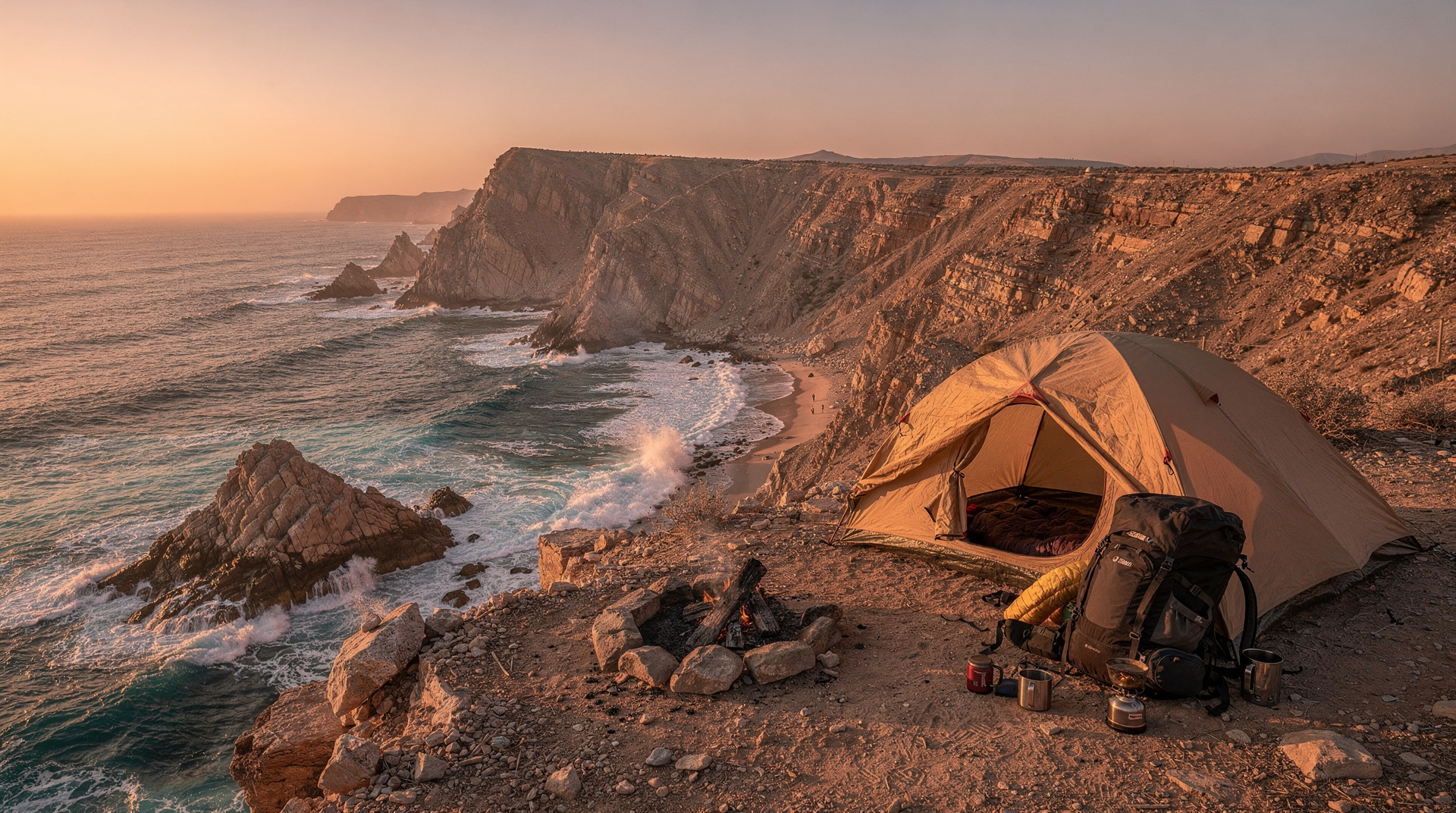
Travellers wanting to sleep under the stars along any of these routes rather than always returning to a hotel should read the wild camping in Oman guide first — it covers where camping is genuinely permitted and how to do it respectfully and safely.
Essential Road Trip Planning for Oman
4WD vs Standard Car
A 4WD is mandatory for routes 1 (Wadi Bani Auf section), 2 (Jebel Akhdar above checkpoint), 5 (full flexibility), 6 (north of Khasab), and 8 (Ras Madrakah). For routes 3, 4, and 7 on the paved sections, a standard car is fine but a higher-clearance SUV adds comfort on rough surfaces.
Rental prices in 2026: standard SUV (Mitsubishi Outlander class) from OMR 18–25 per day; 4WD SUV (Toyota Fortuner class) from OMR 30–45 per day; Toyota Land Cruiser Prado from OMR 55–80 per day. Book with Europcar, Avis, or local operator Sixt Oman for competitive rates.
Fuel Prices and Availability
Oman’s fuel prices are government-subsidised. In 2026: Super (95 octane) costs approximately 220 baisa per litre (roughly USD 0.57); diesel costs 200 baisa per litre. Most modern rental 4WDs run on Super. Always carry a 20-litre jerry can on routes 5 and 8.
Fuel stations are generally open 24 hours on major routes but can close for prayer times in smaller towns (each closure is typically 15–20 minutes).
Driving in Oman: Practical Notes
Speed limits are strictly enforced by cameras: 120 km/h on motorways, 100 km/h on open highways, 60–80 km/h through towns. Fines are issued automatically and can be paid at any Royal Oman Police station.
Camels cross roads without warning, particularly at dawn and dusk on the Haima–Thumrait stretch. Slow down any time you see a “Camel Crossing” sign — the signs are there for good reason.
For a guided version of the best mountain and interior scenery, the 4-day Oman highlights tour from Muscat covers Nizwa, Wahiba Sands, and the coast in a well-planned loop with a driver who knows all the stops.
Navigation and Connectivity
Google Maps works well on main routes but loses confidence on unpaved tracks. Download offline maps via Maps.me or use OsmAnd with the Arabian Peninsula dataset for full off-road coverage. Local SIM cards (Omantel or Ooredoo) provide 4G coverage on all main highways; mountain wadis and the Jiddat plateau drop to 2G or no signal.
Seasonal Considerations for Oman Road Trips
October–April: Optimal for all routes. Daytime temperatures range from 22°C in the mountains to 30°C on the coast. Clear skies and low humidity make long drives comfortable.
May–June: Increasingly hot on low-altitude routes (35–42°C on the Haima plain); Jebel Akhdar remains pleasant at altitude. Salalah approaches khareef season.
July–September: Salalah and Dhofar province transform into a green tropical landscape — unique in the Arab world. The mountain descent into Salalah (Route 5) is extraordinary in mist. Central and northern Oman is extremely hot (45–50°C possible on desert routes); avoid long drives without exceptional preparation.
The best time to visit Oman guide covers seasonal conditions for all regions in detail.
Frequently asked questions about scenic drives in Oman
Do I need a special driving licence for Oman?
No special licence is required. A valid driving licence from your home country is accepted for rental, along with an International Driving Permit (IDP) if your licence is not in English or Arabic. Most European, North American, and Australian licences are accepted directly.
Is driving in Oman safe for foreigners?
Oman consistently ranks among the safest countries in the Middle East for road travel. The roads are well-maintained, signage is in Arabic and English, and local drivers are generally courteous. The main risks are speeding (the biggest cause of accidents), camel crossings at night, and getting stuck off-road without the right vehicle. Stick to daylight hours for unfamiliar mountain routes.
How much does it cost to rent a car in Oman?
In 2026, standard saloon cars start from OMR 10–15 per day, compact SUVs from OMR 18–25 per day, and proper 4WD vehicles from OMR 30–80 per day depending on class. Week-long rentals attract 10–15% discounts. Fuel costs roughly 220 baisa per litre (Super 95).
Can I drive from Muscat to Salalah in one day?
Technically yes — it is 1,050 km on good highway, achievable in 10–12 hours of driving. However, this is not recommended. The monotony of the Jiddat plateau at high speed after several hours creates genuine fatigue risk. Breaking the journey at Haima (at the halfway point) makes for a far safer and more enjoyable trip. Some drivers prefer to fly one way and drive the other.
Are there petrol stations on remote routes?
On the main highway south (Route 5), fuel stops exist at Nizwa, Ibri, Haima, Thumrait, and Salalah. On coastal routes 3 and 4, fuel is available in Quriyat, Tiwi, and Sur. Always fill up completely before leaving any town on remote routes, and carry a 20-litre jerry can as backup on desert driving.
What is the best road trip route for first-time visitors?
The Muscat–Nizwa–Wahiba Sands–Sur–Muscat loop covers everything essential: mountain scenery, ancient forts, desert dunes, coastal landscape, and turtle beaches. It works as a 5–7 day itinerary with a rental SUV. The Muscat to Nizwa route is the ideal first day.
Can I do scenic drives without a 4WD?
Yes — Routes 3, 4 (on paved sections), and 7 are fully achievable in a standard car and cover some of Oman’s most spectacular scenery. The coastal road from Muscat to Sur can be driven in a saloon car on its entirety if you stay on the main highway, skipping the wadi tracks. Jebel Akhdar above the checkpoint and Wadi Bani Auf require a 4WD.
What should I carry in the car for remote driving in Oman?
Minimum supplies for any remote route: 5–10 litres of extra water per person (heat risk is serious), a charged power bank, offline maps downloaded in advance, a basic first aid kit, a tyre repair kit or spare tyre (rental companies sometimes provide these — confirm before departure), and a phone number for Oman’s emergency services (9999 for police, 1444 for ambulance).
Which of these drives is genuinely worth it if I only have time for one?
Route 2, Nizwa to Jebel Akhdar, delivers the highest concentration of drama per kilometre — switchbacks, canyon views, and a mountain plateau in under two hours from Nizwa. If you would rather avoid a 4WD checkpoint altogether, Route 3, the Muscat–Quriyat coastal road, is the best fully-paved alternative and pairs naturally with a stop at Wadi Shab.